King Tut goes to the Alaska State Fair


King Tut, and a princess (?). Not the usual Fair fare.


It wasn’t the Alaska State Fair that I remember from twenty or thirty years ago. Not that much was missing, except for the fried raviolis, but lots of things were new. King Tut showed up, for example. Marla, Jim, and I joined hundreds of other Fair-goers to walk through a traveling exhibit of reproductions from his tomb that had appropriated one of the exhibit buildings on the fairgrounds. Crowds paused at displays with the history of the tomb’s discovery, and ohh’ed and ahh’ed over golden warriors, and a reproduced mummy lying in the open coffin.
 
 
Instead of the hushed museums where such things usually reside, the golden statues  were crowded together, surrounded by hastily set up low curtains, and crowds clustering on every side.
 
Next up was Brad’s World Reptiles, a returning attraction for the last couple of years. You could crowd in with even more people and lots of kids to watch videos, admire the denizens of dozens of cages, or have your picture taken with an alligator for $6.
 
The alligator was alive but remarkably inactive — drugged? Chilled?
 
 
As we made our way through the crowds, we paused to glance at the wild variety of human endeavors and interests represented here — political parties, the National Rifle Association, energy companies (many more of these than in previous years; but I didn’t see any wood-burning stoves this year); hot tubs, tools, car raffles, pull tabs, tarot card readings, information groups, jewelry, art, antiques, cosmetics, specialty foods, religious organizations, gardening, and so much more. An article about the Fair in the Anchorage paper said that there were 405 people selling things and services (about 100 of them new), and 70 booths with food (none of them new this year).
 
 
“Fool the Guesser” — he will tell you your age, weight, birth month, and along the way, sell you a stuffed animal or two.
 
Marla outside one of our favorites, the Russian Orthodox church booth.
 
 
Clean coal technology, next to tire chains.
 
 
The weather cooperated. After days of gray and rain, the clouds still hung chill and damp over the Fair grounds when we arrived a little before noon.
 
The half-full parking lot under gray skies, about 11:30 .am.
 
 
By 3:30 in the afternoon, the sun was bright over a mostly-full lot. The mountains were out, with a few clouds lingering.
 
A friend wanted photos of the racing pigs and the bunny rabbits. The pigs don’t race until later in the week, so we did our best with some curious young ones.
 
 
Two svelte young pigs, old enough to be inquisitive about the ruckus in the next cage over.
 
 
The rabbits were tougher to photograph, hemmed in with wire net cages, and mostly uninterested in their admirers. Some years, volunteers have rabbits out to pet, but not today.
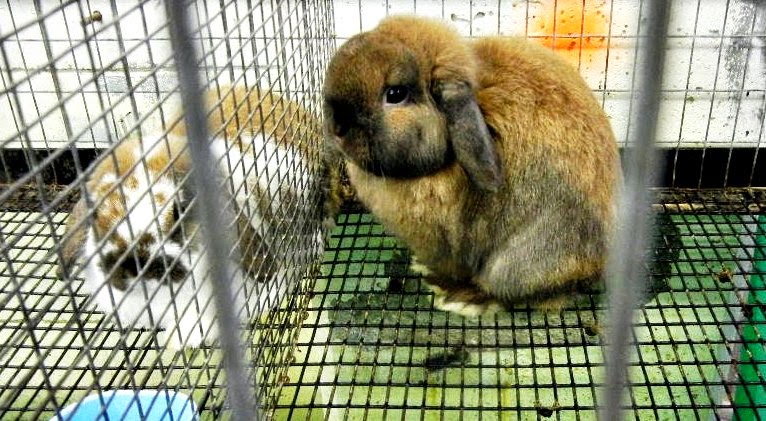
 
This one had a purple rosette for Grand Champion. It’s very cute in its rabbity way, but I can’t tell you why it’s a champion.
 
We thought that maybe not all of the animals were on display yet — the barn seemed only two-thirds full. The poultry, cows, pigs — all were scarcer than in years past.
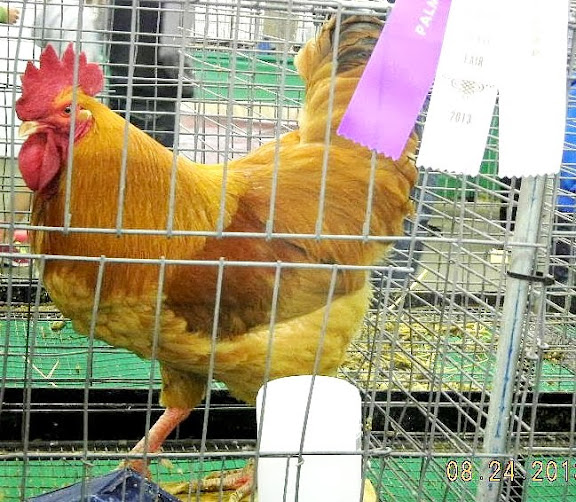


A champion rooster struts his stuff.
 
 
We watched the 4-Hers get their sheep ready to show. Someone nearby was explaining how the legs had to be positioned to show off the shape of the hips, and much more that I didn’t eavesdrop well enough to hear.
 
Goats were plentiful, asleep and awake.
 
The Alaskan — a reindeer. His name is Oscar; he’s two years and four months old, and sadly, his destination was described as “market,” rather than “Santa’s sleigh.”
 
The barn holds all of the vegetables, which again seemed sparse this year. The giant cabbage weigh off isn’t until next week, so we had to make do with cabbages in the neighborhood of 43 pounds (the record is 138.25 pounds, set at last year’s state fair), and ten-pound kohlrabis.
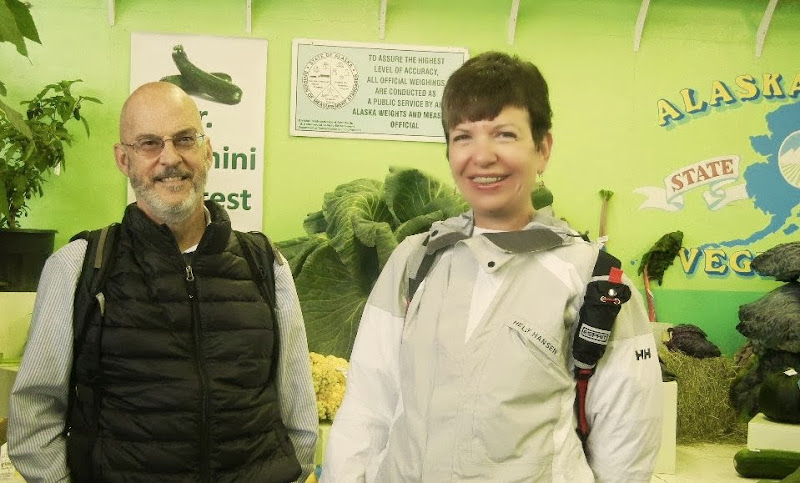
 
Jim and Marla in front of the big cabbage for the week. The monster ones come in a few days from now.
 
 
Last in the barn was the bonsai room, this year much smaller than in the past. It looked as if only one person had arrived as yet, so the bonsais were sparse.
 
 
Our favorite was the miniature pine forest, with pinecones on the trees.
 
 
Of course, “Fair” means “food.” That’s another way the Fair is different this year than even five years ago — the dozen or more languages being spoken on the paths were reflected in many more choices of things to eat — tacos, yes, and corn on the cob, turkey legs, pulled pork, fried chicken. . . but also gyros, a booth devoted to Korean soup (Bi Bim Bop),Thai, Italian, Japanese, vegetarian. We were surprised to see no line at all at the funnel cakes — but plenty of people were still focused on eating their candy-sprinkle-laden chocolate-covered ice cream bars before they dripped irretrievably.
 
Our favorite, deep-fried peanut potatoes (called that because of their shape) from Bushes Bunches, provided lunch. We sat at a picnic table near the barn, enjoying the sun that had just arrived, and watching the crowds. 
 
There was food to take home too — spices from around the world, honey, nuts, oils and vinegars, and fresh veggies.
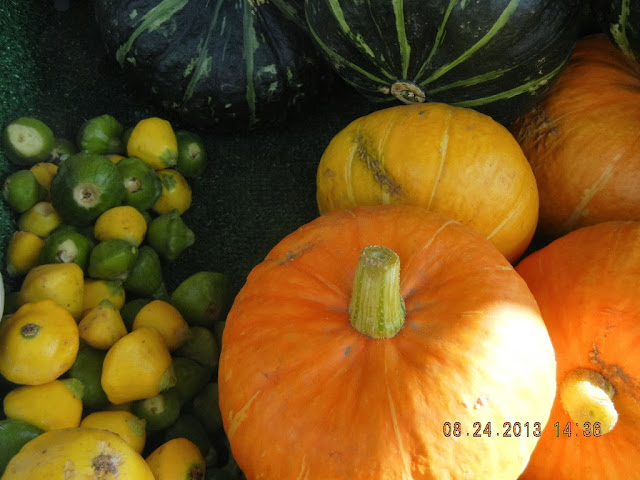
 
 
Local squashes at Bushes Bunches. 
 
Once you’re well supplied with food, it’s time for the rides . . .  or not. Even if we were not eager to ride them, they’re essential to the ambiance of the day.
 
The Midway, Alaska State Fair, August 24, 2013. Looks pretty much like any midway at any fair in the United States in the past fifty years.
 
Besides the rides, and the food, and the shopping, and the people watching, there were dozens of performances. Groups of kids were clustered all over, in their costumes or warmup clothes, waiting to dance or cheer or sing. 
 
These girls were waiting around 11:30 for their act to go on at the Colony Stage. It was still gray and cool, so they’re dressed to stay warm.
 
 
And then there was the hall with clothes and crafts, where my siblings and I entered many exhibits in our 4-H days during the 1950s and ’60s. At some fairs, the clothes and handmade work don’t look much different in style from our entries. But much of what was being shown at the Alaska State Fair in 2013 would not have been imagined in earlier decades. One difference could be that the Alaska State Fair is open to exhibitors of all ages; our county fair was limited to people under the age of 21.


Dresses tagged as “judges’ choice” and “grand champion.”
 
 
A fish for a wall, not found in nature. I would think twice about having him in the bedroom.
 
 
The Fairgrounds are noted for their flowers, and this year was no exception.
 
Pansies.
 
 
A final glimpse of the Fair, with all of its souvenir glories, in contrast to the views of mountains, water, and woods on the way home.
 
 
The Fairgrounds are a world unto themselves, with glimpses of mountains as a background for the rides and booths. The Knik River with Mt. Susitna in the background shows the other side of the state.


Posted in Uncategorized | Tagged , , , , , , | Leave a comment

A small town Fourth with a big time race

The gun goes off for the first wave of the Seward, Alaska Mount Marathon Men’s Race, July 4, 2013.
Seward (population 2,700) swells to 30,000 people every Fourth of July. The main draws are the Mount Marathon races, a 3.1 mile round trip up and down the gravelly muddy treacherous side of a 3,022 foot mountain that rises above the small frame houses. A whale-ish white cruise ship sits at the dock in Resurrection Bay. The ships that carry coal from the Usibelli Mine in Alaska’s Interior to ships bound for Asian ports are out for the day, leaving the town to the tourists and runners. Seward looks like the small Midwest town I grew up in — a grid of streets named after trees and presidents, small frame houses with neat little porches, shaded by old lilac bushes and tall evergreens. But it sits at the edge of a bay on the Gulf of Alaska, and mountains with glaciers surround it on three sides. It’s an improbable place for world-famed race built on a bar-room bet eighty-some years ago.
The races — women’s, juniors, and men’s — are what draw the crowds to Seward every Fourth of July. Once they’re here — families, bikers, tourists, teens — Seward sees to it that they are well entertained between the main events. The deep-fried halibut with corn fritters and honey butter are justly famous. Tacos, reindeer sausages, ice cream, and Kettle Corn are equally popular. The NRA has a booth, and places selling Silly String abound. The churches offer pies, chicken barbeques, bottled water, and sodas. And at 1:30, the parade starts.
The Coast Guard leads with the colors . . .
Followed by the bikers.
Every good parade has royalty,
Patriotic cars — this one, a Corvette honoring vets,
Girl Scouts,
Boy Scouts,
Plenty of red, white, and blue,
And fire trucks, the louder, the better.
What Seward has that no place can boast of: determined women runners, headed for the finish line after the grueling and dangerous trek up and down the mountain. Everyone cheers, even louder than for the parade events.
It was an excellent parade, even though the people in trucks and on floats didn’t throw nearly as much candy as in some years past. Also missing were the politicians. In 2010, the gubernatorial candidates, the Senate candidates, the Congressional candidates, and a decent number of people running for seats in the state house and senate were on hand to march along Main Street. They could have gone to much bigger cities — Fairbanks, Anchorage, Juneau — but Seward has the cachet. We’re looking forward to the 2014 parade for that reason, among others.
We stopped in at the gift shops up and down Main Street during the interlude between the parade and the start of the men’s race. At every step there was entertainment.
I wanted one.
Then it was time to watch the guys warm up, running, skipping, dancing, lunging back and forth along the block ahead of the start line.
We thought that Gumby might have extra protection if he stumbled coming down the hill.
Most men didn’t wear costumes, but some were patriotic nonetheless. Observe that several have shiny silver ankles — they have wrapped the tops of their shoes and lower legs with duct tape to keep the rocks and dirt out.
Waiting for the Mount  Marathon Men’s Race to start.
The second wave waits to take off, five minutes after the first. The red-painted guy didn’t add any extra weight with a costume, but he does look fierce.
The first wave of men are already above the tree line about twenty minutes after the race start. Eric Strabel won the race with a new record  of 42 minutes, 55 seconds, breaking Bill Spencer’s time of 43 minutes, 21 seconds in 1981)  
Here’s Eric Strabel — number 8, to the far left of the photo, just past the start line.

Posted in Alaska Travels | Tagged , , , | 2 Comments

A sunny Solstice, Anchorage 2013

What to do with a sunny Saturday in Anchorage? It was the weekend for all of Anchorage’s Solstice celebrations — the downtown party, and the Mayor’s Midnight Sun Marathon, plus all of the regular summer activities — yard sales, farmers’ markets, the Downtown Market, and the things that people do when the sun shines and there’s no snow (we are still aware that a month ago we had an inch of snow on the ground). We drove to REI and parked the car there, with the intention of spending the day wandering from summer sight to summer sight.
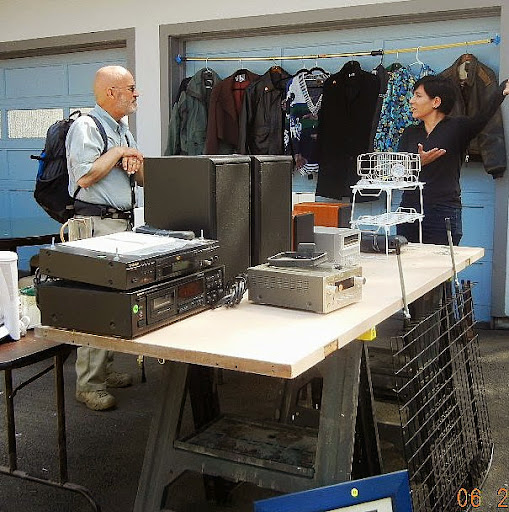
Jim with his new backpack from REI, at a yard sale.
From REI, we walked to the Spenard Farmers’ Market. We bought radishes (at $12/pound, as it turned out — they were small, deliciously spicy and very local, but pricey) from a charming young woman who had moved to Wasilla from Connecticut and become a farmer. We walked down Romig Hill to Westchester Lagoon.
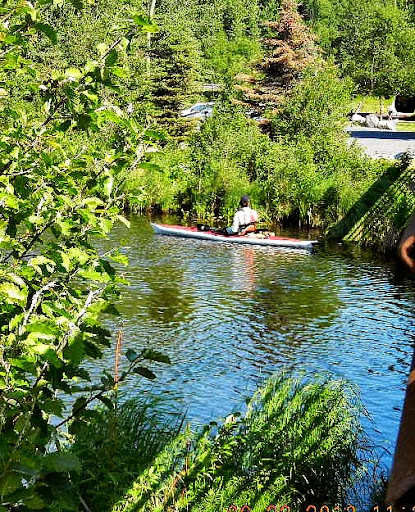
Kayaker just putting in at Westchester Lagoon. Sunshine and mid-60s when we started, with a light breeze, and few clouds — close to perfect weather.
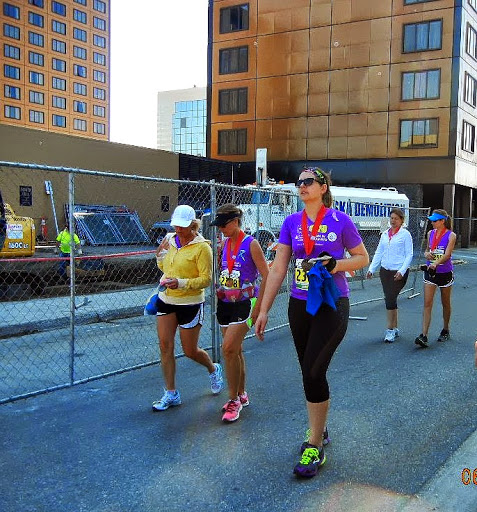
Walking on the Chester Creek Trail for a short stretch we found that we were sharing it with runner/swalkers completing the Mayor’s Marathon. This was near noon, and they had started at 8:00 a.m., so the winners had long since arrived at the west end of the Park Strip. We headed there, with stops at City Market and Fire Island Bakeshop.
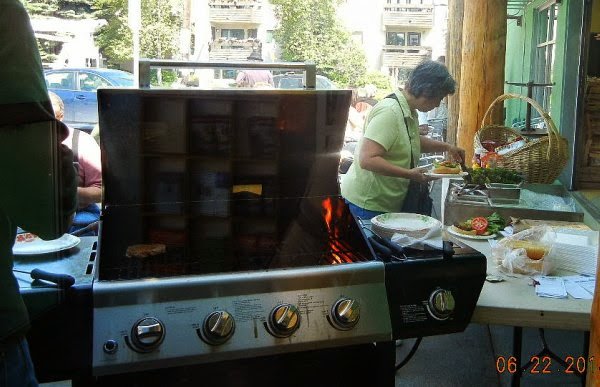
Grilling hot dogs outside City Market for customers [had to get the photo through the window so caught some reflections as well.].
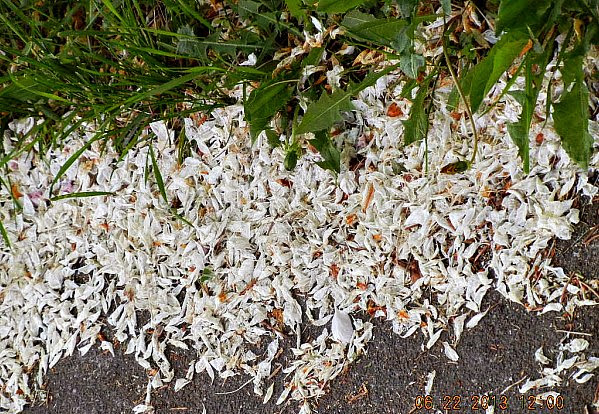
Already, the fruit trees and MayDay (European Cherry) trees have dropped most of their petals in drifts at the sidewalk’s edge.
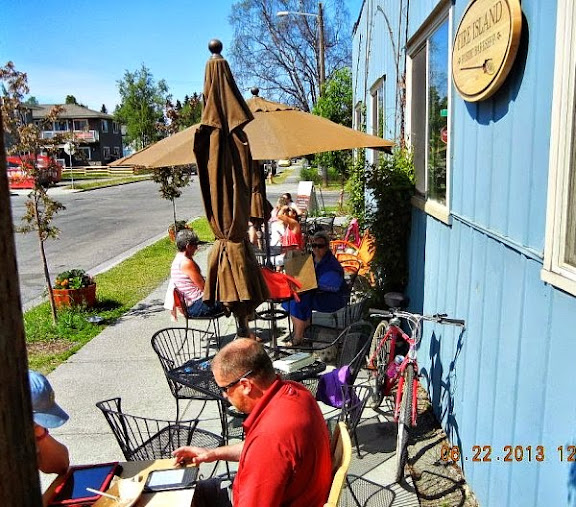
The outdoor tables at Fire Island Rustic Bakeshop were filled; indoors, the tables stood empty, although a steady line of customers streamed through.
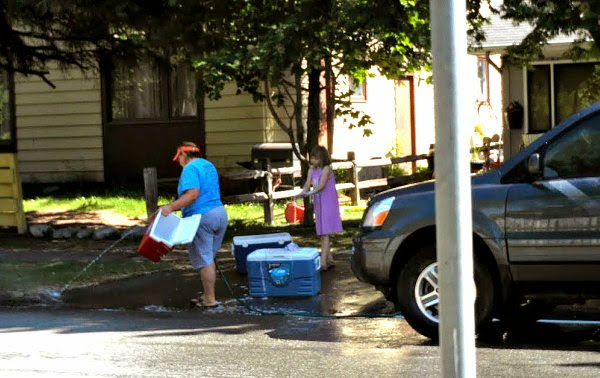
Another summer activity — cleaning the coolers. Getting ready to go fishing? at 1229 G Street.
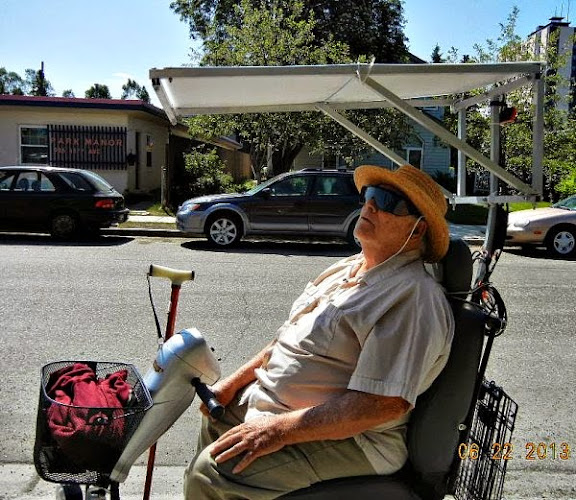
Guy in front of the Pioneer Home showing us his home-made solar-power system for his motorized scooter. He was waiting for his daughter to take him downtown to the Solstice celebration; we saw him there later happily making his way through the crowds.
Finish line for the Mayor’s Midnight Sun Marathon.
We came across a surprising number of apparently abandoned jackets, hoodies, socks, and other items on the Park Strip. Baby Kermit was probably lost, not abandoned. We left him there, trusting he would find a good home (if not his original one).
People from the marathon, with their bibs and finishers’ medals, walking down K Street to the Solstice Celebration on 4th Avenue. Those of you who know Anchorage will notice that to their left, a sizable hole has appeared. A building stood there for all the time that I’ve been in Anchorage, housing lawyers’ offices, Maharaja’s Restaurant in the early 1990s, and a few other things. The Hickels have wanted it for many years, and apparently finally acquired it and tore it down. We assume that a new tower for the Captain Cook Hotel will be going up soon.
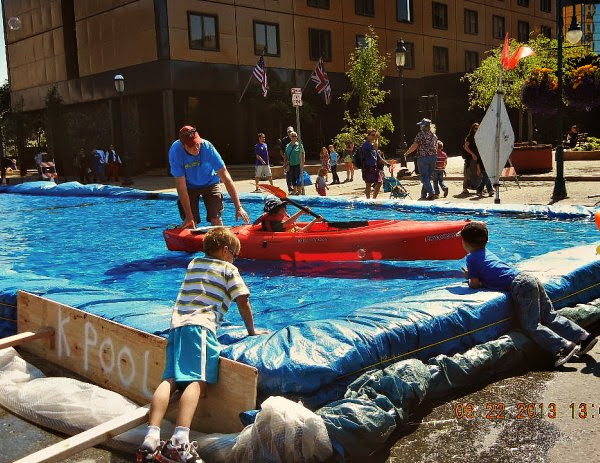
A different form of kayaking than we saw at Westchester Lagoon — a pool for kids filling much of the street in front of the Captain Cook hotel on 4th Avenue.
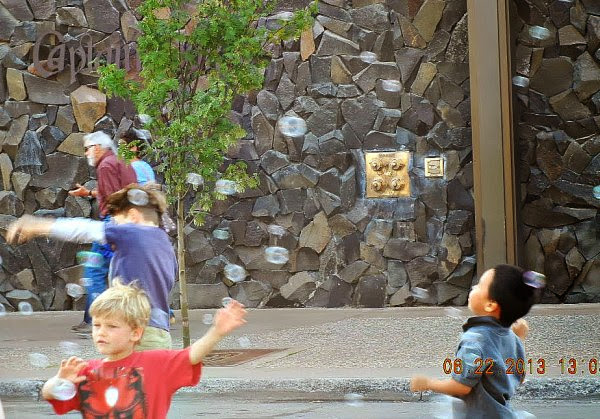
A bubble machine in front of the Captain Cook — my biggest smile of the day.
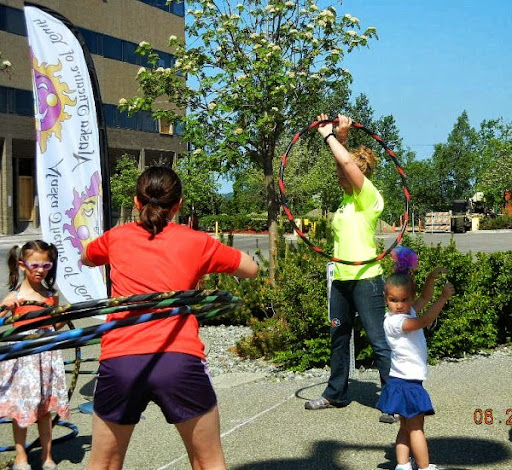
Lots of activities for kids at the west end of 4th Avenue. This is the Alaska Theatre of Youth booth with hula hoops. As we went east, the options grew more adult — first, a block of skateboard jumps and tricks for teenagers, then shiny old cars, then military teams competing in scooter races and an obstacle course, and at the eastern end at C Street, hard rock live music and a beer garden.
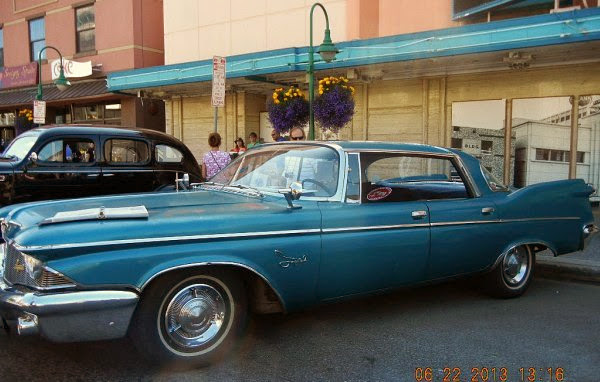
Old car show in front of the Fourth Avenue Theater. Pretty amazing. They actually made cars like this. We must have ridden in them, but I don’t remember it.
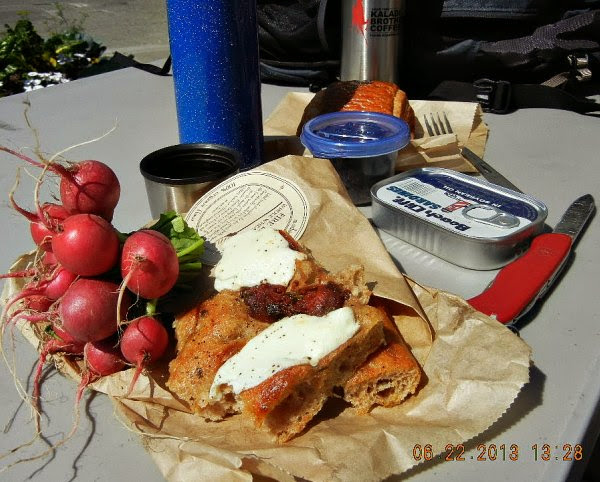
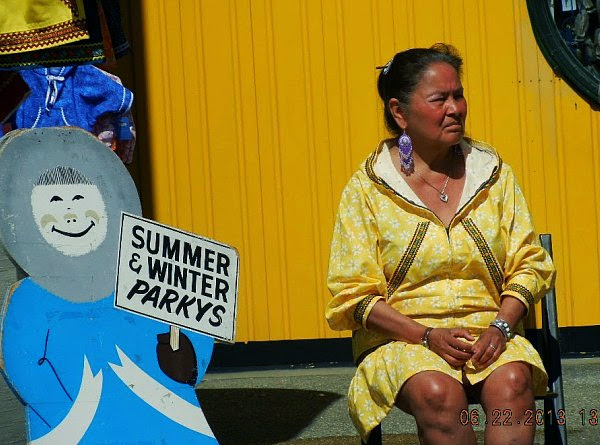
Picnic lunch — Fire Island mozzarella and sun-dried tomato foccacia, farmers’ market radishes and coffee for me. For Jim, a tin of sardines, some raisins, and a chocolate croissant. We found a picnic table at the corner of 4th and E where we could sit in the sun and watch the people. A small Native woman,with mismatched Indian earrings (nice ones), and neatly dressed, maybe in her 50s asked if she could sit there; we said, “sure.” After a bit, she started talking — she had lost her husband somewhere along the way. She was drunk, she said, although she sounded reasonably coherent. She was from Chevak, by way of Mesa, Arizona; it wasn’t clear where she lived now. She wanted to borrow my cell phone to call her mother in Chevak. I said no. We wished her well, and moved on — we offered to call Community Service Patrol if she wanted help, but she thought that she would  try to find her husband.
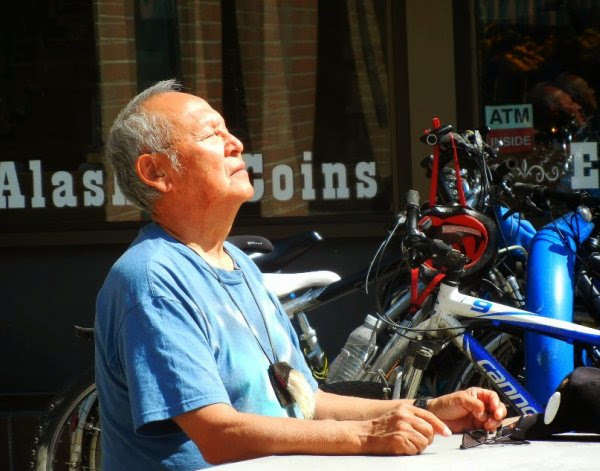
Man at a nearby picnic table, face lifted to the sun.
Woman sitting outside a shop modeling a guspuk.
We continued on to the Saturday Market, where we found delicious chocolates for dessert, and  friends who took us around and introduced us to several of the vendors. Earlier in the day we saw another friend near Fire Island Bakeshop, and yet another one on 4th Avenue. Anchorage was presenting its best “small town” side for the day.
Happy couple at the downtown Saturday Market. We didn’t know them — they just summed up the brightness of the day.
One cute dog photo. There were many dog photo ops, all day long, some cute, some adorable, and others large or strange.
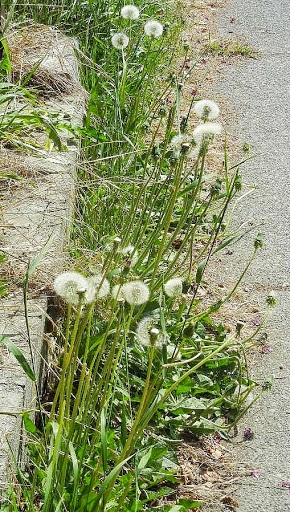
Definitely summer — dandelions gone to seed along a sidewalk on the way home. By 3:30 or so when we started to walk back to REI, the sky had clouded over, but the day stayed pleasant.
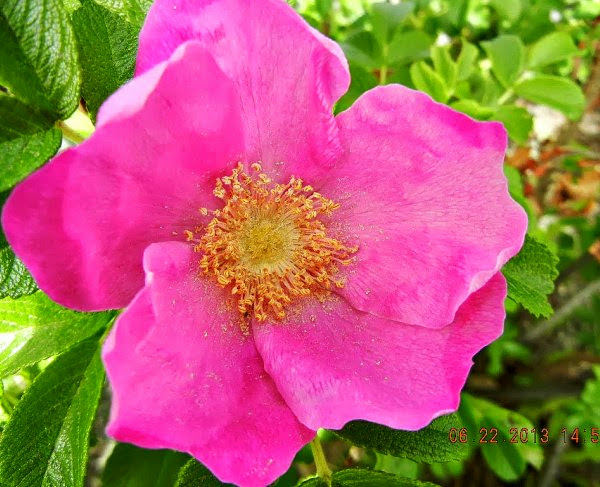
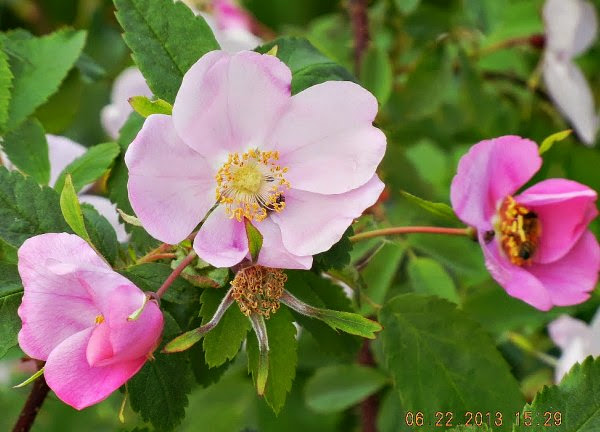
Wild roses near Westchester Lagoon.
Back at the Northern Lights Center where we had parked, Jim napped in the car, and I spent some of our recently-acquired credit at Title Wave (from taking books in) to acquire a few new reads — an account of an American on the pilgrimage to Canterbury in England, recipes for foccacia, American regional food (a recent compilation of writings sponsored by the Federal Writers’ Project during the Depression years — the WPA sent people out all over the U.S. to collect recipes and write about local foods), and a 1960s book about how to see and draw written by a German with a charming sense of humor.
Altogether, the wanderings covered close to nine miles, and we felt that we spent our Solstice Saturday well. We hope that all of you had an equally delightful day, a portent of a wonderful summer to come.
Posted in Uncategorized | Leave a comment

Kachemak Bay Writers’ Conference, Day 4, and back to Anchorage


Naomi Shihab Nye, the keynote poet, at Monday morning’s opening workshop.

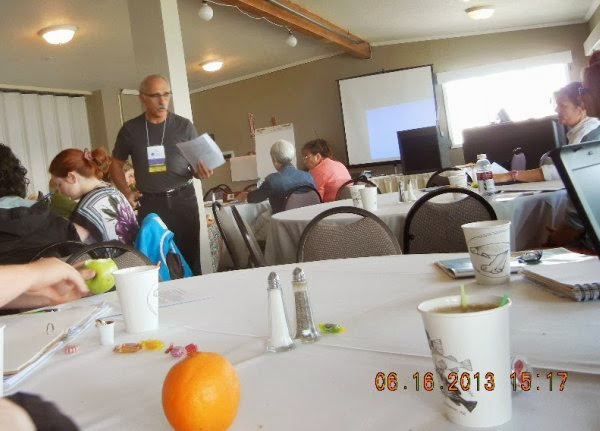
Naomi’s a poet (and children’s book writer, novelist, memoirist, teacher, and so forth). She opened with “Oh my God! I thought I had three hours this morning and I have one. So we’ll cram a lot in.” And she proceeded to do just that, tossing out aphorism after aphorism about writing, along with brief exercises (like practicing scales each day to warm up), then gave us three minutes to write; and then repeated the cycle -advise, write, read aloud.
 
“If you‘re having a dull time, write a thank you note or a love letter — to the soap dish, to a time of the day, to the window, to someone you admire. Or write a farewell — to a fear, or a bad habit, or something you’d like to say good-bye to. Just a few minutes.”
 
She read bits of poetry from others: “There are mornings when everything brims with promise. Even my empty cup.” (From Braided Creek by Ted Kooser and Jim Harrison).  “Dawn in the north. His nose stalks the air, seeking coffee.”
 
She read a sentence from Ted Kooser about revising: “You can learn to love tinkering with drafts of poems till a warm hand from somewhere above you reaches down, unscrews the top of your head, and drops in a solution that blows your ears off.”
 
From there I spent an hour and a half listening to Christine Byl (lives near Fairbanks, and makes a living by operating a trail design company; she just published a book about working on a trail crew with a bunch of guys in National Parks). She talked about Haibun, a Japanese form in which haiku are incorporated into prose pieces. That meant that we got to spend a fair amount of time with Basho (about 1644 to 1694, Japan). An example, from The Knapsack Notebook or the Records of a Travel -Worn Satchel:
 
“They say the ancient poet Sogi nearly staved to death in the high village of Hinaga. I hired a horse to help me over Walking-Stick Pass. Unfamiliar with horses and tack, both saddle and rider took a tumble.
 
     If I’d walked Walking-
     Stick Pass, I’d not have fallen 
     from my horse.”
 
Also, “I believe in traveling light. I sought things I might dispose of, but most were necessities. I had to carry raincoat and overcoat, ink stone, brush, writing paper, various medicines, lunch box — a load. With each slow step, my knees ached and I grew increasingly depressed.
 
     Exhausted, I sought
     a country inn, and found
     wisteria in bloom.”
 
[It sounded so like the Camino.]
 
In short, I had a good time (and, of course, we tried our hands at both haiku and haibun during the workshop).
 
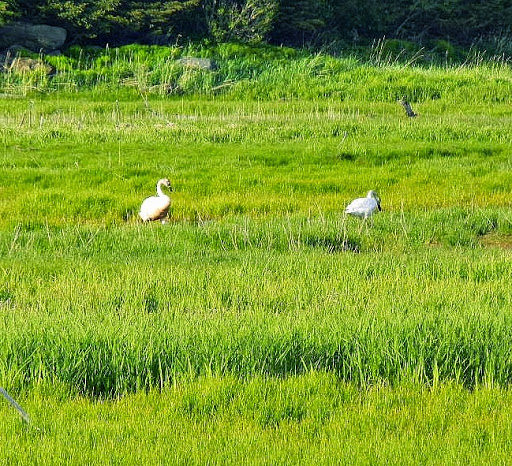
We headed back to Anchorage after stopping at Bishop’s Slough to see if the sandhill cranes were there. They were, off in a distance; and one of the swans from last night was also foraging. 
 
Bishop’s Slough, looking toward Cook Inlet. The big birds were too far away to get good photos. But the air was sunny and cool, and everything is green. 

 
Bishop’s Slugh a month ago; everything brown.
 
The lupine carpets the roadsides, especially near Turnagain Pass and Portage. In spots, swathes of the deep blue run alongside patches of dandelions, perfectly representing the Alaska flag. This is one little spot at Portage — the larger pictures were hard to get  from the moving car.
 
The trip back was uneventful. Some of the road work from Friday had been finished, so there were fewer waits along the way. The water was high in many places — the glacier-silt green Kenai River, Kenai Lake, Tern Lake, and Potter Marsh (from the Rabbit Creek flooding).
Tern Lake.


We stopped briefly at Portage, where the walk along the lake’s edge lies underwater in places.

Cool blue iceberg in Portage Lake.
Last night’s moon over Cook Inlet, about midnight, from the window of our room at the Driftwood.
     End of this year’s Kachemak Bay Writers’ Conference, for me. It was well worth doing. Now it’s time to get back to work on the blog. Thanks for coming along for the trip!


Posted in Uncategorized | Leave a comment

Kachemak Bay Writers’ Conference, Day 3


Rich Chiappone talks scene, summary, exposition.
This was the last workshop of Sunday afternoon. Luckily, Rich is a very funny guy, lively and engaging. The average age in the group was about half that of the typical group over the past couple of days — his abilities as a college professor were well displayed.
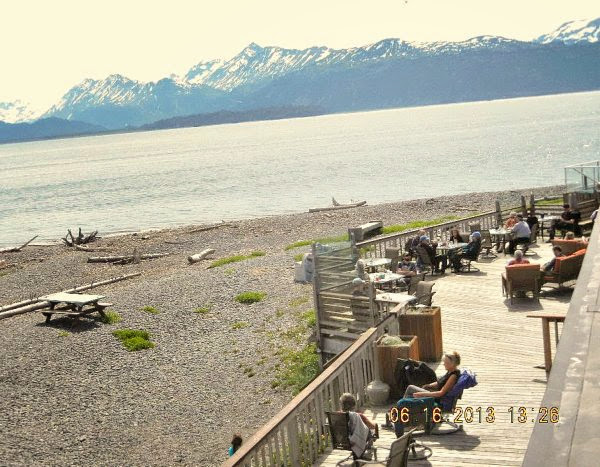
Land’s End deck at break time. I think that some of the conference people may have stayed on for the rest of the afternoon. Not much wind, not too much sun – it was close to a perfect day for deck-sitting.
We took the morning off, mostly, and the evening too. The tail end of the morning session on publishing focused on some of the differences between writing for paper books and other forms of writing. “We’re not screenwriters here,” noted one of the editors. “We’re not rewriting the author’s work; we’re editing and making suggestions (copy editing comes in later as part of the publishing process).” They worried about e-books, but recognized that some of the books that they see and like may do better online than in print.
 Lunch was a Question and Answer with Naomi Shihab Nye, the keynote speaker. She’s done a fair amount of teaching  children, and likes to talk about it. She mentioned that opening a class for children with a song worked for her because the kids figure that anyone who’s going to start by singing a slightly goofy song  isn’t likely to be measuring them. Someone n the room asked for a song she’d used; “Rutabaga, rutabaga, rutabaga, roo” was the refrain that we all sang along with.
A question for Naomi was whether the publishing process wasn’t extraordinarily frustrating. She noted that she is working on the twelfth draft of a children’s book that’s taken her five years so far. It’s gone from a simple short illustrated book, to something with more text and a different audience. It does require patience; she thought having a small group of people who believe in your work helped get through. And it does seem that she always has a lot of work in process. She has talked often about the Middle East too, and the wars’ effects on children. Her voice is powerful because of her background, and because she is so candid and caring.
One writing exercise for the first afternoon session called for taking a “form or object from daily life, and using it to organize concepts and to structure thoughts. Playlists, for example, or recipes, gardening, maps, and so forth. We did the exercise, and discussed choices that people made: shoes, grocery lists, carry-on bags, Led Zeppelin. That class was about making research an integral part of your work rather than turning out like lumpy oatmeal with undigested bits of facts distorting the shapes of your sentences.
Lunch consisted of plates of Pad Thai, which the server proudly offered to us as “vegan and gluten-free.” It was a mound of noodles, sauced brown, with a few little shreds of carrots and zucchinis tucked away in the interstices. I couldn’t eat the rice noodles, and that was all there was, so she brought me a couple of slices of toast from the restaurant. There was no salad, no dessert. An odd meal. I shared my toast (they were big pieces), and my chocolate, and someone else had a bag of fresh cherries, so at least our table  did OK.
Jim and I walked after the last class, along the Spit. We saw:
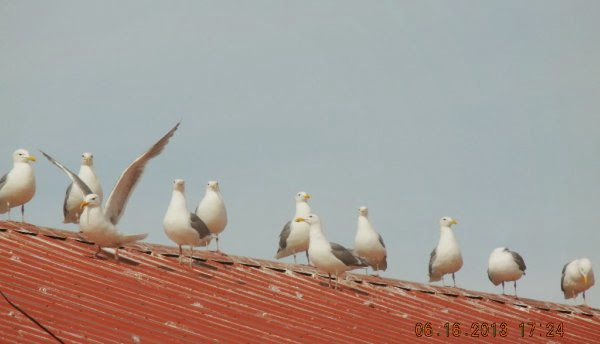
Gulls on a roof.
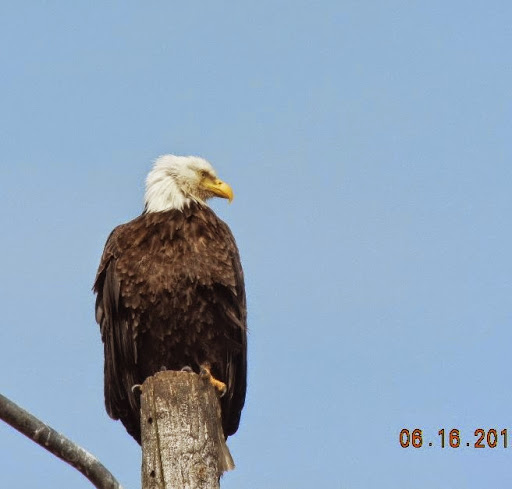
An eagle nearby, showing his best side no doubt.
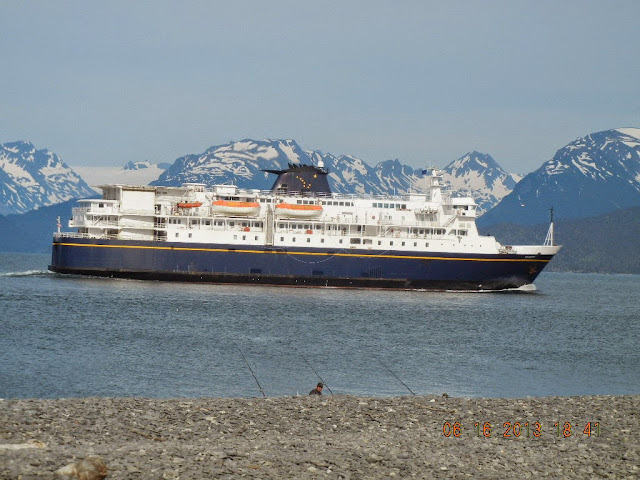
The ferry leaving.
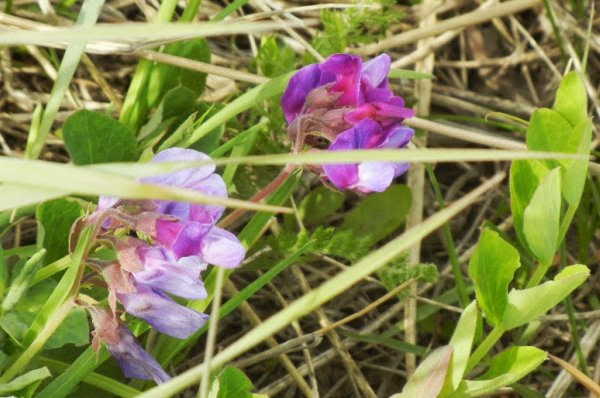
Purple vetch.
Then we went to dinner at Land’s End for Fathers’ Day.
And afterward, walked on the boardwalk along Bishop’s Slough where we heard a crane, and saw a pair of swans.
It all is very different from our trip less than a month ago, when everything was brown and chilled from the weekend snow.
Posted in Uncategorized | Leave a comment

Kachemak Bay Writers’ Conference, Day 2

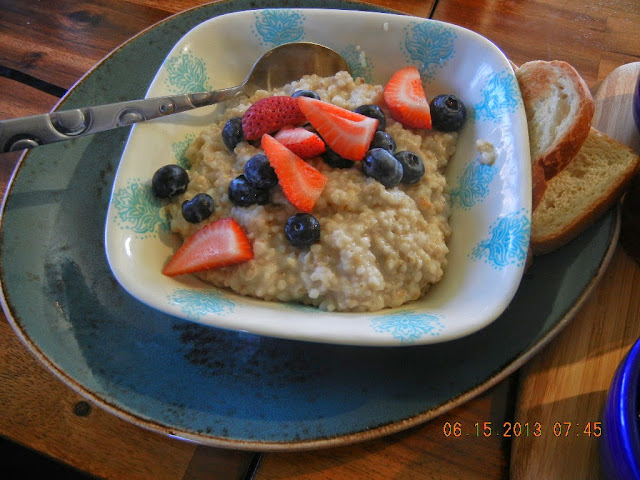
Breakfast at La Baleine on the Spit; Jim’s oatmeal with berries on it. It had sides of dried cherries, walnuts, brown sugar, cream, and honey, along with homemade toast, and butter — a morning feast.
Fog hung over the Spit almost the whole day.
The morning opened with a panel loosely themed around books as travel. Nora Marks Dauenhauer, a Tlingit woman and Alaska’s State Writer Laureate at the present talked about translating from Tlingit into English as a journey.
The later morning was filled with a workshop on images, opening with fifteen minutes of free writing — create a scene of an experience that you didn’t understand, using specific images. Then the teacher (John Daniel, a nature writer, poet, memoirist) handed out sheets with short poems and quotes and talked images for an hour, with a few minutes working again on the free write, and a couple of minutes of Q&A. One quote, from Crowfoot, Chief of the Blackfeet Confederacy as he was dying in 1890: “What is life? It is the flash of a firefly in the night. It is the breath of buffalo in the wintertime. It is the little shadow that runs across the grass and loses itself in the sunset.”
Jim met me for lunch. We stopped at the Homer Farmers’ Market to take photos and chat with people, before going to lunch at Fat Olive’s (Italian and delicious).
Little girl at the Market.
Mennonite woman (originally from southern Indiana) selling baked goods. Very Midwestern — almost all sweet breads and pastries, often frosted.
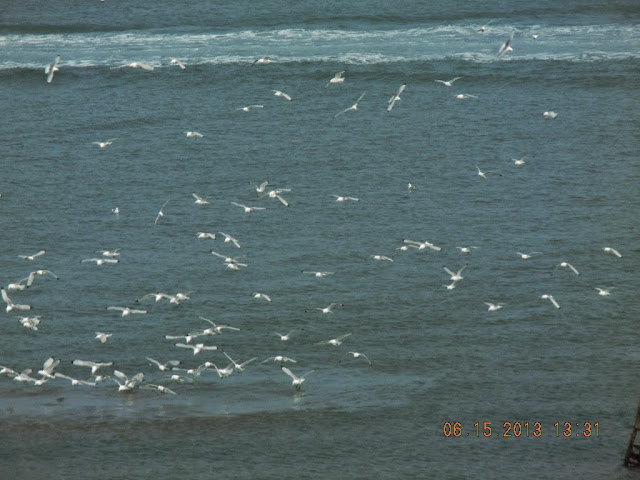
The fog lifted a bit in the afternoon, but a chilly wind persisted — only 50 degrees despite the sun. It didn’t hinder the fisher people, or the multitudes of tourists on the Spit, or the gulls.
Gulls at Land’s End.
The first afternoon session involved another writing exercise, this one a description of your most embarrassing moment, just describing the experience but without any reflection on it. Then ask what you know now that you didn’t know then, and incorporate that. That’s reflection, as distinguished from exposition, or from writing about experience.
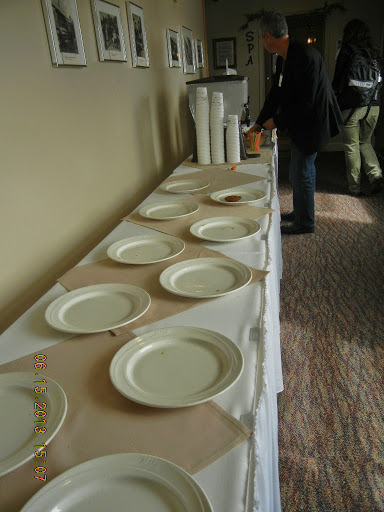
At the break, I went downstairs, noticing the long double row of plates with cookies. Coming back, not more than seven or eight minutes later, this is what I saw:
A single cookie, on the far plate.
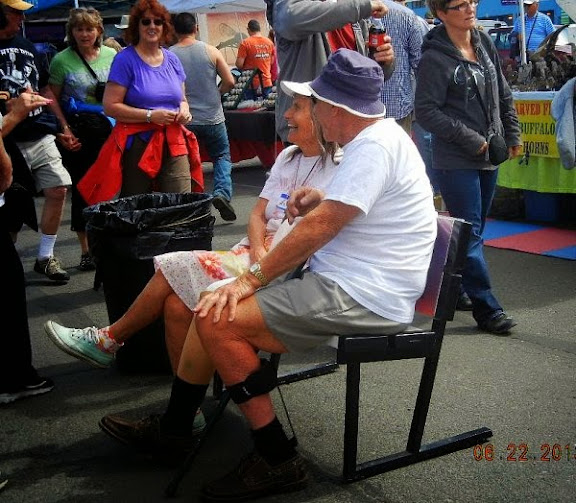
Thirty seconds later, that was gone as well, and a minute later, some of the staff people who had been arranging the rooms for the next session came out and wailed, “Oh no!”
The final session featured Christine Byl who wrote Dirt Work: An Education in the Woods (about working on National Park trails as the only woman in a group of guys; a mix of memoir and natural history and science), and Alexis Rizzuto, a Boston editor at Beacon Press. That combination worked well — both were dynamic and candid, and full of interesting perspectives on the publishing process.
One thing that Jim commented on yesterday and I watched for today was how many people were taking notes. Everyone had pen and paper (only one younger guy was taking notes on his laptop and he was pretty diligent about it). But the only time that they used them for the most part was during the writing exercises. They didn’t take notes –I rely on notes so much that I find it hard to think about writing without them.
We went to Naomi Shihab Nye’s evening readings at the high school (public invited). So many captivating things that she said. “You can’t order a poem like you order a taco. You have to live in a way that poems find you.”  She described a man who gave his wife a pair of skunks for her birthday because they had such beautiful eyes [not noticing anything else about them]. “The poems that have been hiding in the eyes of skunks for centuries crawl out and curl up at your feet.”
And she emphasized kindness, as do many of the people here. It’s a pretty mellow, pleasant environment, not exactly what I expected to find.
View from the classroom window -- the beach at Land's End with fisher people and a boat.

Posted in Alaska Travels | 1 Comment

The Camino, in the rear-view mirror

Here’s the final post in the series about our Camino, with a few days in New York, and our first week back in Alaska..

Sunday, October 7
We attended a wedding today, a New York Jewish-Catholic ceremony with a stand-up comedian marrying a Shakespearean actress. And then, because Jim’s back was in bad shape, we went home soon after the ceremony and spent the afternoon resting and packing. It was a chilly, damp day that lent itself to such pursuits.
The Camino recedes now, and looks different as we look back on it than it did as we approached it and then experienced it. Anthea said that it felt like graduating from something. It was a thing accomplished, marked by the Compostela paper as done. The reasons for having done it are not necessarily any more evident or articulate, but we changed by taking those steps. Perhaps the wedding we attended helps that perspective. People ask, why marry? It’s a piece of paper, a ceremony, but how does that change the commitment of two people to each other? Difficult, again, to articulate, but it does, and that’s why people keep doing it. A pilgrimage, a diploma, a marriage certificate — nothing changed on the surface, but the person is different in the depths. The ceremonies that accompany the obtaining of those pieces of paper recognize the fact of change.
The change, in each case, is not something that can be easily deconstructed, because it irrevocably changes the whole person from the inside out. The person looks the same, speaks the same language, has the same tics and trials. The eyesight’s no better, the writing hasn’t improved, the lapses into annoying behavior just as frequent. But the relationship with the world, inside and out, is on a different footing. Perhaps that is why some pilgrimages, although they can be done many times, are often seen as a once-in a lifetime event. You’ve finished the journey to Mecca, to Santiago, to Jerusalem, and there’s no need to do it again. Something else will call.
Days later — Wednesday, October 10 — Unpacking, in layers. Most of them are put away by now, and the laundry is done. The cat has decreased his demands for attention from every five minutes to a couple of times an hour.
Anchorage lingers in autumn, but not for much longer. Most of the leaves are gone from the trees,and those that cling on are golden, sometimes red. A few streaks of the September snow line the front range of the Chugach mountains; peaks behind them are more white than not. The last of the biggest farmers markets are on Saturday, and articles in the newspaper mention studded tires. The holiday bazaars are rolling along on schedule — a bead show at the Museum this weekend, the pottery show next weekend.
The list of things to do no longer is limited to get up in the morning, walk, eat, wash, eat, sleep. Now it includes rake the leaves that blanket the drive and lawn, cut up the tree trunks blown down by the September storms, send thank you notes, prepare to vote in November, check the schedule of board meetings, choir rehearsals, and the like — in short, return to Anchorage.
October 14, 2012 — We’ve been back for nearly a week, long enough for the cat to forgive us for abandoning him; long enough to spend several days at work and the judges’ conference; time to get to Homer and back. The tan is fading fast, almost everything is unpacked, and the compostela and credencials are set aside to frame someday.
October 15, 2012 — Here are a few photos to wrap up this journey, and a link to the complete set of emails that we sent from the trip. I realized when posting them that there is nothing about Cruz de Ferro (did I write that and it got lost somewhere?), and not enough about other places. Thanks to all of you for your support and interest — we look forward to our next trip, and to seeing you in the meantime. Link to blog: http://roadtripteri.com/category/2012/. [The posts are most recent first, you can click back through to August 23, 2012 for the first one.]
New York skyline, as we head for the Newark airport.
Autumn mountain ash in Anchorage, October 9, 2012.
Snow on the Seward Highway near Portage, October 13, 2012.
Volcano Mount Redoubt, from north of Soldotna, with a steam plume coming from near the peak, October 13, 2012.
The Homer Spit, with new drilling rigs (just there for the winter), October 13, 2012.
Homer eagle, along the Spit road, October 14, 2012.
Swans on Tern Lake, October 14. We saw plenty of them on Saturday and Sunday, but they were mostly bottoms up, feeding, and a long way away.
Anchorage sunset, October 14, looking west at the airport.
Posted in 2012, Camino de Santiago de Compostela, Camino de Santiago trip, travel | Tagged , , , , , , | 1 Comment

Rabanal El Camino to El Acebo, and the Cruz de Ferro — September 15

This post should be in the middle of the account of our Camino — and if I  ever figure out how to do that, I’ll put it in it’s rightful place. Until then, it will stay here. It was one of my favorite days despite the difficult trail.

Long day:

Foncebadon — This was the town about two hours (nearly four miles) walk uphill from Rabanal. We met Regina and Anthea there for coffee and croissants. I was anxious to see Foncebadon, described in the guidebook as a semi-abandoned mountain hamlet. In books about the Camino written in the 1980s and 1990s that I’ve read, authors move quickly through Foncebadon’s “haunted” streets, populated mainly by large, fierce semi-wild dogs. Today’s sun shone on a strikingly picturesque village with a bar, four albergues, cars, and a few small cute dogs, one of which Anthea and Regina promptly made friends with (see photo). Some of the old stone buildings are ruins; some of the slate roofs crumbling, but the bar served excellent coffee, and the people seemed friendly.
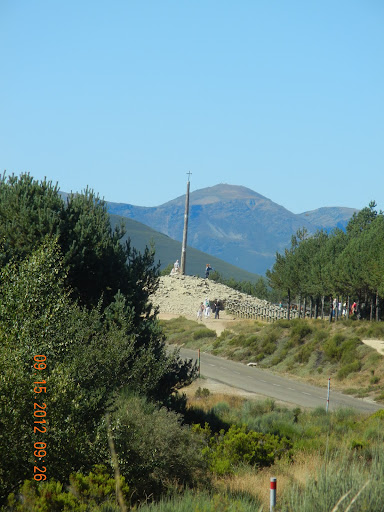
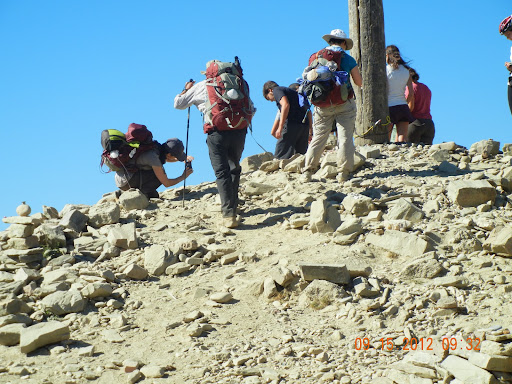
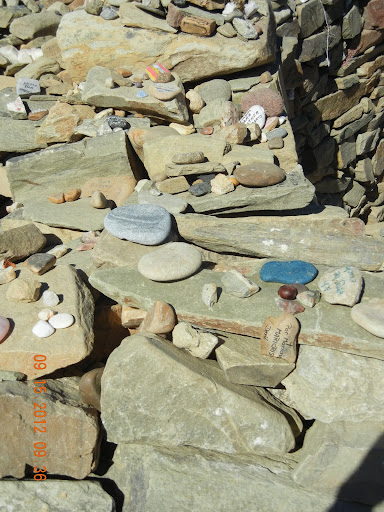
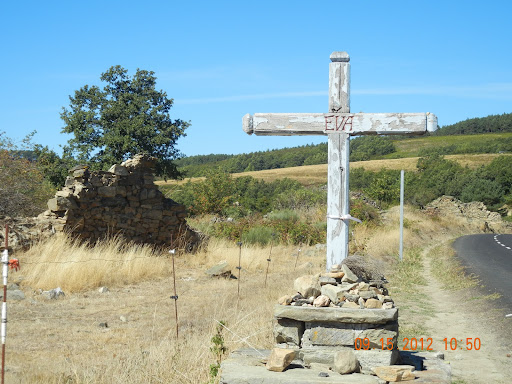
Cruz de Ferro — If you saw the Martin Sheen movie, “The Way,” you remember a tall iron cross with a huge pile of stones at the base, standing atop Mount Irago. Both the Celts and then the Romans were in the habit of leaving piles of stones at the tops of mountains; a medieval monk, Gaucelmo, who took care of pilgrims in Foncebadon, apparently added the cross. The current tradition suggests that you leave a stone on the pile, to symbolize any number of things: the weight of your sins or some part of your past, an intention, a “token of love and blessing,” etc. I left a fossilized clam shell (sort of similar to the scallop shell that symbolizes the Camino) that came from the fossil cliffs on Kodiak Island. Anthea left a stone that she’d found in Pamplona; I don’t know about Regina and Jim. It did mark an important point in our journey, like climbing Alto del Perdon (the hill of pardon) at the very beginning of our Camino.Now we need to climb O Cebrerio, meet my sister Peg and her husband Tom in Sarria, and get to Santiago by about September 27.
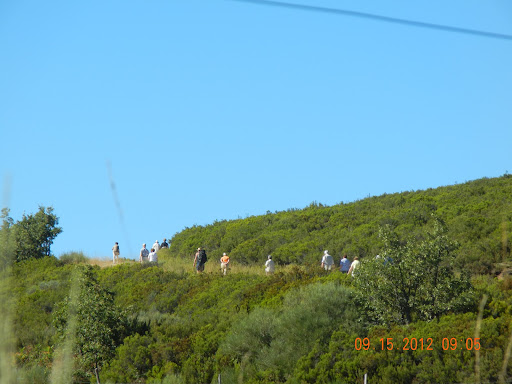
In Foncebadon, a tour bus pulled up, just as we were strapping on our backpacks and hefting our walking sticks. It discharged about 40 people, mostly women, mostly looking retired, who walked (ahead of us) up to Cruz de Ferro, about 2 kilometers. This was not the first tour group that we’d seen, but most of them have shown up at the actual sight, rather than providing a chance for their guidees to walk. I was impressed that some of them could do it; it’s not technically difficult, but it’s dusty, somewhat rocky, and narrow, with an elevation gain of around 800 feet, and they didn’t look like seasoned mountaineers. When we arrived, the group was milling about their guide listening to a lecture, and soon thereafter got on their tour bus and buzzed on to their next Camino adventure. We expect that we will see more of such groups over the next couple of weeks.
The Romans mined gold and iron in these mountains. It must have been a lot of work to get their treasures back to Rome..
The walk — First we went up the hill, an elevation gain of about 1,000 feet, and a distance of nearly four miles. Then we went down a bit and up another smaller hill. Finally we began the fun part, the steep, 1,000 foot descent over the space of about 1 1/2 miles into El Acebo. For much of the way uphill, we walked through pine and oak forests. The trees were noticeably shorter as we neared the top of Mount Irago (where the cross is), at about 4,900 feet. Downhill, we went through more forest, but also purple heather, and yellow-flowered broom. It was a long afternoon, nearly four hours to get from Crux de Ferro to El Acebo, and I kept thinking that  an opportunity for lunch would show up. But it never did, so a bit of chocolate and a handful of almonds constituted lunch. This is all from the perspective of someone who’s climbed up and down the first two-thirds of Bird Ridge a dozen times in the mid-1990s, and does not do downhill well at all. Many people passed us, some tripping merrily along without even a walking stick to help them keep their balance on the loose and slidey rocks. Next hike for me? Maybe Holland — flat, flat, flat.
One bright spot — we saw a flower growing in the middle of one of the rocky ruts, a small resurrection lily (aka, autumn crocus; there were photos of these earlier. They send up their leaves in the spring; the leaves die back; the flower comes up by itself in the fall). It had managed to escape all of the tromping pilgrim feet, and all of the cyclists going down the mountain. Three French ladies showed up at about the same time, and we were trying to get across its name. Finally, one said, “Oh, for after Easter,” and the three of them immediately began to sing a little lilting verse in French. Then we all said, “Buen Camino,” and continued on.
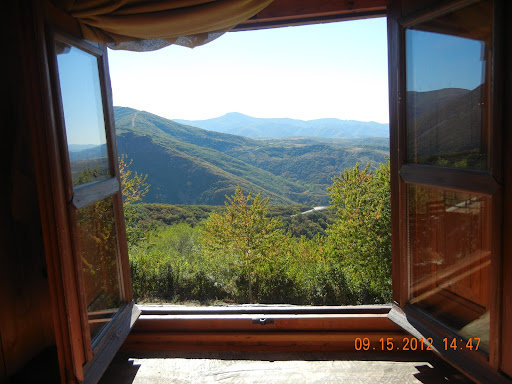
El Acebo — I make our reservations for the next night each afternoon when we pull into the town where we’ll spend the night. I have to call the backpack transport service, JacoTrans, by about 9:00 p.m. to let them know that they should pick up the bag. I chose La Rosa del Agua (described in the guidebook as a Casa Rural — sort of bed and breakfast) by virtue of the fact that they answered the phone (after several other possibilities didn’t) and offered a reasonable rate for a room for four with private bath. I chose well. It was the first place we came to, so we didn’t have to walk any further downhill into town. We have the attic suite, on the third floor of the house — very large, with a living area that has two beds tucked away against the walls, a bath, and a separate bedroom for Jim and me, all for a very reasonable price. I sat and looked out the window as the afternoon sun and mountain breezes filled the room and wondered whether there was really a good reason to ever leave.
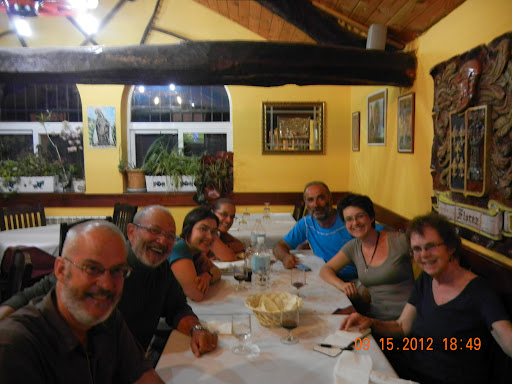
Dinner with the Italians — We arrived at La Rosa del Agua to find that the three Italians we had last seen a couple of weeks ago in Ciruena (at Casa Victoria, with hosts Francisco and Maria who served us all dinner) were on the floor below us. We went to dinner with them down in the village and had a very pleasant couple of hours conversing in Italian, Spanish and English. There was relatively little overlap — they knew bits of Spanish and English and our Italian has been pretty much limited to “Ciao!” But with charades, pen and journal, a Spanish dictionary, and a few stick figures, we managed to have a lively conversation, and to learn a bit of Italian. Tonino is a cheesemaker in Tuscany, and Tiziana is his wife. Pasquale, one of the jolliest people possible, is a retired airplane mechanic. They expect to arrive at Santiago at about the same time we do, so perhaps we’ll come across them again.
And now, it is well past my bedtime, even without considering the 8:00 a.m. start time for our hike down to Ponferrada. Everyone has done their evening laundry, caught up (sort of) on email, and laid out clothing for tomorrow. The western sky shows a planet and some stars (very little light pollution here, compared to Anchorage, and last night Regina and I admired the Milky Way and decided that it was time for a visit to the American Southwest desert to see more night sky).
Today’s factoid — Yesterday, September 14, 1,217 people got their certificate for completing the Camino at the pilgrim office in Santiago. Not everyone who does the Camino gets a certificate (for a variety of reasons) — so that means around 18,000 people already in September. Last year, the total for the month was 26,000 (down from about 40,000/month in the summer) — looks like this year may come close to the summer numbers, but in September.
The tour group walking from Foncebadon to Crzu de Ferro ahead of us. They did have the advantage of no backpacks.
Cruz de Ferro (means Cross of Iron).
Anthea, Jim, and Regina (white hat) at Cruz de Ferro.
Offerings at Cruz de Ferro — various stones, some painted or inscribed; a chestnut (just below the blue stone).
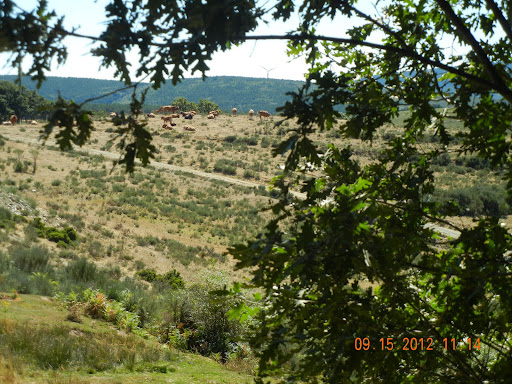
Cows in a pasture, west of Cruz de Ferro, framed by the small native oak trees in the forest that we were walking through. We saw a few cows pasturing in Foncebadon too, the first we have seen in fields on our walk.
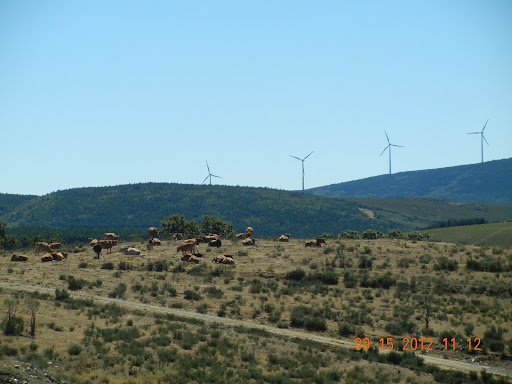
Wind turbines and cows near Cruz de Ferro. We saw lots of turbines today, and have seen quite a few in earlier days.
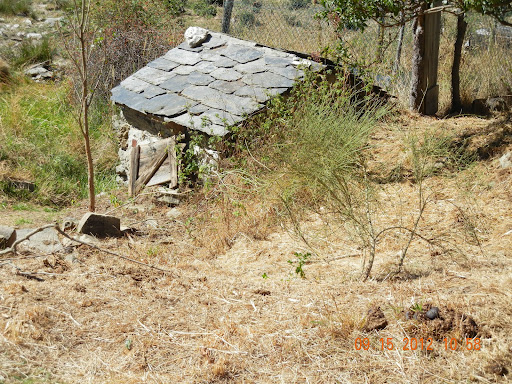
A small stone shed built into the hillside (not far from the cows). The roof is slabs of slate; note the rock that’s weighting down one of the front pieces.
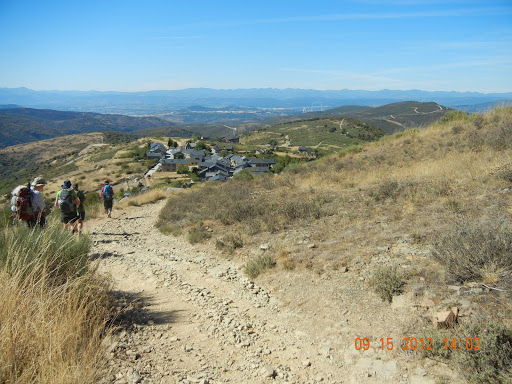
A view of the path downhill, that really doesn’t capture how steep it was most of the way. It does show that it was made of ruts, exposed rock, pebbles and loose stones, and dust (with the occasional gnarly tree root for variety). Jim is closest, in the photo, patiently waiting for me to take yet another picture. The three peregrinos ahead of us will beat us to El Acebo (you can see the rooftops) by a good half hour because I am so very slow.
A pilgrim memorial along the way. We see these several times a day, some small and simple with brass plaques; others more noticeable; some with photos or  a little description of the person honored..
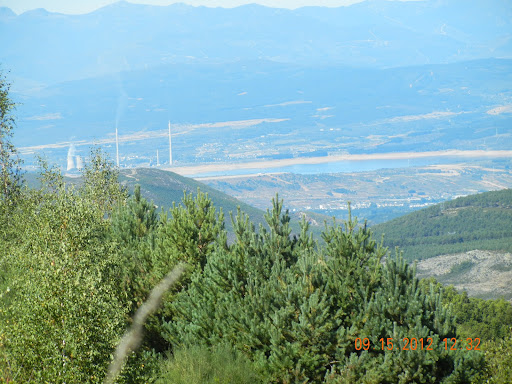
Tomrrow’s destination, Ponferrada, from above El Acebo. Note the nuclear power plant — the squat steaming cooling tower to the left of the city. These photos look hazy, but the sky was clear, cloudless deep blue; the sun hot — mid-80s.
Regina in El Acebo with Perrita (little female dog), who followed people (including us) up to Cruz de Ferro, and then followed other people all of the way to El Acebo — twelve kilometres or about six miles. Perrita arrived in El Acebo just about the same time Jim and I did, a couple of hours after Regina and Anthea. They were delighted to see her, but concerned — they found food and water for her, and then got our hotel owner to call the bar in Foncebadon where we met her. The owners eventually drove over to El Acebo to pick her up — this may not have been her first excursion out of Foncebadon along the Camino.
The view from one of our bedroom windows at La Rosa del Agua in El Acebo.
Dinner with the Italians — Jim, Pasquale, Regina, Tiziana, Tonino, Anthea, Teri.

Posted in 2012, Camino de Santiago de Compostela, Camino de Santiago trip, travel | Tagged , , , , , , , , | Leave a comment

New York City days

Two days in New York City — how much can we cram into them? Miles of walking (8 one day and 10 today, some theater, shopping, and plenty of serendipitous (or not) adventures. Jim’s been under the weather a bit, so he stayed in Fairfield, New Jersey, where we have a pleasant  Hampton Inn hotel — everything works, there’s heat and wi-fi, two towels per person, and six hangers in the closet (the usual Spanish wardrobe had four, no more). Plus, there’s a laundromat, free breakfast, and a newspaper every morning.
Anthea and I have taken the half-hour bus ride from a spot near the hotel into the New York Port Authority each morning, and from there, have walked, taken the subway, and even called a few cabs. For Friday, we tried to focus on getting a couple of essential items of clothing to complete our outfits for tomorrow’s wedding, on meeting some of Anthea’s theater friends from Anchorage who are making their way in the big city; and on seeing an off-Broadway play written and performed by several of Anthea’s classmates from Carnegie Mellon. Saturday, my desires were to get to the Strand bookstore, the Union Square market, and the Nordstrom Rack; Anthea wanted also to get together with friends in Queens and to see “Newsies” — the new lead is another of her CMU drama school compatriots.
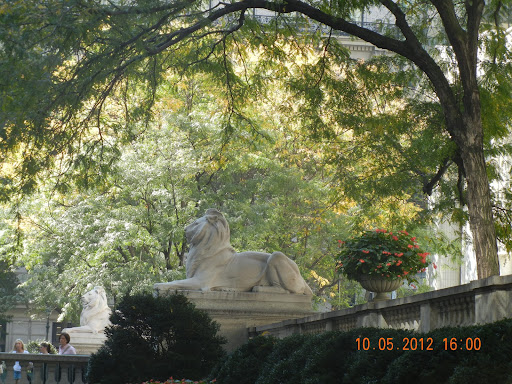
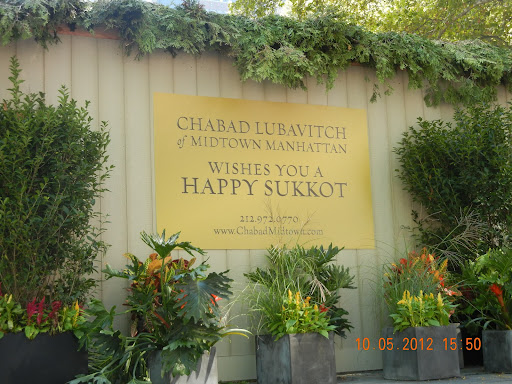
The thing about Manhattan is that something new is going on in every block. Walking down Fifth Avenue on Friday, we stopped in at St. Patrick’s Cathedral to light candles, and got to sing the hymn at the end of Mass which was an old Irish favorite. We saw Sukkot booths and signs honoring the Jewish holiday. We came around a corner and discovered the New York City Public Library lions, which had to be photographed even though we didn’t have time to go into the building.
Besides all of the people and buildings and events, we had shopping to distract us — a bead store here, a Japanese book store there. On Friday, we went to Bloomingdale’s. The departments (at least clothes) seem to each be little fiefdoms, so while the ladies in one department will be immensely helpful while you’re looking at “their” clothes, if you can’t find what you want, too bad. On Saturday, Nordstrom’s Rack and the Strand bookstore (18 miles of books) sated our desires.
Friday night’s play, “The Old Man and the Old Moon,” was two hours of folk music, shadow puppets, and high spirits telling a folk tale about an old man who abandons his duty of filling up the moon with light to go looking for his missing wife. It seemed an unusual play for New York theater, but the house was full and the audience enthusiastic because it was so captivating. Pigpen, a group of six guys with whom Anthea worked during her CMU years, wrote the play and did all of the acting — they won top honors at the New York Fringe Festival in both 2010 and 2011, and looks like they may set new records in the off-Broadway world as well.
We took the bus home at midnight, but didn’t know where the bus driver would let us off — it turned out to be an isolated spot a mile or more from our hotel (we figured that out with Anthea’s GPS. We set off to walk there, accompanied by the crickets and frogs in the chill night air. It’s quickly apparent to anyone who’s walked along highways how little accommodation car roads make for pedestrians, and midnight just emphasizes how vulnerable walkers are. We were delighted to see another hotel along the way where we could ask about calling a cab. Instead, the manager there suggested calling our hotel, and sure enough, they very kindly sent a van over to pick us up.
I got back to the hotel about 6:00 this evening, and ate dinner with Jim at the hotel restaurant. Anthea stayed in town to see another classmate play the lead in “Newsies.” Tomorrow, we will spend much of the day at our friends’ daughter’s wedding, and then pack for our flights out on Monday afternoon. Anthea heads for Seattle, and we’ll go back to Anchorage.
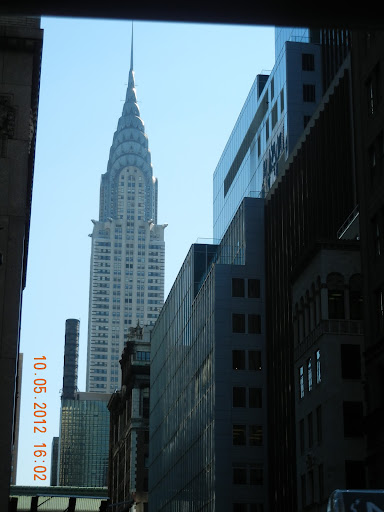
The Empire State building; King-Kong was off-duty yesterday.
The New York City Public Library lions.
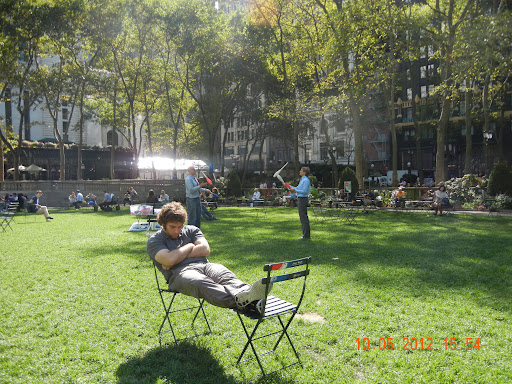
Napping in a park; juggler in the background.
A Jewish Sukkot holiday display in Bryant Park. Anthea’s research on Sukkot says that the holiday commemorates the years during which the Hebrews wandered in the desert and lived in temporary dwellings. The greens on the top of the buildings or structures created for the occasion are always of green plants to honor this (I hope I have gotten this close to correct).
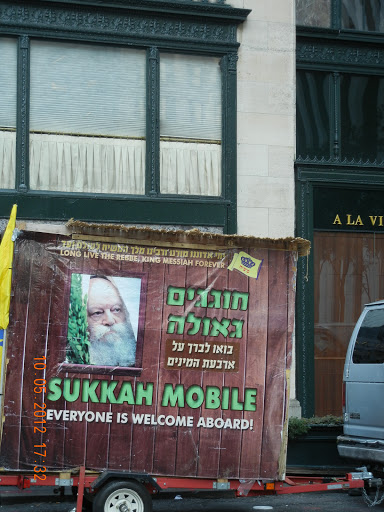
A mobile Sukkot booth, which is apparently also conveying the teachings of a particular rabbi.
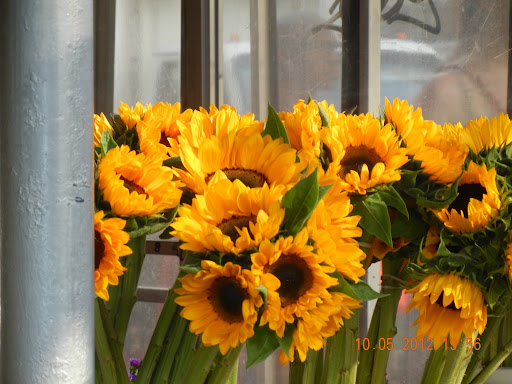
Sunflowers for sale, reminding us of all of the sunflower fields along the Camino, from Pamplona all of the way to Santiago.
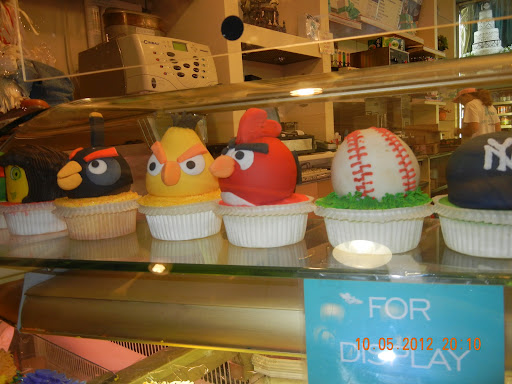
Sesame Street cupcakes at the Chelsea Market.
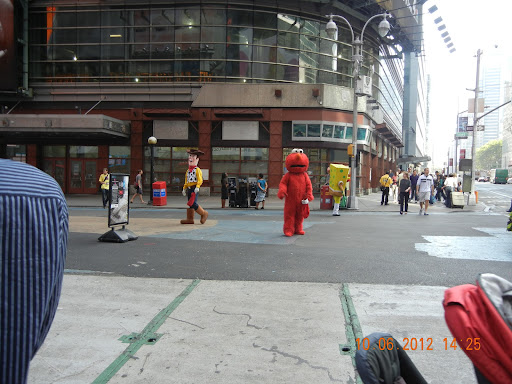
Cartoon characters at Broadway and about 41st, on Saturday. They each have a tip jar, and the idea is that you can get your photo taken with them. By the time I came back to that corner late in the afternoon, Micki and Minnie and half a dozen others had joined them.
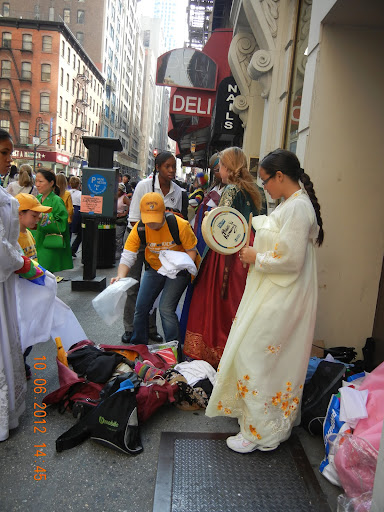
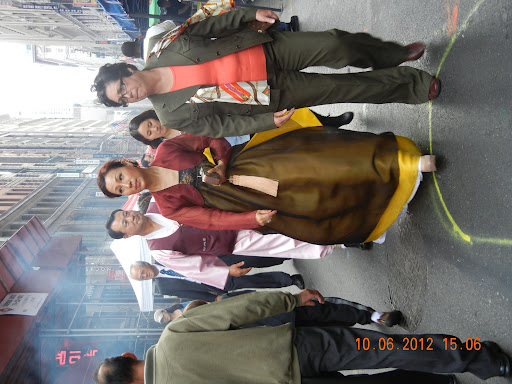
People organizing and dressing for the Korean parade on Saturday. The very Scandanavian-looking woman (second from the right) appeared to be in charge of the women in the long dresses.
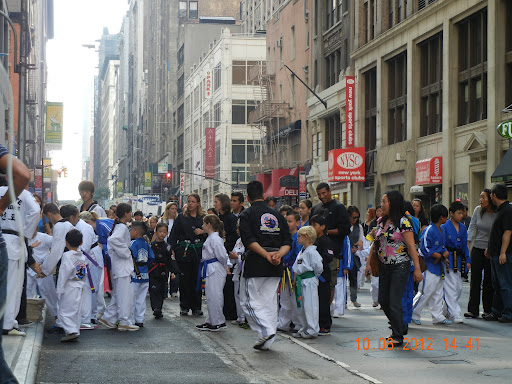
More Korean groups (mainly martial arts) milling about before the parade.
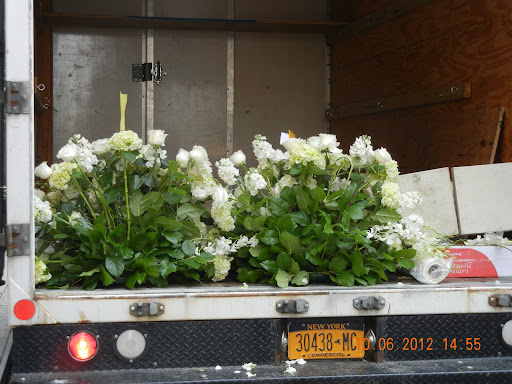
Flower arrangements in the back of a truck, waiting to be delivered.
A green spot in the city. I’ve always been impressed by the numbers of trees, parks and growing things in New York City.
Koreans at the food and crafts fair celebrating Korea Day on Saturday.
A few blocks away from the Korean Food Fair was another food festival set up in Madison Square Park, with dozens of delicious choices.
Diners at Madison Square Park.
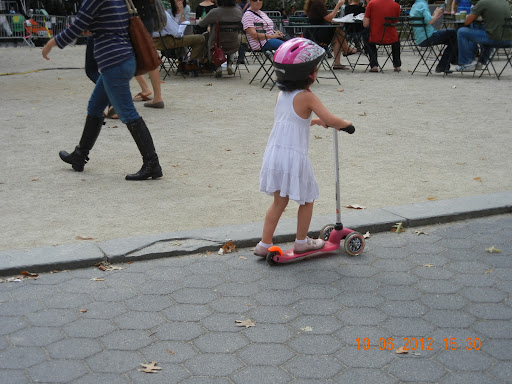
Scooters are the “in” thing for city kids — we saw them in Santiago, Barcelona, and now New York.
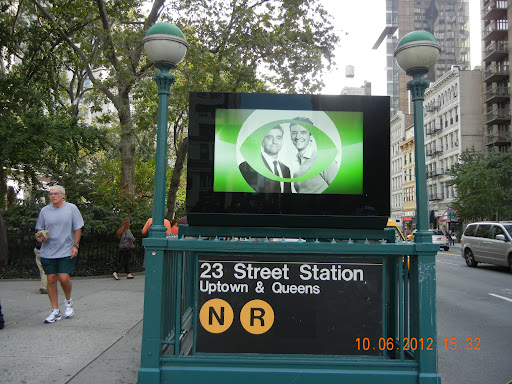
TVs are everywhere — at (some of) the subway station entrances, for the back seat passengers in taxis, on buildings —
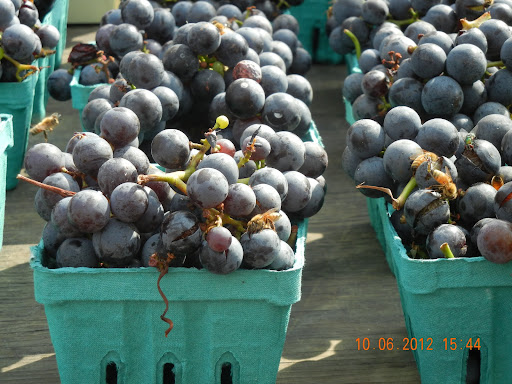
Local grapes for sale at the Union Square Market — but beware; they are buzzing with bees and wasps.
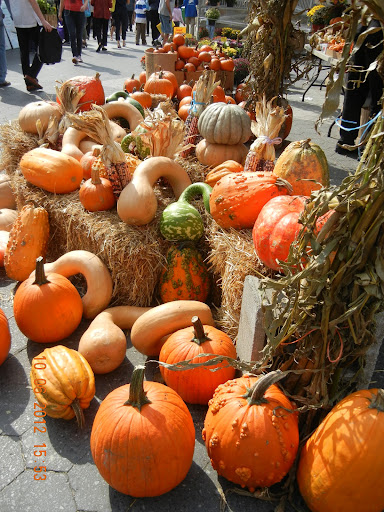
Autumn in abundance at the Union Square Market.
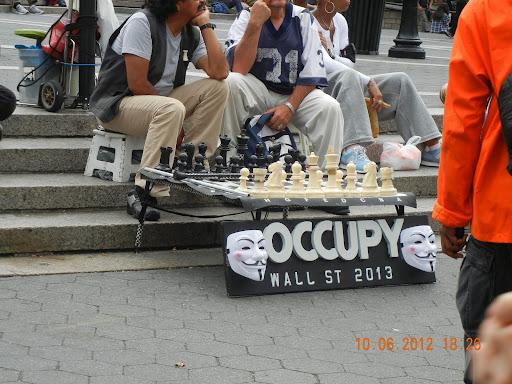
People playing chess at one of a dozen or so chess boards along Union Square, and conveying a message simultaneously.
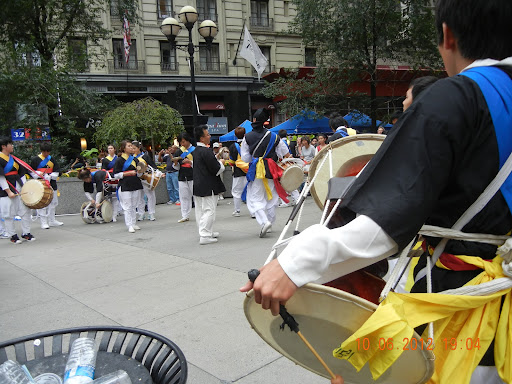
Korean drummers and dancers, later in the afternoon as I walked back up Broadway to the bus station.
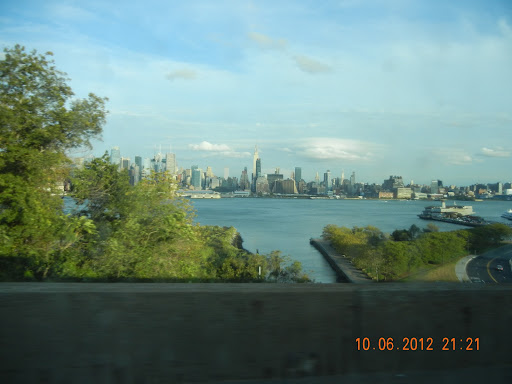
Manhattan skyline in the distance as the bus heads west into New Jersey.
Posted in 2012, travel | Tagged , , , , , | Leave a comment

Travel days, from Barcelona to New Jersey

Yesterday — it seems so long ago, because it is actually a day and a half — we left Barcelona. Reluctantly — we’d gone to the market in the morning for the last chance at those delicious pastries and fruits; stopped at the hotel for last-minute packing; and then had an interesting cab ride to the airport with Jordi. He spent some time telling us about the architectural peculiarities of Barcelona homes, and more time talking about Catalan Independence. Life at the Barcelona airport was tedious in the wait-in-line for an hour to check in way of airports, but got more interesting once we were on the plane and the crew announced that we would be taking off half an hour late. Because we had only an hour in London to make our next flight and knew that we would have to go back through security again, this piqued our interest considerably.
In fact, we were half an hour late into London, and semi-frantic activity ensued. When we got to security, the person there had to print out new boarding passes with new seat assignments for us all. Then she practically pushed us into the screening line, the guy there sort of waved us through without really looking at the X-ray scanner, and we ran another quarter mile or so to the gate. We made it on to the plane, and in fact with considerably better seats than we’d started with, plus a little extra exercise.  After that, it was eight hours on a trans-Atlantic flight — little to say. We got to Newark on time; the one checked bag (with our walking sticks, pocket knives and my backpack) arrived several hours later.
Today was another travel day — we went from Newark to Guilford, Connecticut to see friends there — three hours driving up, and four hours driving on the return trip. Between construction, rush hour, accidents, and general unfathomable traffic hold-ups we spent seven hours in the car. We remarked that in seven hours, we could walk about 14 or 15 miles; we could drive (today) about 200 miles; or we could fly (yesterday) from London to Newark. Of those choices (and assuming no rain), we would prefer to have walked the 14 miles, although it is valuable to be able to cover all of that additional territory when the circumstances demand it. On the other hand, when the afternoon rain came pouring down with no more than a minute’s warning, we were happy to be in the car, not struggling to pull on our ponchos, and not having to walk several more miles through the mud and little rivulets in the path.
Connecticut/Guilford — which is right on the ocean is lovely — worn slabs and boulders of pink granite, and marshes shape the landscape. The trees are just beginning to turn colors and the summer’s flowers and greenery remains lush and bright. Even the muggy gray clouds and haze didn’t hide the pleasures of the views. Cormorants, egrets, and ducks swam on the marshes. The homes, old and new, were expensive but interesting.
Now we are settled for three days into a very suburban hotel in Fairfield, New Jersey that has free breakfasts, a laundromat, easy access to transportation to the city, a restaurant that features the current American version of Mediterranean cooking (with quite acceptable chefs), and pleasant helpful staff. Tomorrow we’ll sleep in, head into the city for an afternoon of shopping and looking around, and an evening at a play written and performed by some of Anthea’s friends from CMU.
Layers of spider webs holding last night’s rain, in a Connecticut yard.
Boats docked in a Guilford bay.
Connecticut has many stone buildings (this restaurant where we ate lunch is one) and stone walls that reminded us of Spain. It’s a transition between the West Coast with most houses built of wood, and Europe (at least around the Mediterranean) where so much is stone or brick because of wood’s scarcity.
A bit of autumn color beginning to show. It’s difficult to take a photo of trees without getting power lines showing up — it’s an indication of the deeply uneasy relationships between the two things. The storms blow the trees onto the power lines, and people are without electricity for days at a time.
A pool of pink granite in a front yard.
An old stone wall. The stones stacked diagonally and on edge may indicate that it was built by the local Indians.
Posted in 2012, Camino de Santiago de Compostela, Camino de Santiago trip, travel | Tagged , , , , , | Leave a comment