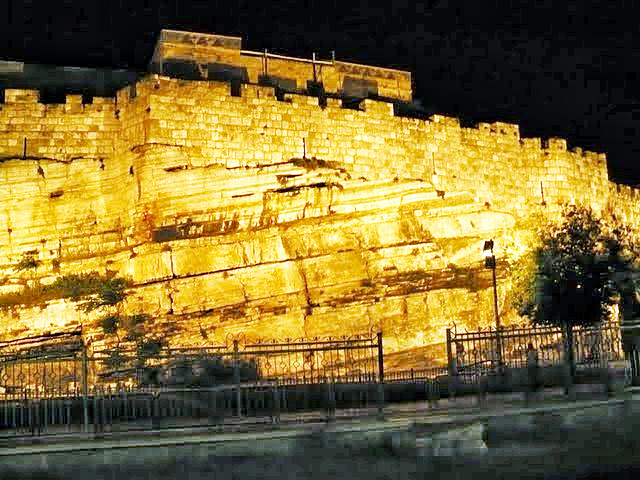
April 15, 2010 — Across from Herod’s gate in Jerusalem

April 15, 2010: Across from Herod’s Gate
Wall of the Old City of Jerusalem, on Sultan Suleiman Street not far from the Rivoli Hotel.

At 3:45 a.m. today in Athens we met up with a band of pigeons foraging along Ermou Street, a couple of the area dogs (sleep all day, play all night), and handfuls of people leaving the 24/7 McDonald’s on Syntagma Square with their shakes and burgers. By 5:00 we were at the Athens airport, waiting for our Turkish Airways plane to Istanbul and then to Jerusalem. After showing our passports at least a dozen times, going through two major security checks, flying several hours on Turkish Airways, and walking half a mile through the Tel Aviv airport, we found ourselves buying guidebooks, and heading out to the curb to catch a shuttle.
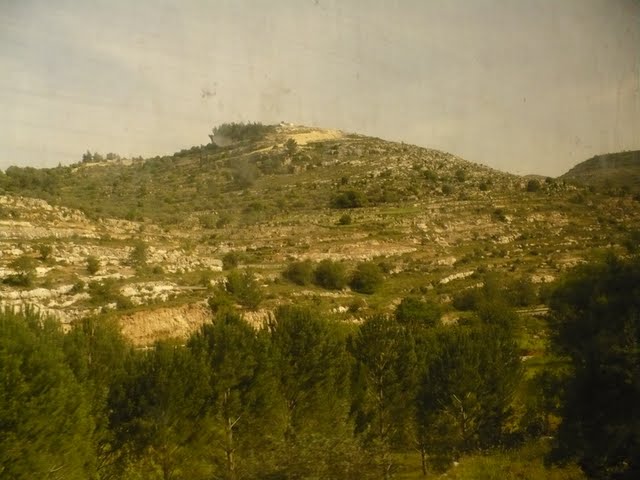
Israel countryside, west of Jerusalem.

I think of Israel as desert, and many of the hills we drove through were light-colored limestone with low shrubs dotted here and there. But we saw hay fields and orchards, long stretches of Queen Anne’s lace along the road banks, white clover, tall grasses and yellow mustard. In spots, it looked a lot like Central Illinois. Then a few palm trees would rear up alongside the Queen Anne’s Lace, and it would be clear that we were not in Illinois. We saw a single black and white cow standing in a field, and a couple of horses to add to the Illinois illusion. There are long stretches of planted forests and woods – pine trees, cypress, and many others that I didn’t recognize, but overall the land was brown hills, and rocky fields and terraces, where the limestone crop has had the best of it for thousands of years.

An hour and a half shuttle bus ride later, in the company of eight Hasidic Jewish American boys coming back to Jerusalem (for school? not clear) who got dropped off in various little alleys and corners of Jewish Jerusalem we found ourselves at the Hotel Rivoli in the Arab Quarter, directly across from Herod’s Gate in the Old Wall. It’s actually relatively recent in Jerusalem history, built (I think) in the mid-1500s by Sulieman the Magnificent, ruler of the Ottoman Empire. His territory included Greece as well, until their Independence in the 1820s; Palestine remained under Turkish control until the early 1900s. Our three hours in the Istanbul airport, and another several hours reading the Turkish Airlines magazine while flying left me with the impression that Turks are proud of their rule over so much of this area, and celebrate it regularly.

The Hotel Rivoli is in a different world, the Palestinian District. I booked the hotel because it came with a private bath (it is in our room, but the door doesn’t close, so Jim came up with a way to wedge it closed); Internet in the room (“Yes, sometimes there is Internet in that room, but tomorrow we give you a different room and tonight you use the Internet in the lounge here”); and basics like heat (“Oh, this is summer. We don’t heat in the summer. There are extra blankets in the room. You understand of course.” – There are blankets – a vibrating purple polyester; and it may be warm in the day but gets down to the 40s at night. I will not feel very understanding in the morning if the room is 60 degrees.) We asked for a dinner recommendation and he suggested shwarma (grilled meat, more or less, made into a sandwich). “Oh, the lady is vegetarian. Oh, then, bread and water.” He beamed. “They will give you bread and water. Maybe tomato.”

We walked a few blocks looking for places to eat and finding shoe shops, dress shops, produce markets, drugstores, sunglasses – all much smaller than their Athens cousins, and spilling out into the street much more haphazardly. The streets are crowded  – many  small children between about four and ten; women – some with children, some without – buying produce from other women sitting on the sidewalk with produce spread out around them – open bags of small nectarines, fat dark golden raisins, small zucchini, stacks of fresh grape leaves, bunches of flat-leaved parsley, and a number of fruits and vegetables that I don’t even recognize from reading. We ate at a hole in the wall “baguette shop” that gave Jim a Greek salad and a 12″ baguette, and me french fries and a 6″ baguette with four or five tomato slices and a few swipes of olive oil. We were hungry. We ate most of it and appreciated it, and looked for other places on the way home.

We crossed a main road to go along by the Old Wall – no stop lights, but at crosswalks all of the drivers actually stop for pedestrians – the exact opposite of Athens, where being in a crosswalk just means that the drivers can take better aim. Then we walked down into Herod’s Gate through the Old Wall, and just as it has for thousands of years, it housed a produce stand and a watchmaker, and a couple of other little businesses. That led into the Old City, which we decided to save for tomorrow. Across from the Damascus Gate, a 10-year-old boy minded a cart that sent up the smoke of grilling meat – he set up in a median between two parts of the main road. The world passed by – a very few Hasidic Jews, some nuns garbed in blue and white, a tall priest in a cream habit with black (not a Dominican), tourists from everywhere, the Arab women with their black high-necked to shoe-top dresses/coats and head coverings – and more. We saw a couple of soldiers standing guard at Herod’s Gate, and a policeman or two – nothing like the numbers in Athens.

Jerusalem is built on hills like Athens, and there are stairs everywhere. The hotel had an elevator at one time; it is closed off now, so we climb two steep sets of steps to our room. Luckily, we have been in training in Athens. A cousin asked if we were doing this because we liked walking or because transportation was too expensive. We do like the walking (and have not worn out any shoes yet). In Athens, the buses and Metro are inexpensive, but for a couple of miles, not convenient. We don’t know about Jerusalem yet, but having spent some time in the traffic this afternoon, my guess is that walking will be considerably more useful here too.

At about 7:20 we were back in our room. I was looking out the back window at the sun setting pink and purple, and at an abandoned bird’s nest built on the wide sill between the screen and the shutter that hasn’t opened in the last thirty or forty years, and heard the evening call to prayer. It started very close by, and then moved away, finally dying out five minutes later. In Athens it would have been church bells, and perhaps in parts of this city, the church bells count out the hours also. But here, I think we will hear more of the call to prayer. Somewhat later a siren went on for five minutes – perhaps this has to do with our proximity to the police station. And now, at 9:20 p.m., someone is hammering vigorously at a project that didn’t get done during the day.

Looking at the map, it appears that we are steps from a hospital and a police station and very near half a dozen other things to see. But we will save those for tomorrow. We’ve been up since about 2:00 a.m. and need to get some sleep to strengthen us for tomorrow’s explorations.

Posted in 2010, Israel, travel | Tagged , , , , , , , , | Leave a comment

April 23, 2010 — Fishing boats and ferries — Poros

April 23, 2010: Poros — Fishing boats and ferries

Poros harbor.

Six-thirty in the morning was half-light in Athens, with the Acropolis set against Homer’s “rosy-fingered dawn.” A few birds were awake enough to sing, but none of the people on the Metro (including us) were awake enough to look anything other than glum. Our trip to Piraeus and our search for ferry tickets and the ferry was uneventful, and at 8:00 a.m. the Apollon Hellas moved out into the sea with us and about fifty teenagers among its passengers.

Ferry to Poros

Luckily, the teens were bound for Aegina, and left us in peace after that. During their hour as our companions they never ceased their chatter and movement, like flocks of sparrows or maybe seagulls – not as musical as sparrows. They settled in a group for a moment, then rose up and flung themselves around and settled again in a different grouping. Mostly the boys clung together and the girls swarmed separately. The boys played cards, threw paper wads, ate. The girls chattered, got drinks, ate, finished the drinks, chattered, regrouped. I tried napping, but couldn’t miss the crescendoing excitement, louder laughter, cheers, more laughter, shouts, clapping . . .

Harbor at Poros

We spent a pleasant and very low-key day on Poros. We tried, for the first half-hour walking along the main street, to locate a guidebook to Poros. Some shopowners seemed insulted that we asked, and others looked at us with profound blankness – what do you mean, and why would you want such a thing? So we relied on our feet and eyes to find out what was interesting about that island as distinct from all of the others. Food and coffee were the first things; we ate an early lunch at Poseidon’s Taverna – pizza margarita for Jim, fried zucchini slices and tomato fritters for me, “weird” spaghetti for Anthea, most of which was left behind, and a basket of good Greek bread with olive oil for dipping.

Ambrosia Cafe, Poros.

We strolled along the street until the downtown ended, then turned and walked along the waterfront in the other direction. It was lined with boats docked in groups – mid-sized sailboats and yachts, small ferries to take people across the water to the town on the other side – just a fifteen-minute ride, fishing boats, and a cluster of yachts that looked like they might be for rent because they were all made and managed by the same company. Looking at the names on the boats – from the U. S., Sweden, the U.K., South Africa – we felt more directly that we were no longer alone on the vast continents of North and South America. From Greece, you can travel much more directly to China (along the Silk Road), or south to Cape Horn, north and west to the British Isles – you are connected through history and geography much more directly with most of the people of the world than you are in the United States.

Some of the fishing boats were set up for night trawling for squid, with big lights to attract the ten-tentacled creatures. Others had already done their work for the day, bringing in fish for the tavernas spread along the street. A couple of restaurants were grilling octopi in front of their restaurants, hoping that the delicious scents would draw in diners. In the water, little schools of six-inch red fish, and some larger silver fish swam, easy to see in the clear Mediterranean water.

Taverna on the waterfront at Poros.

The boats that were tied up had piles of nets and buoys on the docks, and an occasional fisherman spreading his nets to dry. Others were still out on the water, leaving only covered piles of nets to mark their place on the docks. Most were small, some almost tiny, their decks so crowded with gear that we wondered how the fishermen could move around – and where did they put the fish that they caught?

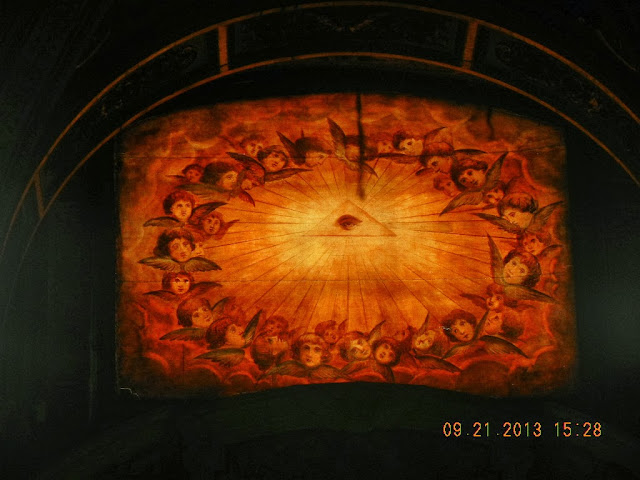
We walked over to the church to see the eye in a sunburst carved in white marble above the front door, flanked by Alpha and Omega (which represents God as the beginning and end of all things). On the street side of the church was a mosaic depicting the angel announcing to Mary that she can become the mother of God if she chooses. The old woman who cares for the church came over to watch me sketching the eye and said that the name of the church was Panagia Evangelismos, which translates roughly as the Annunciation of Mary. I was hoping that she would invite us in, but she seemed to consider her job done and walked away.

Eye above church door on Poros.

On the land side of the street, the village climbed up steep hillsides. Its architecture mixed the style of Athens – creamy browns and Mediterranean red tile roofs – with the whitewashed stucco and vividly painted blue doors and shutters of the islands. Where the houses ended, scrub bushes, limestone, and occasional clusters of shade trees and evergreens took over, with the exclamation points of cypress trees punctuating the hills. From the Malibu café, hard rock pounded out, a reminder that while the hills and houses were timeless, time was still alive and moving on.

Poros city, above the island harbor.

Anthea has a cold and Jim’s hip was bothering him a bit, so we found a pleasant coffee shop on the waterfront where we could sit and watch the motorcycles buzz by. One of the initial attractions was a sign in the window that said they had waffles were made with Golden Carbon Flour. Small world story – the flour used to be made in Buchanan, Michigan where I grew up. The company still maintains some connection with Buchanan I think; the signs advertising the flour said Buchanan on them. We of course think that there is nothing finer than waffles made with Golden Carbon Flour, so the shop had to be a good one. And when the owner saw Anthea with her computer out, she came out to say that the café had just installed free wireless – so we had a little Internet time as a bonus.

Carbon Golden Malted Pancake and Waffle Flour, made in Buchanan, Michigan; sold on Poros in Greece.

When the ferry back to Piraeus docked, hundreds of people disembarked getting an early start on their island weekend. Only a few passengers got on. From Poros to Aegina, it was calm, the afternoon sun brightening the limestone hills that we passed, and highlighting a occasional ruin or lighthouse. The teen hordes returned at Aegina, doubled in size, we swore. Eight hours roaming around on Aegina didn’t apparently diminish their energy level much at all. “How is that possible?” I asked “Are they the same ones?” Jim and Anthea looked pityingly at me: “Does it matter?” But I verified that they were the same – the girl with the blonde mohawk was on board again.

To add to the chaos, an accordion player walked around playing “Never on Sunday,” which is not the only tune the Greek accordion players know, but the one they always start with. Anthea had gone exploring; Jim was reading and writing; I was writing. He stood 18 inches away from us. We studiously ignored him. Finally he stopped playing and said something ending in “Please.” I said “Ochi” – “no,” and he finally left. Meanwhile Anthea was out on deck taking video of the island scenery – but said she couldn’t do an audio commentary because all of the kids who weren’t inside racketing were out on deck singing Greek camp songs. We agreed that it would make a good sound track for a dystopic post-apocalyptic movie.

After that, a quiet dinner at the Paradisikio taverna near Syntagma was ideal. We walked past the square on the way to the Metro station, an evening concert blasting into the air at much the same volume as the ferry kids. The police with their riot shields stood at the ready on the opposite side of the street. We left them all to their evening’s entertainment, and headed home to start packing for Monday’s departure. Tomorrow we think that we will take the train down the coast in the afternoon and get some beach time, of which Jim and I have had very little. Anthea will join us; she’ll have the morning for writing papers for classes.

Poros from the ferry.

Posted in 2010, travel | Tagged , , , , , , , | Leave a comment

Sicilian wheat, a smattering of tastes


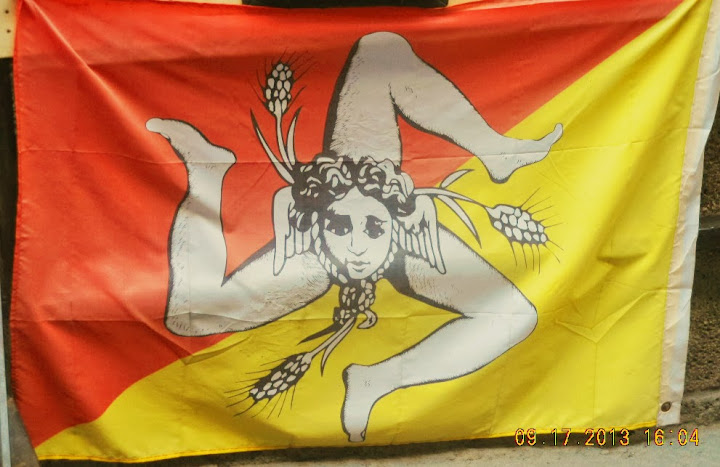
The Sicilian flag shows Medusa’s head, with ears of wheat alternating with the three legs that some say represent the three corners of Sicily. One source says that the Gorgons (Medusa was one of three) represented the destructive aspect of Athena. Perseus cut off her head and presented it to Athena who wore it on her shield. Thus the presence of Medusa on the Sicilian flag shows Athena’s protection of  the island.

The three legs show up in symbolism elsewhere in Europe and throughout the world, so  they may represent other qualities as well. In 1082, the Normans who invaded Sicily took the three legged-symbol back to the Isle of Man, which then used it (just the legs) for its own symbol. Another interpretation of the three legs is that they represent the Greek name for Sicily, trinakrias, Sicily adopted the flag in 1282; its red represents Palermo, and  the yellow stands for Corleone, the two major cities of the time on the island.

Wheat has been one of the glories of Sicily since its Greek days, and possibly before. A couple of years ago, a friend guest-blogged here about Gold from Sicily. Since that  time, I’ve had the good fortune to visit Sicily and see a bit of that history and present day myself. Although we went in September and missed seeing the wheat fields in their glory, we had ample chance to sample Sicilian cuisine. From pastas to pizzas, from elaborate cakes, to memorials of martyrs, to daily breads, we saw and tasted wheat in many forms. Here are a few.


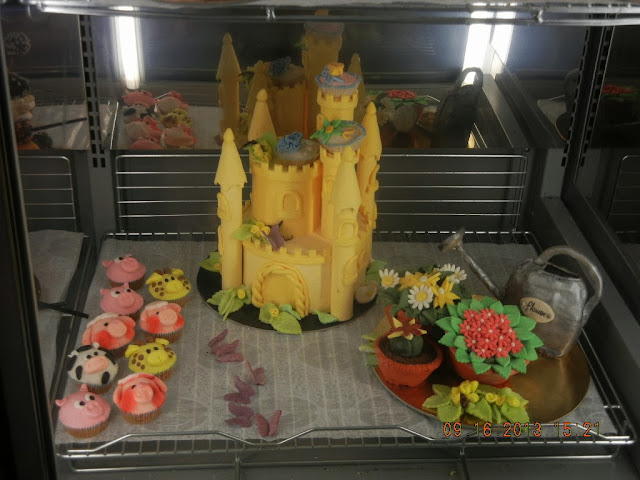
Pastry shop in Catania, with elaborate cakes.


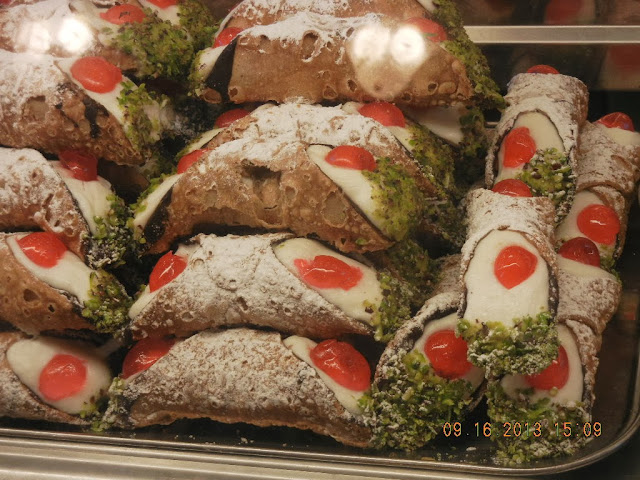
Cannoli, with pistachio and strawberry jam decor.


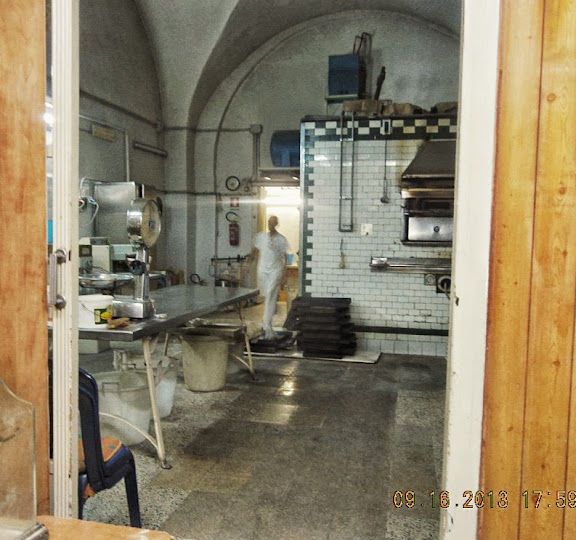
Baker in small shop near the waterfront, Catania.


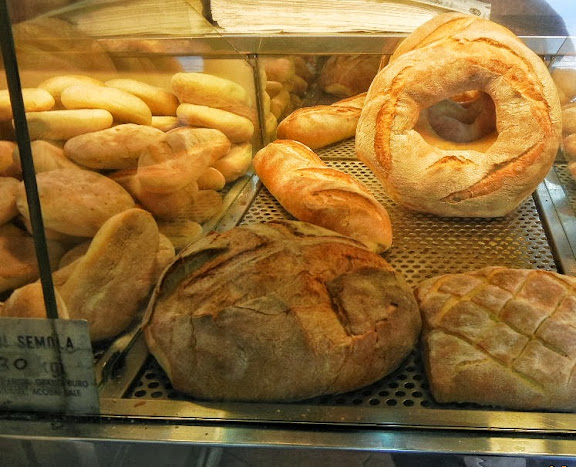
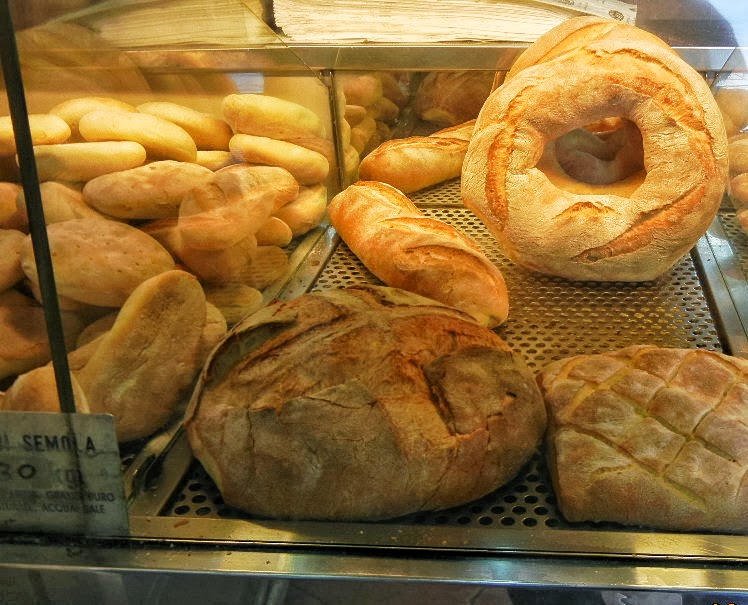
Breads for sale at the Catania market, September 18, 2013.


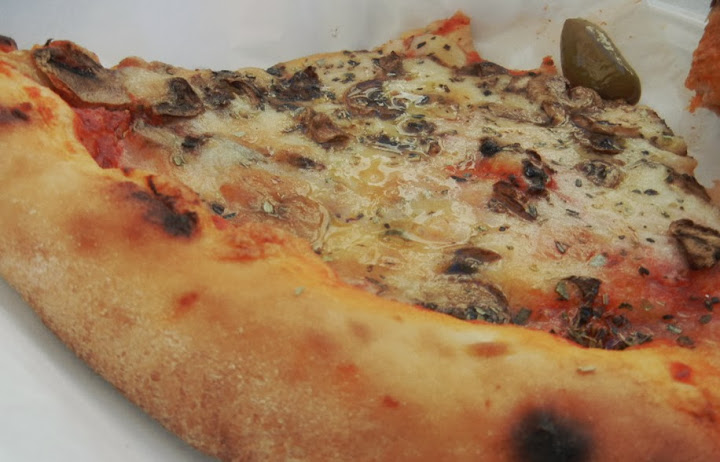
Pizza for lunch in Ortygia (Siracusa), from Cafe Professore, eaten outdoors on a square (September 18).


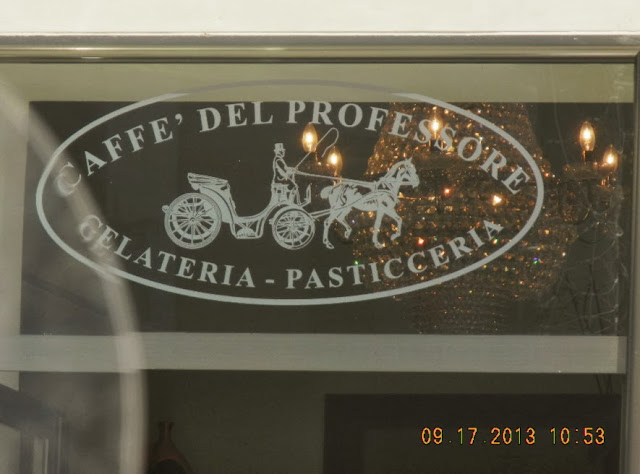
Cafe Professore — everything you could want in an Italian cafe on a hot day — a shady spot on the square, good pizza, cold drinks, gelato, and air conditioning inside for a brief respite from the sun’s heat.


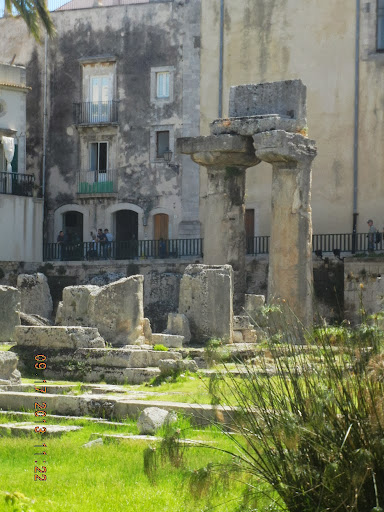
Ruins of the temple to Apollo, just down the street from the Cafe Professore.


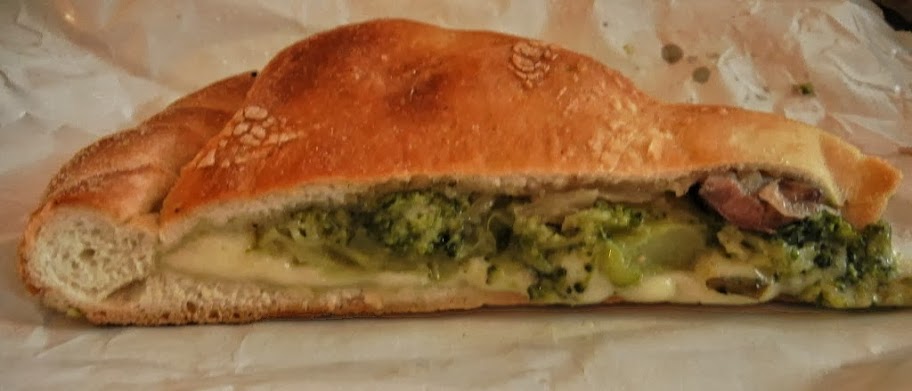
Sfinciuni, the Sicilian version of pizza (recipe and more detail here). Alice at the Hotel Trieste sent us to a bakery nearby to get this. This one is stuffed with broccoli, and a bit of onion and mushroom.


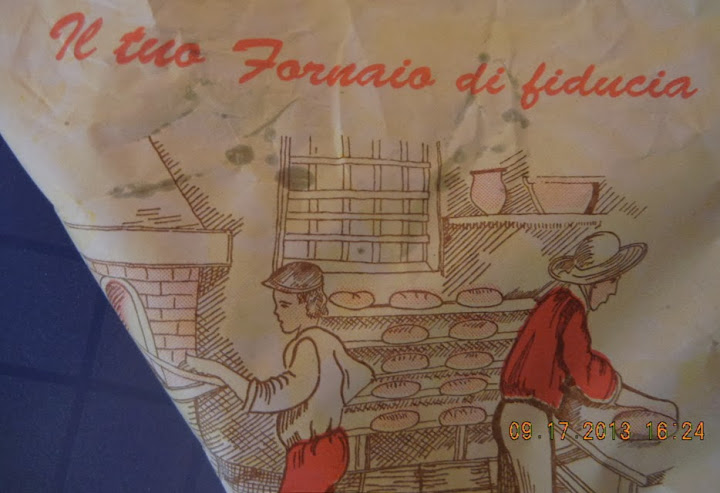
The wrapping paper for the sfinciuni.


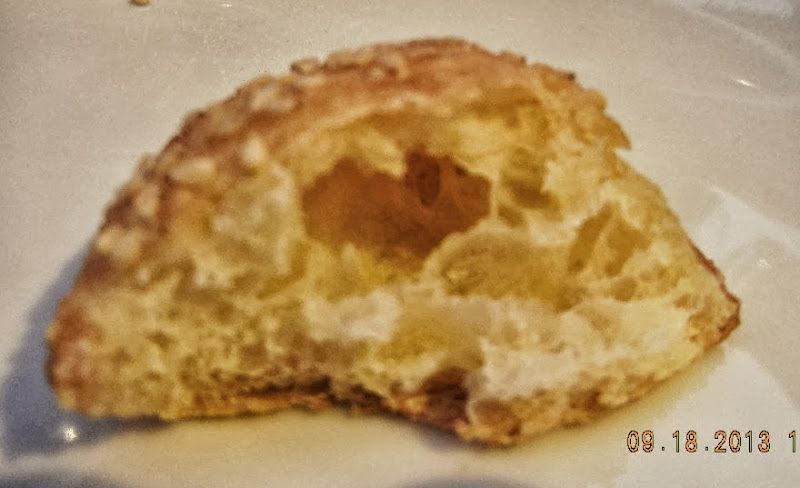
Bread for dinner in Catania, September 18.


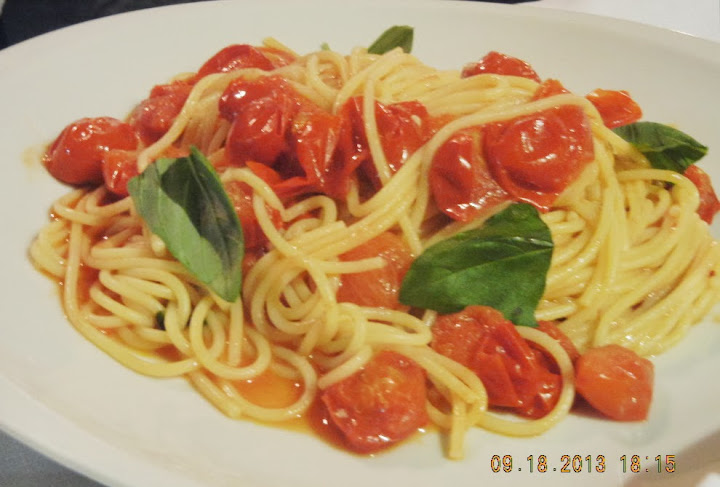
Spaghetti with cherry tomatoes and basil, Catania, September 18.


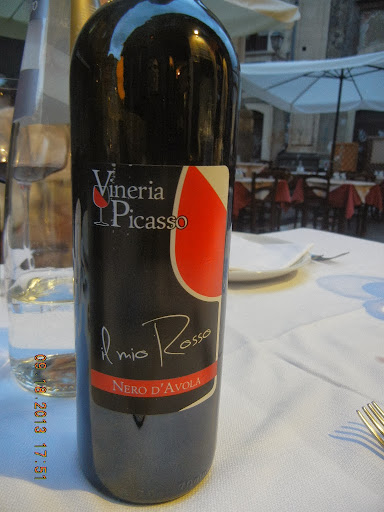
The house wine, at Vineria i Picasso.

Posted in 2013, Sicily, travel | Tagged , , , , , , , | Leave a comment

California sunshine, October 2013

Anchorage, a brief patch of blue sky on October 14.
We left rainy windy Anchorage on October 15. At 8:00 p.m., the power blew out at our house, so we headed for the warm, well-lit airport many hours before our 2:30 a.m. flight to San Francisco. When we arrived in the Bay area (via Portland) at 9:30 a.m., we stepped out into sunshine, fresh breezes, palm trees, and the golden-brown hills of California autumn. Anthea met us at the S.F. airport; we rented our car; and set out for Menlo Park, home of Jim’s generous cousin.
The rest of that day, fighting hard against enormous sleepiness, we spent stocking up on road-trip supplies at Trader Joe’s, exploring Menlo Park and Palo Alto, and getting take-out Greek food  from Evvia in Palo Alto for a late dinner at the cousins’ home.
Palo Alto palm tree in the afternoon sun.
Morning glories, Menlo Park.
Menlo Park mailbox.
Thursday was our day to see the city.  Our strategy for getting there from Menlo Park was a little complicated (no fun, otherwise, right?). Anthea took the train in, and walked up Market Street to meet a college friend for lunch. Jim and I drove to Vallejo where we had rented a hotel for the night to be closer to our weekend destination in Reno, parked the car, took the ferry to the city and met Anthea after lunch.
Great idea all the way around, but driving in the Bay area is still driving in the Bay area. Luckily we went up the east side of the Bay, and were going north. But even at that, the best of all circumstances for morning driving, it was half an hour more than Google maps optimistically promised. We arrived at the ferry terminal at 9:58, for a 10:00 ferry. The ticket seller, watching us running up to the window, panting and frazzled said, “Don’t worry, I called them and told them to hold the ferry for you.” And they did.

The ferries to and from Vallejo are fast, clean, comfortable, and scenic. The sea air is exhilarating and we saw a hawk, a seal, and our fair share of gulls. Hard to find a pleasanter way to spend an hour being transported, especially after two hours on the freeways.
Vallejo in the distance. The sky was cloudless, with a brown haze smothering the horizon. The air is better than it was thirty or forty years ago, but it’s not as clean as Anchorage.
At the Ferry Terminal Market Building, pigeons waiting for someone to bring them lunch.
The Navy ship, Carl Brashear, coming into the harbor under the Bay Bridge. It carries cargo; was named after the first African-American to become a Master Diver. The Bay and the docks are known for their tourist appeal, but are working docks — besides the Navy ship, we saw container ships, ferries, tour boats and sailboats.
The cormorants stake claim to their part of the bay.
People along the Embarcadero. The day was too nice to spend much of it inside, so we walked along the waterfront for a couple of hours. Here were a few of the people and sights:
Denizens of the Alcatraz Landing Cafe.
Protection from the hot sun (something you didn’t see much of in Anchorage during the past couple of months) — hats, umbrellas. Note the heavy coats tied around the waists. We saw plenty of people wearing coats, down vests, hats, scarves, boots — looking like Anchorage-ites in November. It was at least 75 degrees, and although it was cooler in the shade with a breeze, these warmly-dressed people were in the full baking sun.
Sunning themselves, along the Embarcadero —  not over-dressed for the afternoon.
A young busker, tap-dancing, trumpet-playing, and singing.
Waiting for the actors to show up? The cameraman is ignoring the characters seated  behind him on the monument near the Ferry Market Building.
Anthea and Jim along the Embarcadero. Jim’s shirt was combining with the camera to create a nice interference pattern. 
A rush-hour demonstration for better immigration policies, turning off Embarcadero to go down Market Street.
From the Ferry Market — dahlias.
Tomatillos and hot peppers.
Broccoli, leeks, artichokes, and white and green asparagus.
Leaving San Francisco at sunset.
Sunset over Marin County from the ferry.
Moonrise.

Posted in 2013, travel, Uncategorized | Tagged , , , , , | Leave a comment

Hotel Trieste, Catania, Sicily

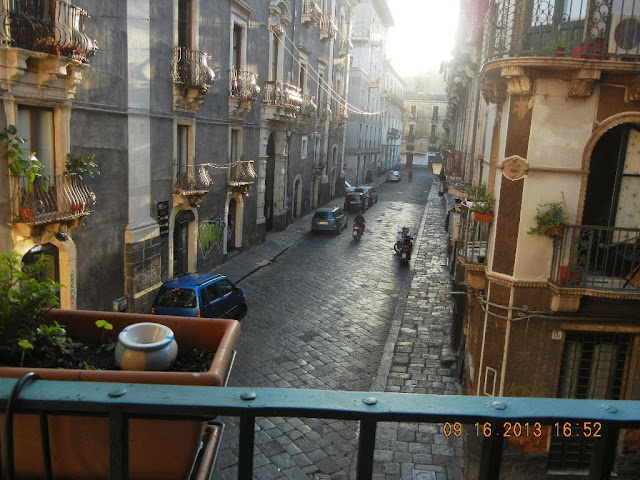
View from our balcony at the Hotel Trieste, looking west, about 5:00 p.m., Catania, Sicily.I had never heard of Catania before deciding to visit Sicily with my husband, daughter, sister and her husband. We flew from Rome, mid-September, to this city of 400,000 people (center of an area of 800,000). Our home-town Anchorage, has about 325,000, and the whole state of Alaska has just over 700,000. And yet, we’d never heard of Catania, although the people there had certainly heard of Alaska.

Another difference — Catania’s been there since about 900 B.C.E., making it close to 3,000 years old. Although people are likely to have been living in the Anchorage area for that long, the first permanent settlement was in 1915, not even 100 years ago.


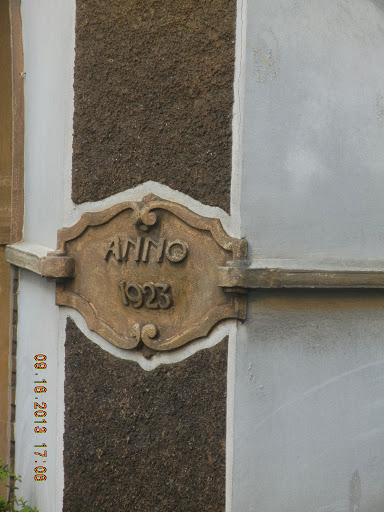
Plaque on a building across the street from the Hotel Trieste. This suggests that the Trieste is probably of a similar age, and the whole street has existed much longer than most of the buildings in Anchorage.


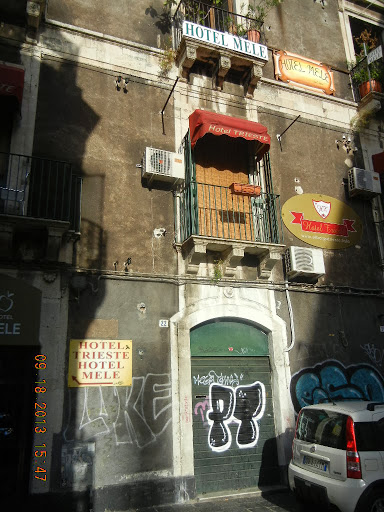
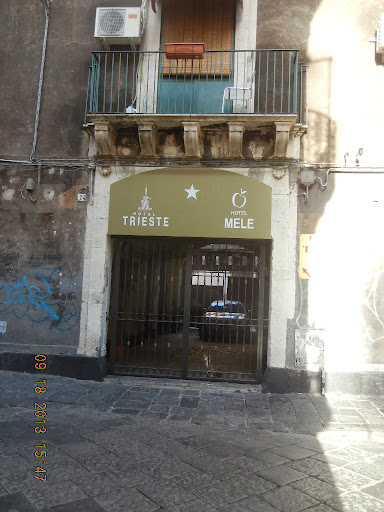
View of the hotel from the street. Note the graffiti, ubiquitous in Catania, as it was in Greece and much of northern Spain. One awning says “Hotel Trieste,” and the one above it says “Hotel Mele.” The sign at street level has both names. That garage door will be rolled up at night, and tables and chairs for a bar will come out onto the street.


A view of the gates for the Trieste and the Mele. Every place we stayed in Italy had a set of iron gates at the entrance to the property, then a locked entrance to the hotel or apartment building, and then a locked door for the hotel room. It felt secure, but a  little odd. Immediately inside the gates is an ope, cobblestoned area used to park a couple of cars.


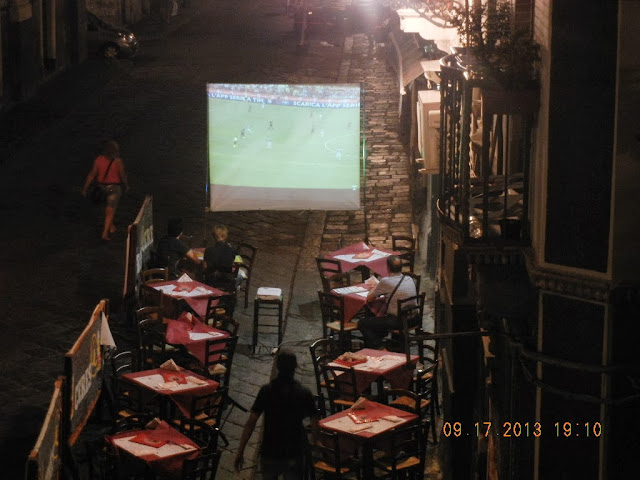
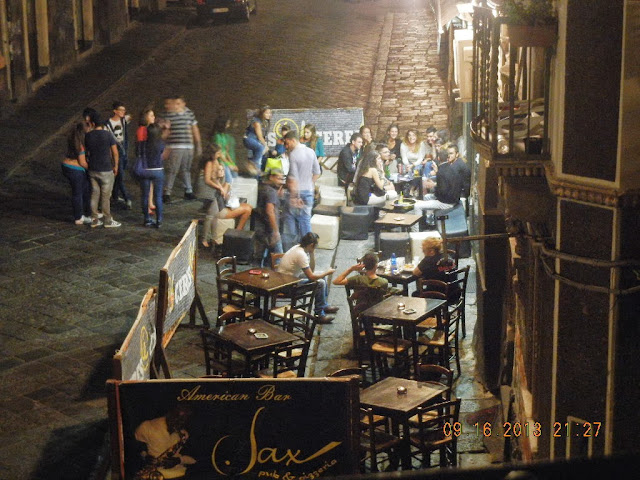
The quiet street comes alive at dusk, with “American bars” up and down its length. By day, when you walk down the street, you see some shop windows, doors to houses, and roll-down metal garage doors, graffitied or plain. At night the doors roll up, the bar owners carry out tables, chairs, movie screens/monster TVs, and sofas. Italian bars are usually open all day, selling coffee, liquor, beer, and food. American bars exist for the sole purpose of drinking, watching sports (or maybe Simpsons, while waiting for soccer), and socializing; they never open until dusk.


The street in front of Hotel Trieste at 10:30 p.m. [This was a night with no soccer game, so no TV out front.]

The “hotel,” like a number of places we’ve stayed in Spain and Italy, is just seven rooms on one floor of a building. At least one other hotel, the Mele, shares the building, as do a number of apartments. The owners, Alice Bianchi and Guiseppe Koenraadt, would like to expand soon. They found us a guide for Mt. Aetna, recommended bakeries, served us a local liqueur on our last evening, and took care of us in every way. One could not ask for more gracious hosts, better English, or more knowledgeable guides.

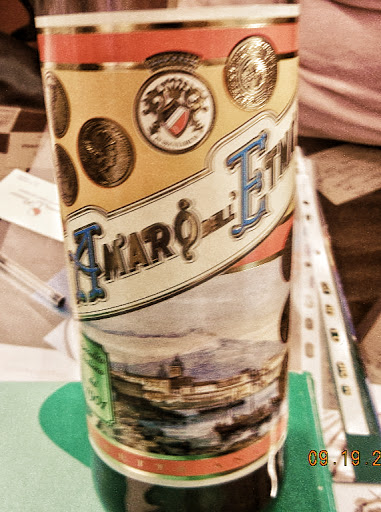
The local liqueur, Amaro dell’ Etna [http://en.wikipedia.org/wiki/Amaro_(liqueur)], that Guiseppe and Alice served us on our last evening at the Trieste. Wikipedia describes amaros (amaro is Italian for “bitter”) as liqueurs made with herbs, bark, roots, flowers, and other ingredients. We can tell you that it was sweet, powerful, and delicious.

Hotel Trieste owners, Alice Bianchi, Guiseppe Koenraadt, and the twins (nearly 4).

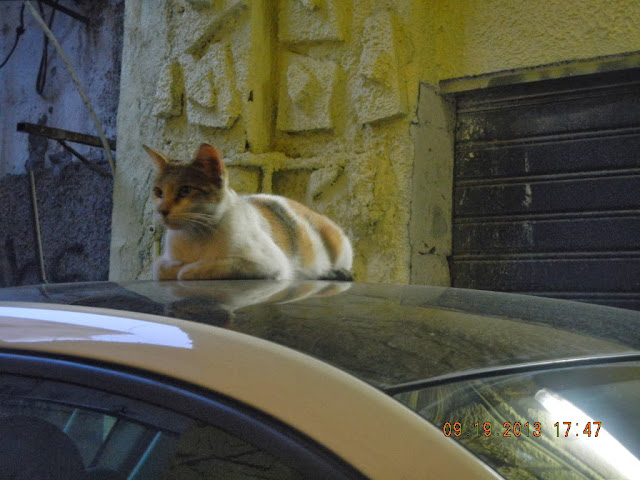
On the ground floor of the hotel, inside the tall iron gate, is a paved area or parking. This is one of the cats that made their home there, under or atop the cars.

Posted in Sicily, travel | Tagged , , , , , | Leave a comment

Sicilian impressions — Catania Market


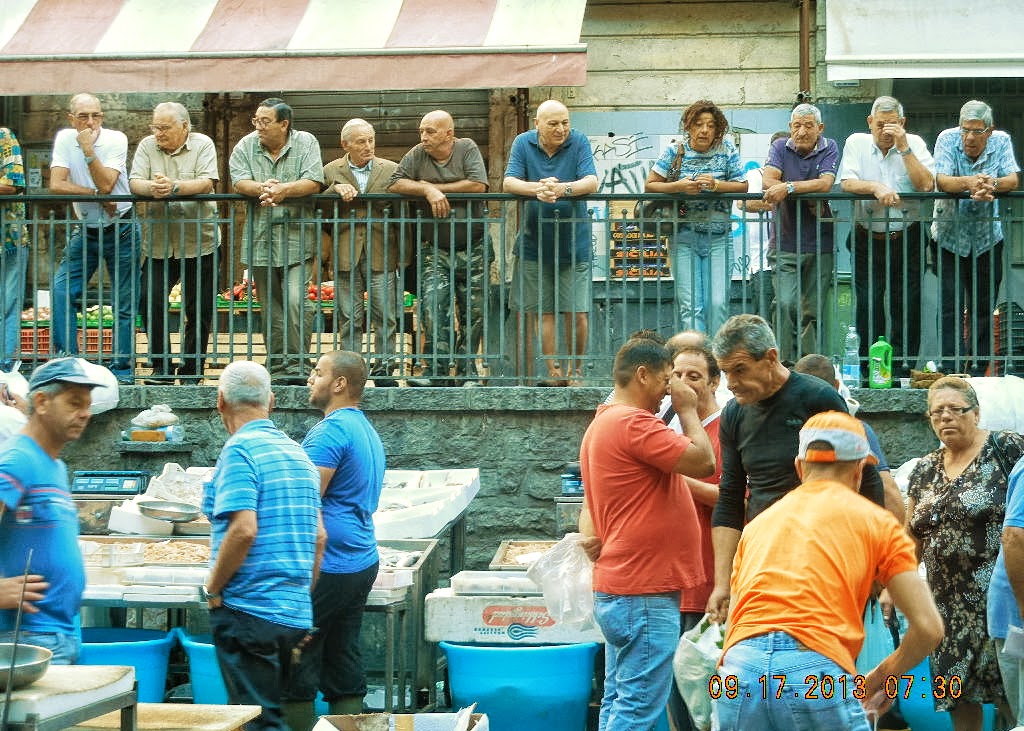
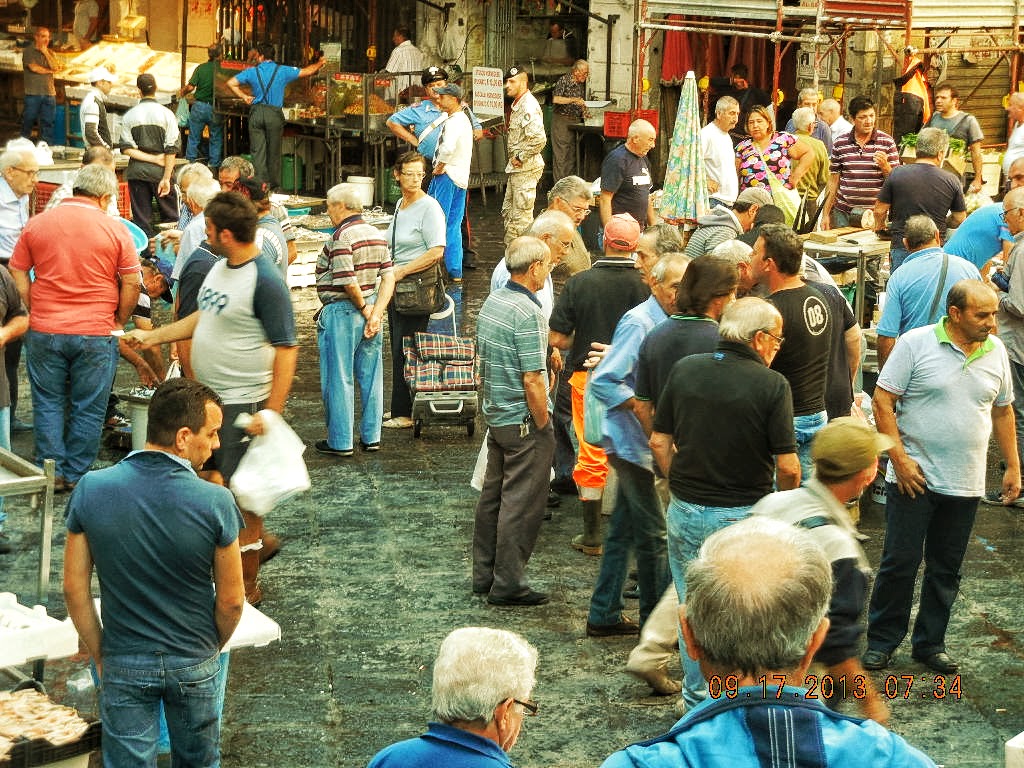
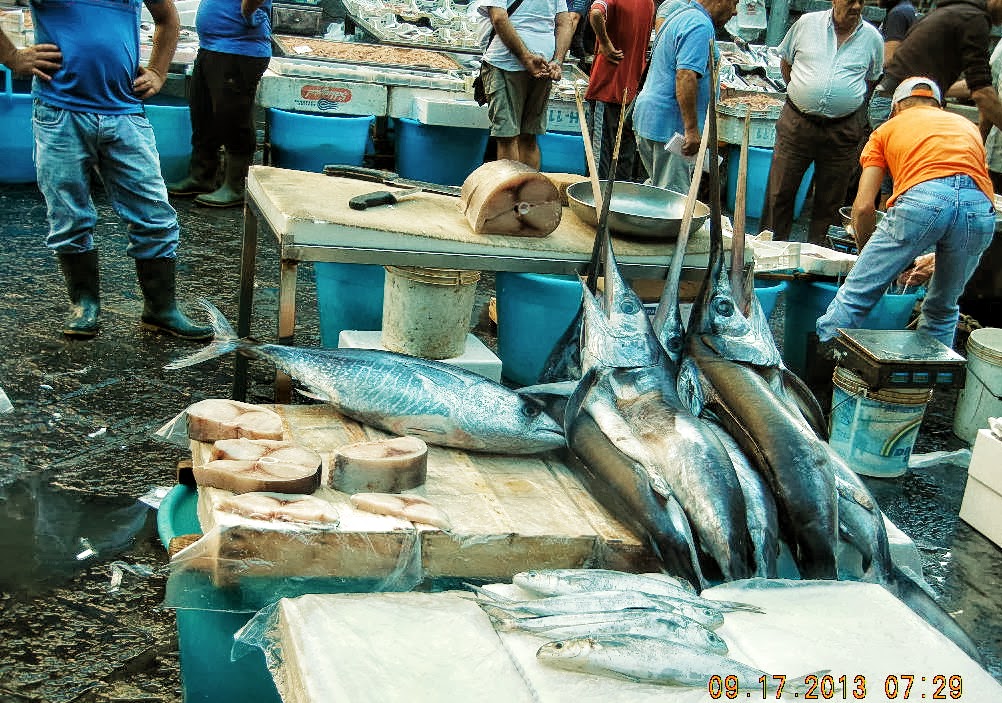
The morning crowd at the Catania Fish Market. The group in the lower right is buying herring (or mackerel?) from a fisherman who has just brought them in from his boat. He’s pulling out handfuls, weighing them, and taking money from the buyers. Luckily for the people of the city, the market is on two levels, allowing easy viewing of the action in the center.

Catania, in Southeast Sicily has survived earthquakes, frequent eruptions of Mt. Aetna, and the rule of Greeks, French, Spanish, Romans, and more. It’s a city that’s rough around the edges and alive with fishermen, tourists, and all the wealth of the fields, vineyards and olive groves that surround it. The fish and produce market is particularly noted for its vigor.

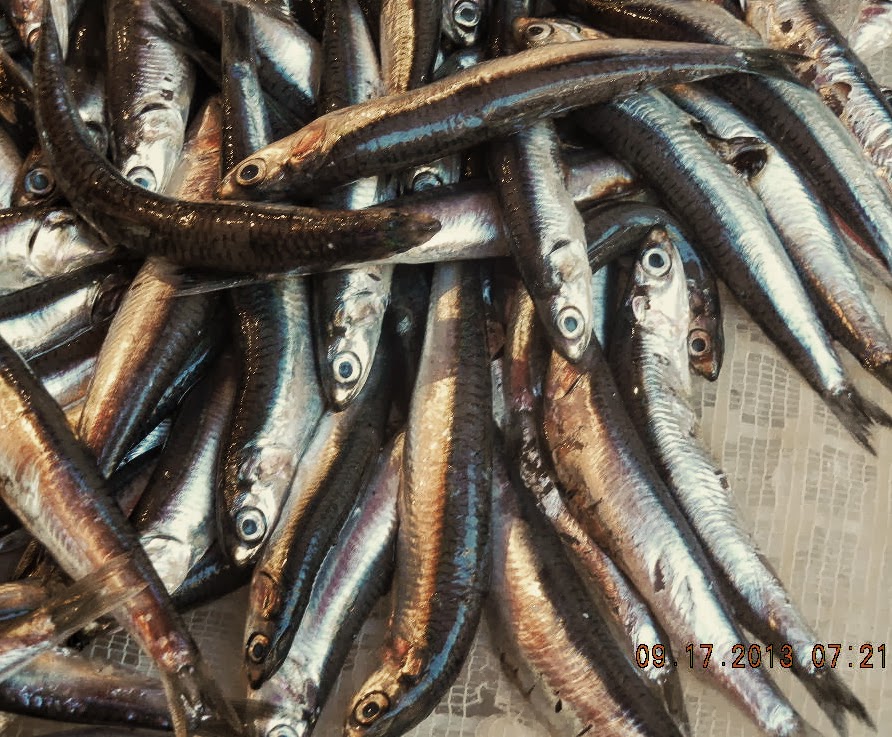
    Mackerel for sale.

   Seaweed with lime.

  Swordfish, whole and sliced into steaks.

People at the markets all over Italy seem to specialize. This man is carrying lemons and limes, and has a basket of parsley strapped to his front — garnishes for the seafood that others are selling.

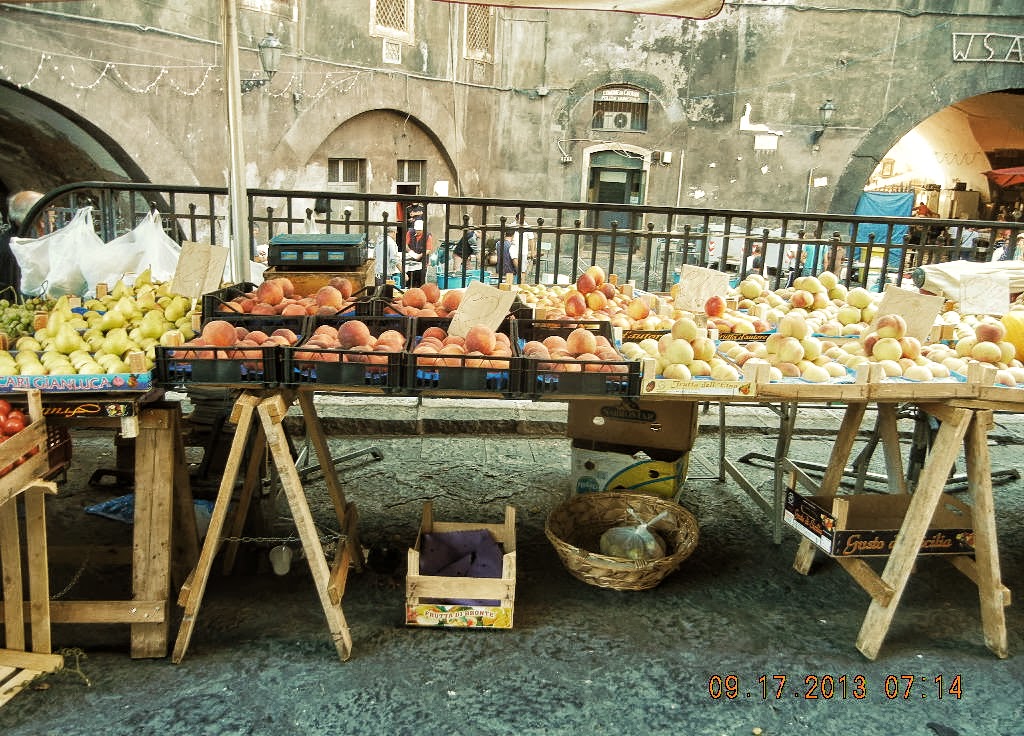
The market sold fish of almost every description (not so many octopi and squid as we would see in Siracusa), poultry, meats (including rabbits and horse meat), and fruits and vegetables.

 Prickly pear cactus fruits, which grow around the area.

    Local olives.

 
 An array of fruits and vegetables.

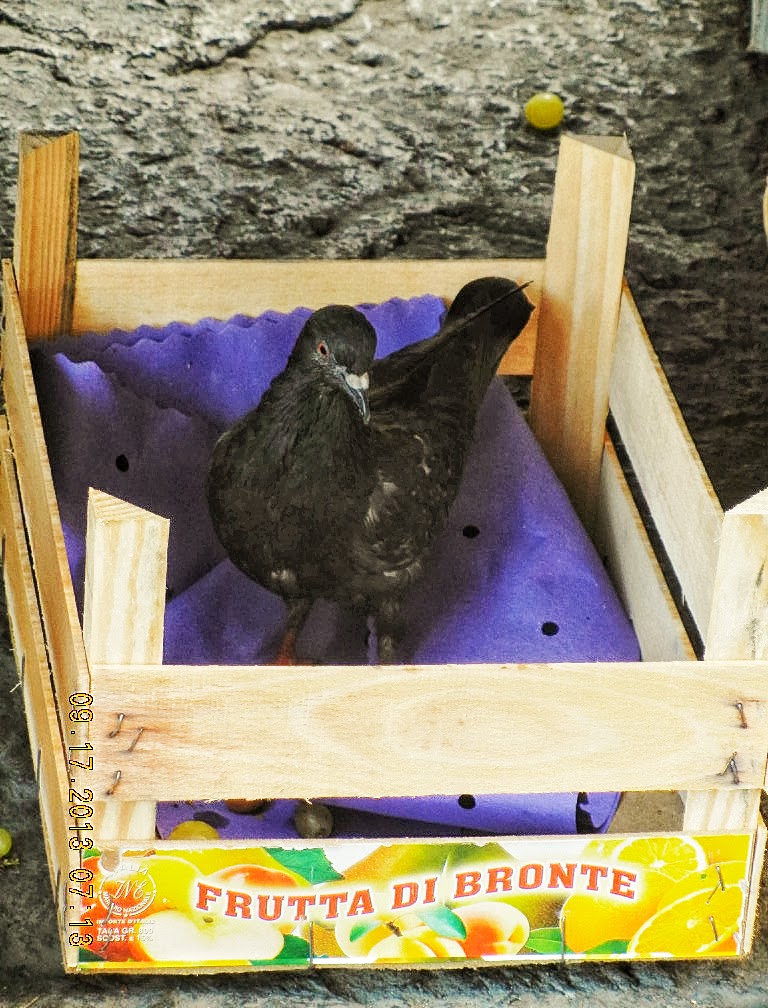
Not all of the animals were for sale. This pigeon hopped into the box beneath the table in the photo above.

A few stalls sold breads, but perhaps there were so many bakeries that were easy to get to that people didn’t expect as many choices at the market.

   Leaving the market, on our way to Siracusa for the day.

Posted in Uncategorized | Tagged , , , , | 1 Comment

Roman Holiday, September 14, 2013

If you were a Roman in the old days, you would not go to Ostia on a holiday. These days, you might, just to look at what was left of a bustling Roman community. We went to Ostia (means “mouth,” and is located where the Tiber empties into the Mediterranean Sea. In its heyday it was a salt-producing town, and the port of Rome, with 60,000 people. After the fall of Rome, the city lost its importance, and besides that, the Tiber changed course and silt covered over the city. That saved it from the next thousand years of scavenging for brick and stone to use in new churches and government buildings, and preserved the mosaics, the mills, and the monuments.
Ostia is out in the country, with horses grazing alongside the ruins, butterflies, and herbs everywhere underfoot. Overhead, those magnificent pines, the ones that inspired Resphigi’s music, shade the cobbled roads through the old city. Underfoot, their brown needles scent the air with every step, and make your feet slip against the stones. We saw green lizards, each one with enough iridescent bling to sate the glitiziest of tastes. Butterflies and tiny grasshoppers flitted just over the low-growing mint, and in a field next to a white horse, an egret stood watching for lunch. It was peaceful and quiet, the sort of silence that the guys in the Sistine Chapel and St. Peter’s were trying in vain to enforce.
For the afternoon event, we visited the Capuchin Ossuary, hard to describe adequately. It consists of several rooms under a church run by the Capuchin monks (from whence, cappucino, as in the delicious coffee drink). The rooms are dioramas created with the bones of thousands of monks (the bodies dated from about 1530 to 1870). One is called the pelvis room, another the shoulder blade room, and another the skull room. Wikipedia says that there are other ossuaries in Europe where the bones of the dead are displayed as reminders to the living that this is their fate. This, however, is considered the most artistic.
In the evening we dined well at Il Foccacia near the Piazza Navona. The house wine was chianti; the special of the evening was an entree of grilled porcini mushrooms (Regina had that); and they had all sorts of veggies in the various offerings. Afterward we wandered around the Piazza taking photos of fountains, fortune tellers (they don’t like that), vendors, and the half moon in a clear sky.
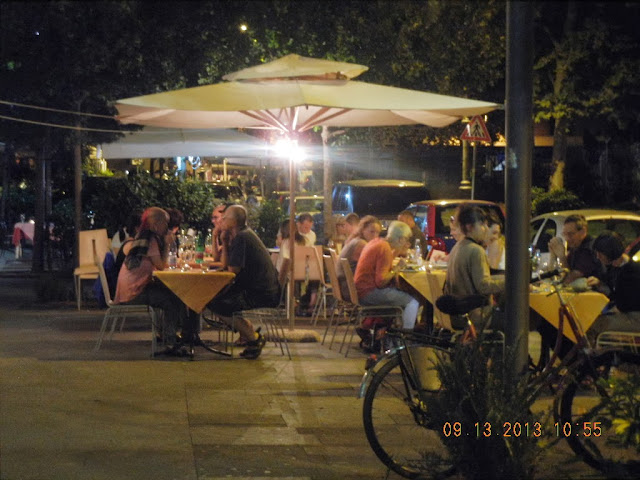
For gelato, we headed back to our neighborhood favorite, getting there about 10:30 — it was packed. Usually it’s quiet, so we must be getting there earlier than most people. And it was Saturday night, in the mid-70s. The streets, even at 10:30, were filled with everyone — old people, lots of families with toddlers and babies and kids, groups of young people, couples of all ages, clusters of men; clusters of women, vendors. Every cafe had its tables along the streets and sidewalks, and all of them seemed busy. Hard to believe how many there are, crowded with Romans, as well as tourists.
The finale for the evening came as we were walking back to the apartment. Several cops on motorcycles came roaring down the street, blue lights flashing. They were followed by more regular people on motorcycles, and then more and more and more — we estimated between 100 and 150 in all, with a few more cops bringing up the rear.
Random observation: Roman drivers don’t use turn signals. Why would you, when you have no more idea than the driver behind you what you are likely to do next? A turn signal implies more than split-second thought given to your next move, something that rarely occurs as far as we can tell.
Ruins at Ostia.
Regina examining ruins at Ostia.
A mosaic floor, open to the skies now.
Part of the cemetery at Ostia, outside the city walls, as required by Roman tradition. The niches were for urns with ashes.
The Roman pines.
One of the rooms in the crypt of the church of  Our Lady of the Conception of the Capuchins, All of the decorations are human bones from the monks over the past few centuries, except their habits. No photos allowed; so got one from the web.  http://en.wikipedia.org/wiki/File:Capuchinos_2.jpg.
File:Capuchinos 2.jpg
Teri, Anthea, and Regina at Trevi Fountain, along with hundreds of others.
Anthea, Regina, and Jim at one of the fountains in Piazza Navona.
The Ponte Sisto at 10:00 p.m.


Posted in Uncategorized | Tagged , , , , , , | Leave a comment

Rome, the Eternal City, September 13, 2013

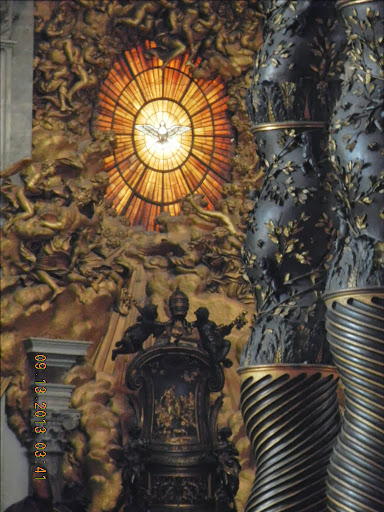
Bernini’s altarpiece, and his “Dove” alabaster window in St. Peter’s Basilica, Rome.
Guess the eternal city is a good description for the day, because we spent a sizable chunk of it seeing the Vatican Museums and St. Peter’s Basilica. The guidebooks say to allow three hours for this, but I’m here to tell you that it doesn’t even come close. Three days, maybe, but you would undoubtedly get overloaded on the surfeit of art and history far more quickly. Eternity would be sufficient, but by that time, there would be more beautiful things to collect into these museums.
We saw much of it — the ancient Egyptians, and the Roman versions of their mammoth statues; the ancient Greeks and the Roman versions of their exquisite work (the Romans were great copiers, and thus preserved many Greek statues that would have been lost forever); the Roman versions of Roman gods and goddesses and heroes and nobles; and the Christian versions of the ancient Romans’ gods and goddesses, and stories, which they took to be important accounts of Christianity’s roots. [For the record, it wasn’t until the 1600s or so that the Church decided that it was inappropriate to use all of the Greek and Roman stories. Before that, they used the stories as symbols, or allegories, or history, and regularly decorated altars, churches, and tombs with the motifs and characters.]
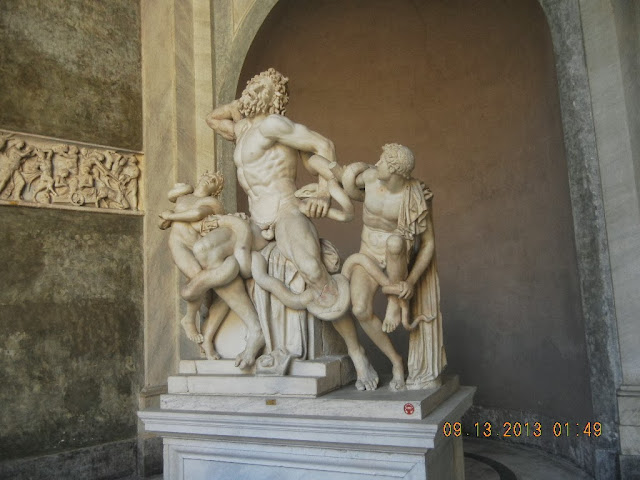
We saw lots of things that we had studied in art history classes — the writhing Laocoon (which had been written about by the ancient Romans; when it was re-discovered in 1506, the then-Pope identified it as so important that he called in Michelangelo to help restore it, and used it for the start of the Vatican Museums). The Apollo Belvedere was around the corner from Laocoon. A copy of a Greek statue by a Roman artist, it was re-discovered just a few years before the Laocoon, and soon made its way to the Vatican. Michelangelo’s Pieta is in the Basilica itself, and we passed through the Sistine Chapel on the way to the church.
But of the three hours, at least an hour was spent being swept along in slow crowds, unable to escape the clusters of guides and their listeners all linked together by little transmitters set in their ears. In the Tapestries rooms, I began to wonder about fires. Earthquakes. Anything like that. The crowds were not exactly orderly as it was. They were only innocuous because they were attending to the lectures. But give them something to focus on about their immediate welfare, and it would not have been a pretty sight. Paranoid? Yes. I was pleased to be in more open spaces.
We ate a quick lunch at a decidedly touristy, but friendly place near the Vatican, and set out for the subway station to go to the train station to meet Peg and Tom Lazio (one of my sisters and her husband; they also were on the Camino with us for part of the time). When we finally connected with them, about 5:30 p.m. it was at the corner of Via Veneto and Via Lazio; in another half hour, their son and his wife showed up as well, and we all ate an excellent dinner at Antica Enoteca near the Spanish Steps. The son and his wife head back to the U.S. tomorrow, and Peg and Tom will go with us to Sicily next Monday.
Tomorrow we go to Ostia, and tonight, having gotten home late, I will add a few photos, and send this off.
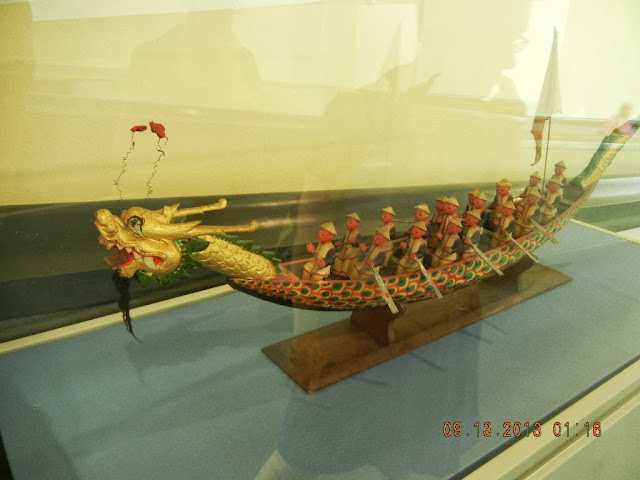
These days, the Vatican Museum has collections of art from all over the world. This is a model of a Chinese dragon racing boat, part of a series of boats from everywhere set along a ramp winding up into the main floors of the museums. We liked the little red things sticking up above the eyes; Regina thinks they are mustaches, and I wonder if they couldn’t be eyebrows.
Laocoon (a Trojan priest) and his two sons being strangled by giant snakes sent by Poseidon (in some versions) because Laocoon recognized that the Trojan horse was a ruse, and tried to demonstrate that by striking the horse with his spear. Poseidon (pr Apollo, or Athena in some accounts) who sent the snakes was on the Greek side, and thus wanted to preserve the trick being played on the Trojans.
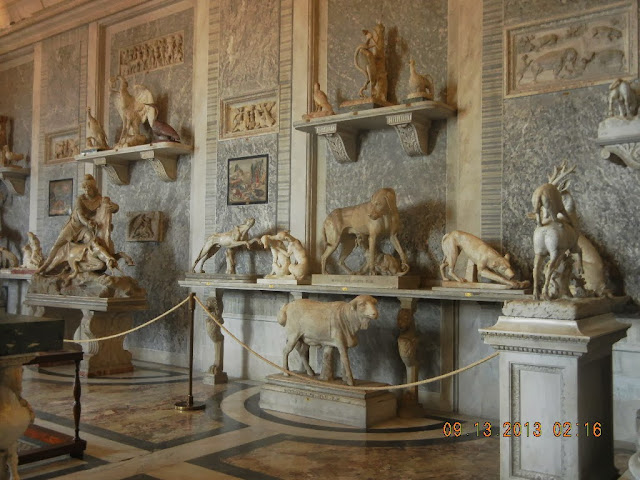
A room full of animal sculptures from different eras, one of two rooms like this.
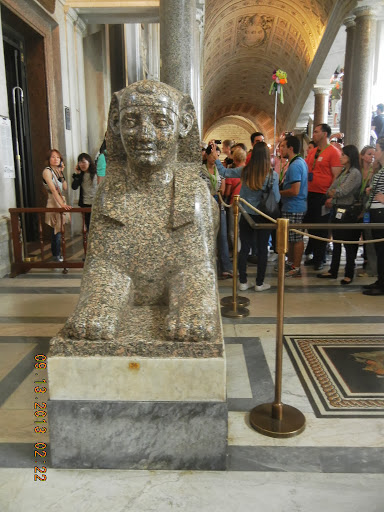
A Roman granite version of an Egyptian sphinx, with a typical crowd in the background. Note the guide’s tall pole with something colorful on the top so that his group can follow him.
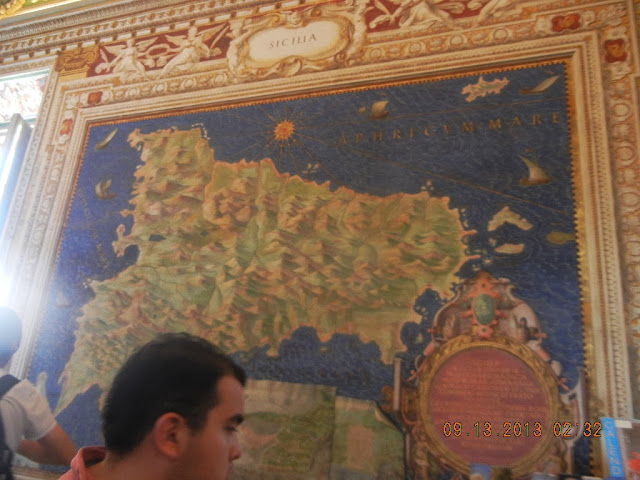
Huge map of Sicily, tapestry? — one of dozens in an endless series of rooms lined on either side with similar maps.
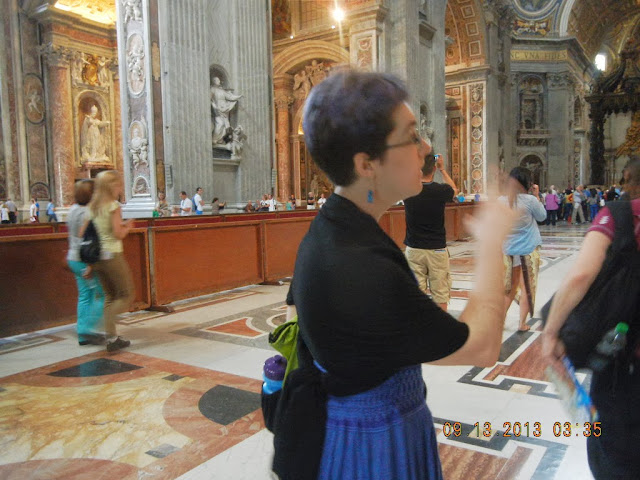
Anthea photographing in St. Peter’s Basilica. No flash was allowed, but we could take photos everywhere except the Sistine Chapel. And that was so amazing, that it would have been impossible to know where to start.
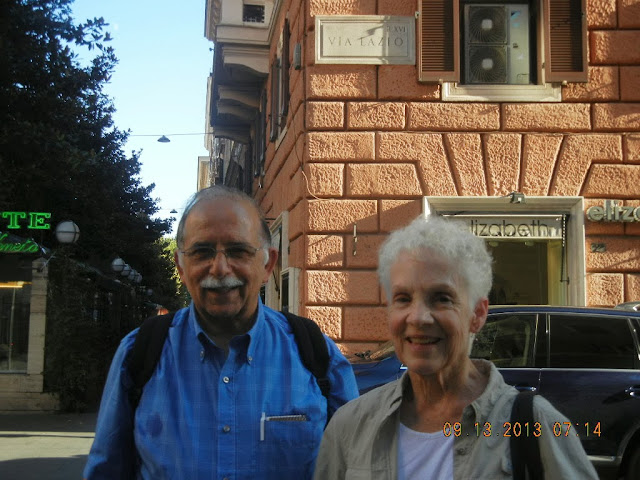
Peg and Tom Lazio, with Via Lazio sign on the building behind them.
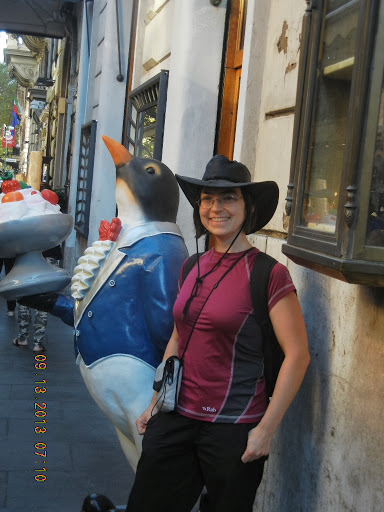
Regina with penguin outside a gelato shop on the Via Veneto.
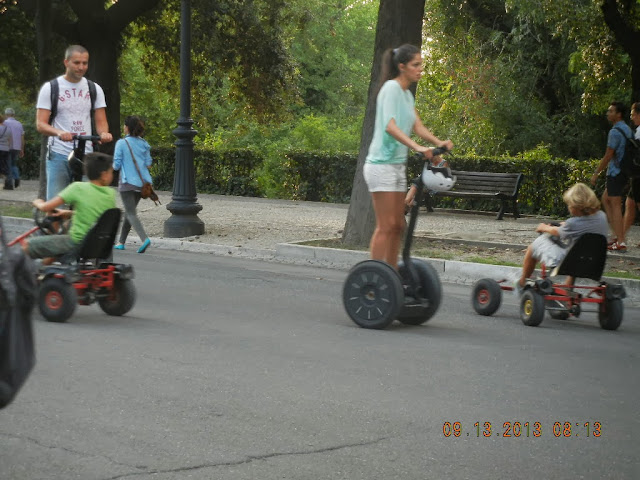
Segways and go-carts in the Borghese Gardens, early evening.
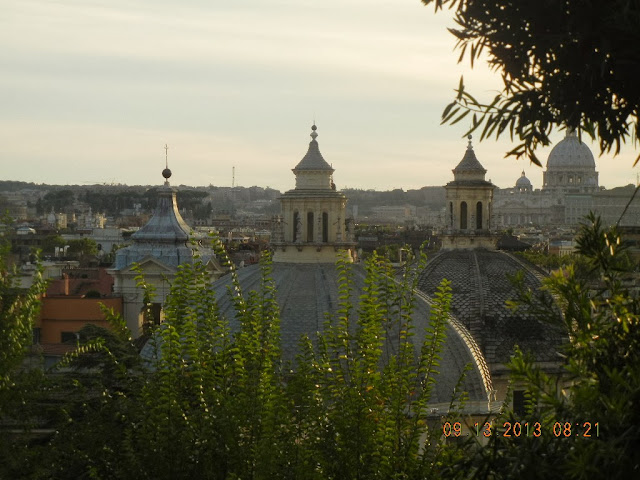
A view of Rome near sunset from the Borghese Gardens.
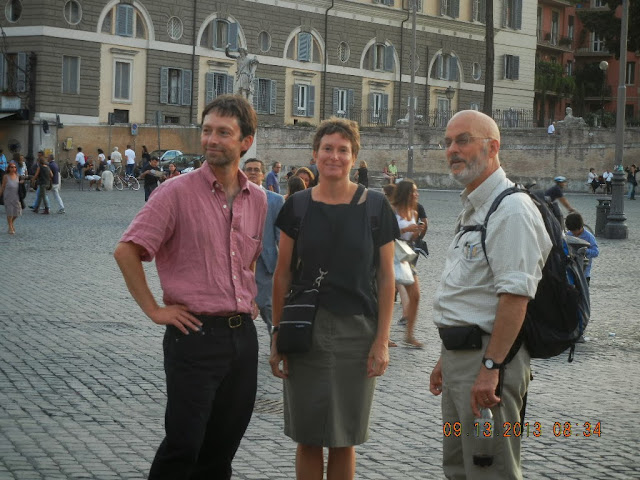
Joe Lazio, his wife Jen, and Jim Carns in the Piazza del Populo below the Borghese Gardens. Joe said that this was along the pilgrims’ way into Rome in medieval and Renaissance days.
An Italian evening scene, in neighborhoods all over Rome. This tells you that the weather is very pleasant.
Posted in Uncategorized | Tagged , , , , , , , , , | Leave a comment

Veni, Vidi, Vici, Rome, September 21, 2013

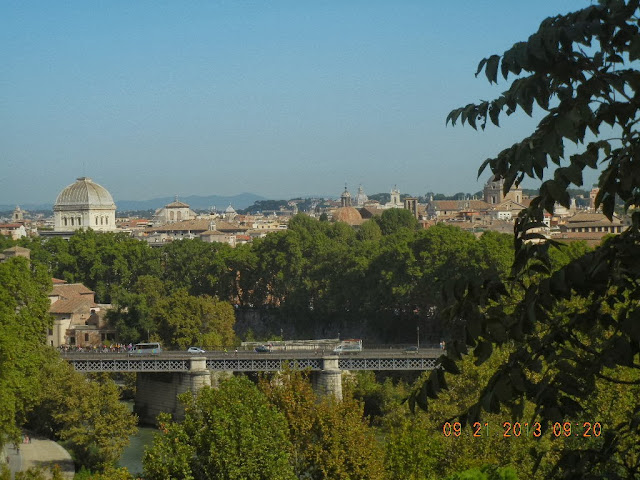
View from the Aventine Hill, with St. Peter’s dome, and the Tiber in the foreground.

Or, as Regina says, “We came, we saw, we ate gelato.”
Our last day in Rome was sunny, hot, and involved some thirteen miles of walking according to my pedometer. Unfortunately, we only ate gelato once, but that was because we did so many other things.
Regina and Anthea have been the world’s best traveling companions, with ideas for things to do and the courteous persistence to make them happen. Regina thought we ought to take a walking tour, and  found one that was “free” (tips only), and would last from about 10:00 to 1:00. It was 2:30 before we bid Alessandro farewell and set out for what he said was recommended as the “world’s best coffee.”
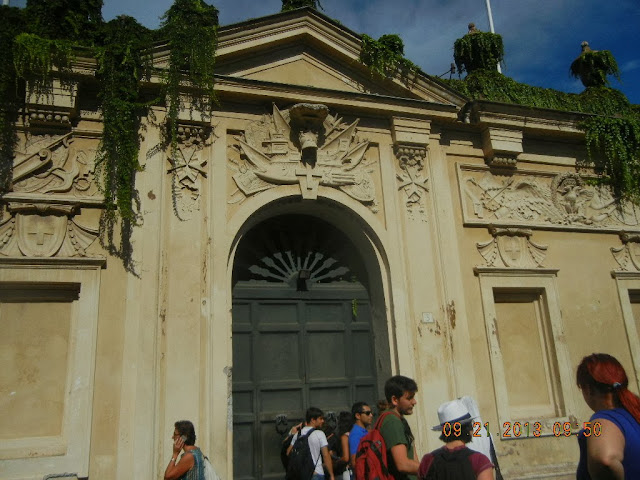
In the intervening hours, he showed us everything from four or five churches, to the Knights of Malta’s little bit of sovereign country (with a peephole in the gate through which one looks down a long corridor of trees to a perfectly-framed view of St. Peter’s dome), to the bitter orange trees planted in a courtyard (bitter, so that people wouldn’t steal them). He was full of information and stories about the streets, houses, piazzas, and monuments.
One crucial bit of information that would have done us good at the beginning were the three rules for crossing streets taught to every Roman child from the earliest age. Never run (the motorist, motorcyclist, bicyclist is mentally calculating where you are and where you will be if you walk at a steady pace; if you hang back or run or do something unexpected, the calculations will be off by the fraction of a second necessary for it to all work smoothly); walk at constant speed; and don’t show fear (don’t just stand on the sidewalk waiting because the motorist takes that as fear and goes ahead). You just step out (at a crosswalk) and start walking steadily. It’s extraordinarily unnerving, but has always worked so far.
Alessandro took us to a small restaurant that served tasting plates of their various foods for our lunch. Taste of Trastevere specializes in locally grown foods, and the owner brought us platters with zucchini flowers stuffed with cottage cheese (only the male flowers are used for this because the female flowers have the zucchinis attached); little bites of hard cheeses with a sweet chili jam, small pieces of bread topped with pesto and tomato, roasted peppers, pickled cabbage shreds, and more, all well drizzled with olive oil. The beers were locally brewed, and the wine as well. So delicious.
After we parted ways, we found the “best coffee” — it was tasty, about 70% crema and 30% coffee. Best ever? The jury is out. Next, gelato and granita to cool off from five hours of mostly walking. Then, time to head home, stopping at another couple of churches, and doing a little shopping along the way. We found a street with mostly Asian shops — a small grocery, several tailors, alternating with small clothing shops, and some Asian restaurants. There must be other ethnic conclaves in Rome, but we haven’t seen them.
I have resisted taking tours, but both the Etna tour and this walking tour turned out very well. Perhaps the key is to look for small groups and focused interests. Our little group had its own dynamic — two Slovenian young women on holiday (they were wearing out, and decided that the lunch place wouldn’t suit them, so left us at that point); a tall,very well-traveled Norwegian who spoke excellent English who left after lunch to meet friends; an Italian guy in his 40s who didn’t have any English, so only talked to Alessandro; a Portugese au pair; and a German girl who was an exchange student. Alessandro oriented some of his commentary to the au pair and the exchange student, “because they will be here longer.”  Other tour groups seemed to specialize in young clerics, or retired people, or specific interest groups, and were often much larger.
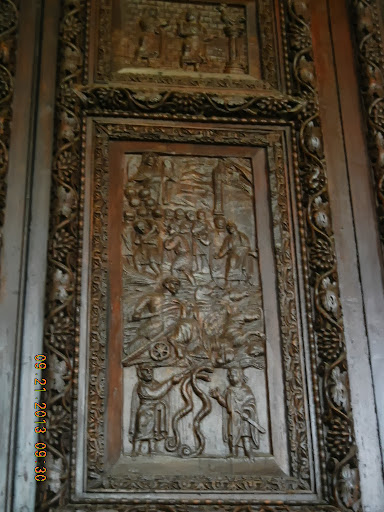
This panel from a huge 5th-century wooden door at St. Sabrina’s shows Moses and the Hebrews in Egypt, and crossing the Red Sea. When the door was restored in the 19th century, the sculptor replaced the villain pharoah’s face with Napoleon’s.
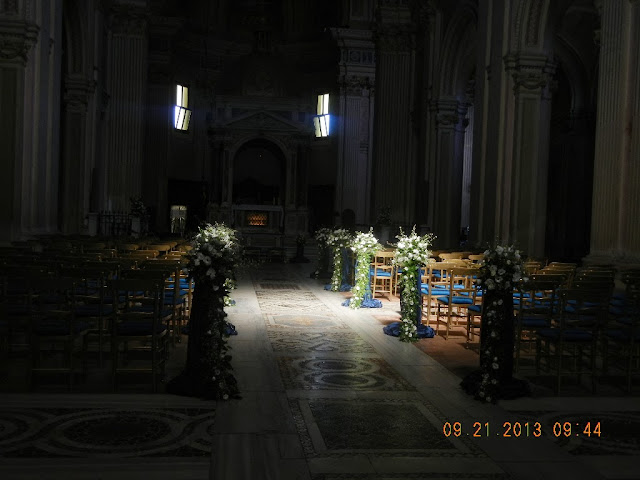
St. Alessio’s church decorated for a wedding.
The entrance to the Knights of Malta’s sovereign territory, with Alessandro and Regina at the right lower corner of the photo..
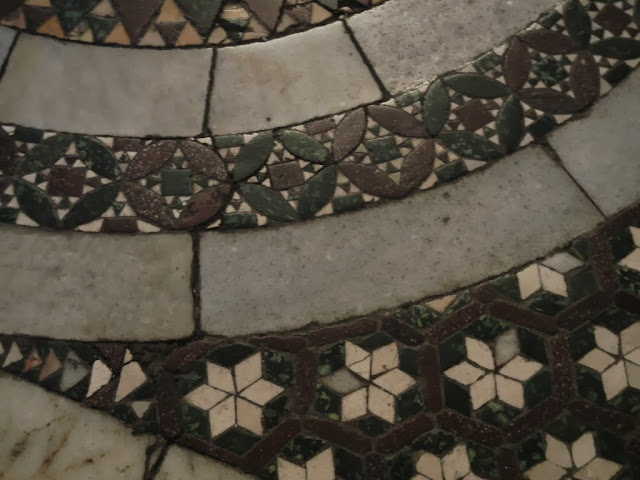
A special type of marble inlay, Cosmati, named after the medieval family in Rome who specialized in it for several generations. The mosaics often used pieces of marble salvaged from the ancient Roman ruins. This is in Santa Maria di Cosmedin, a very old church, but was widely used in all sorts of buildings for a couple of centuries.
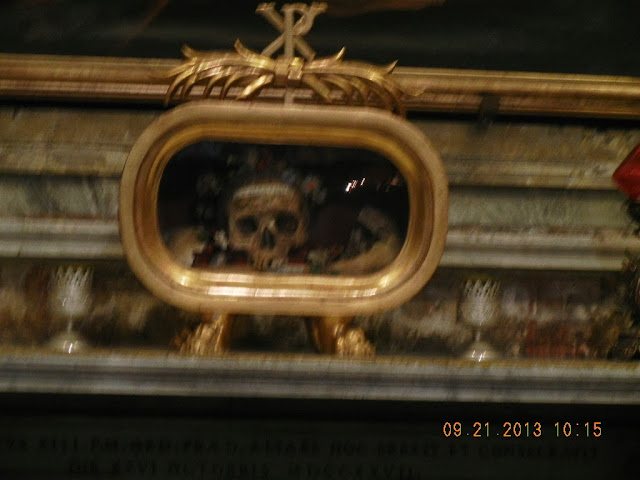
The skull of St. Valentin, set in a gold reliquary, in a side chapel in Sta. Maria di Cosmedin. [Sorry about the blur.]
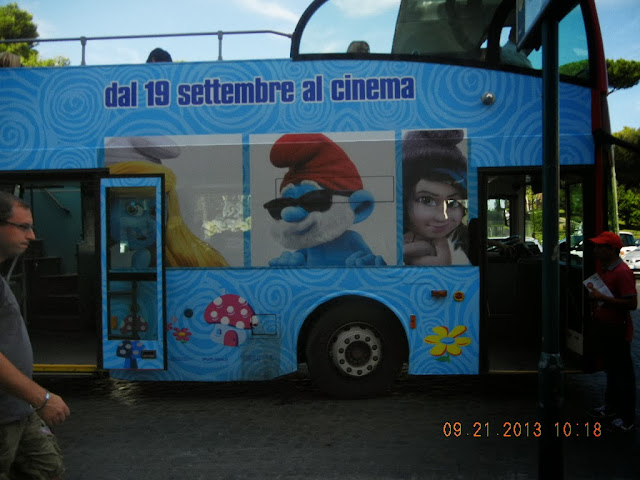
And now, for something entirely different — a Smurf-painted bus.
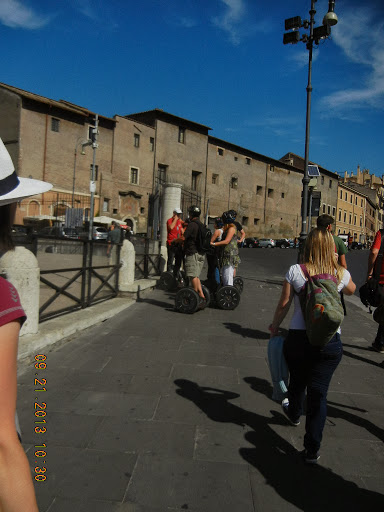
A Segway tour group. We saw several of these, and a bicycle tour group, along with the numerous other walking groups. Note the blue sky, and the people dressed for summer. I think about how we will be dressing in Anchorage when we return there (snow in the forecast for Tuesday), and cherish these views of a world into which snow rarely falls.
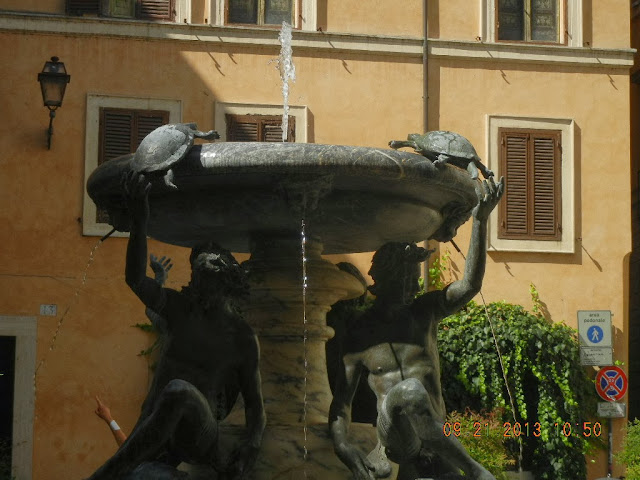
The turtle fountain in Piazza di Mattei. The story associated with it, according to Alessandro is that a young man wooing his love was rejected by the girl’s father because he didn’t have enough money. To prove to him that he did, the suitor invited the father to spend the night at his house in the piazza. In the morning when dad awoke, the ambitious young man showed him the fountain which had been put in place overnight. Dad was persuaded, and the couple married. Alessandro pointed out that among other problems with the story, the house of the supposed suitor in the piazza post-dates the fountain by a dozen years. The fountain was built in the 1580s, and restored about 70 years later, at which time the turtles were added. The fountains around Rome supplied drinking and cooking water to the citizens.
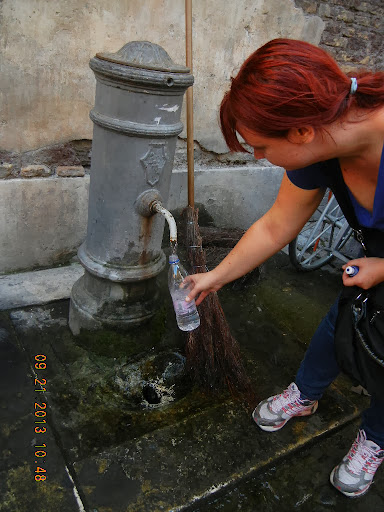
The current version of fountains for the citizens of Rome (and the tourists). One of our group filling her water bottle. The water is cold and clean, often preferable to tap water.
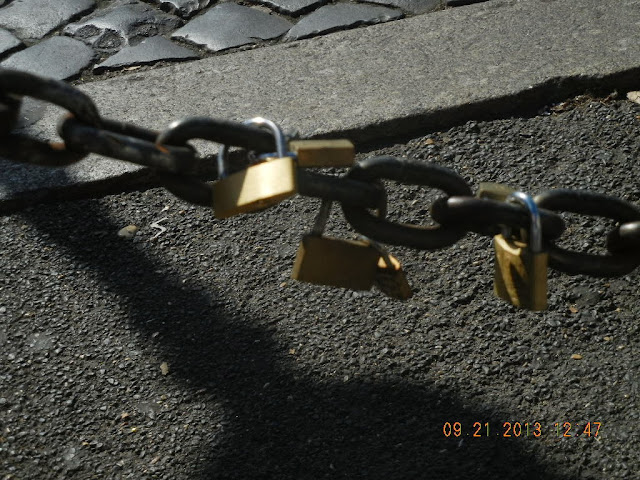
Padlocks on the chains across the entrances to footbridges across the Tiber are placed there by young couples to symbolize the eternity of their love. The key is thrown into the river.
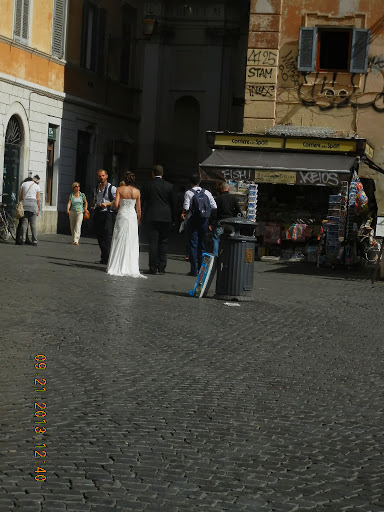
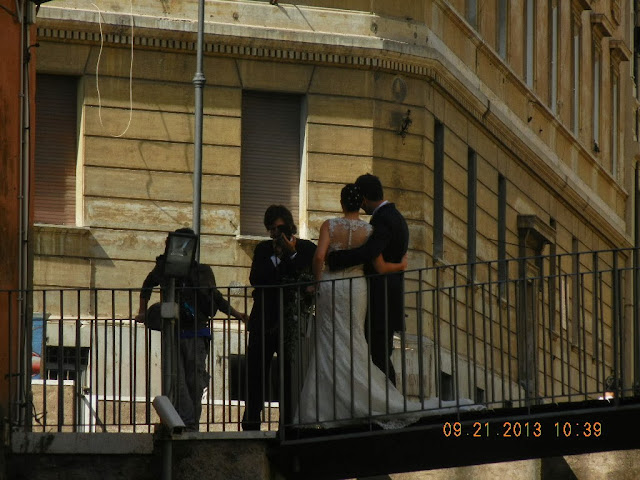
A wedding couple, near the Teatro di Marcello. Presumably their padlocks worked.
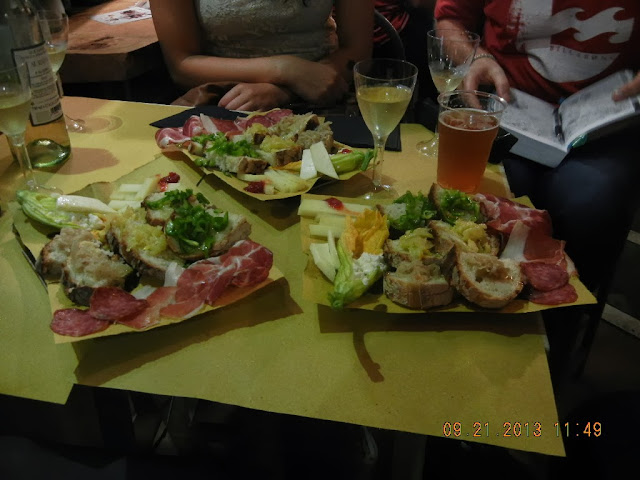
At Taste of Trastevere, lunch plates for the non-vegetarians — we all shared the different tasting choices on these trays, and the trays that the owner prepared for the vegetarians.
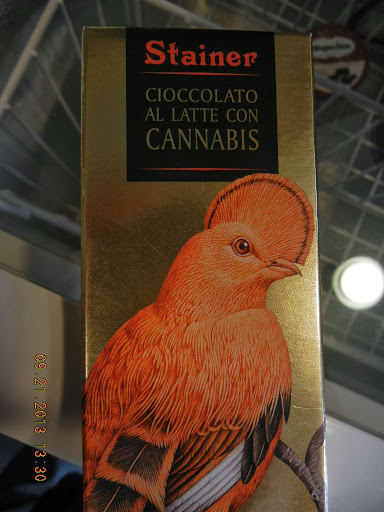
Seen in a chocolate shop — cannabis chocolate (to be eaten as you sip your cannabis absinthe spotted last week).
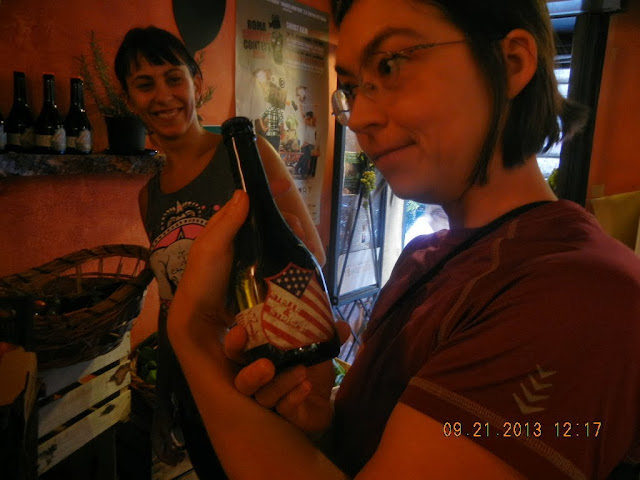
Regina with “Starz and Stripez” beer, locally produced, and the owner of the Taste of Trastevere.
The other of the day’s wedding couples. We saw two, plus preparations for a couple more, plus a christening party in a piazza.
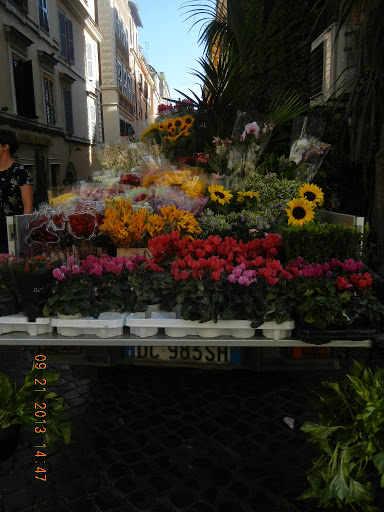
A flower wagon on a side street.
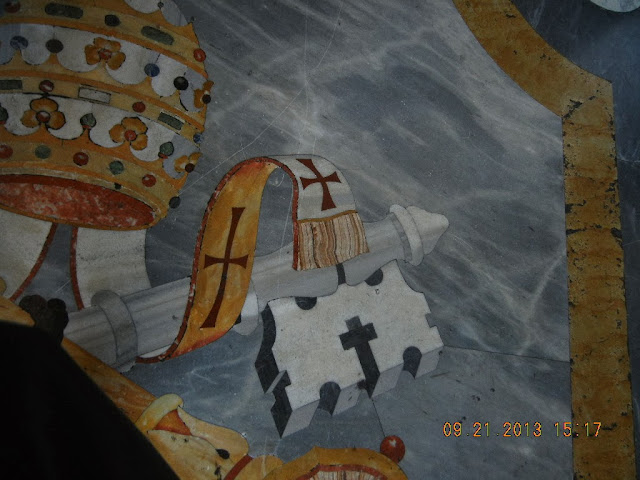
Another mosaic, this one at the entry to Santa Maria di Maggiore. Regina noted that the pattern in the marble has been carefully incorporated into the picture to create the stripes above the end of the key.
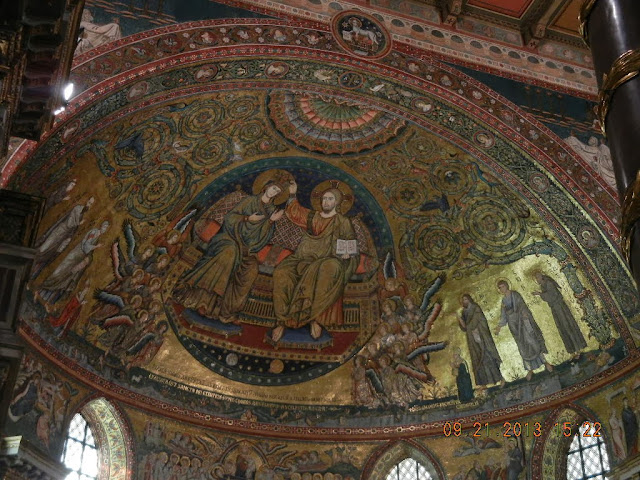
The mosaic dome in Santa Maria di Maggiore, dating from the 5th century C.E. Rome is filled with an amazing number of beautiful things, an overwhelming number, and a very high percentage outside the museums.
A charming window in a side chapel in Sta. Maria di Maggiore. The churches, especially the older ones, are filled with unexpected bits of art and cultural icons.
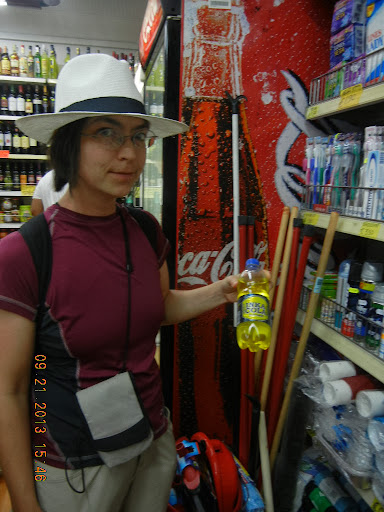
Regina with a bottle of Inca Cola from Peru, found in an international grocery store on our way back to our hotel.
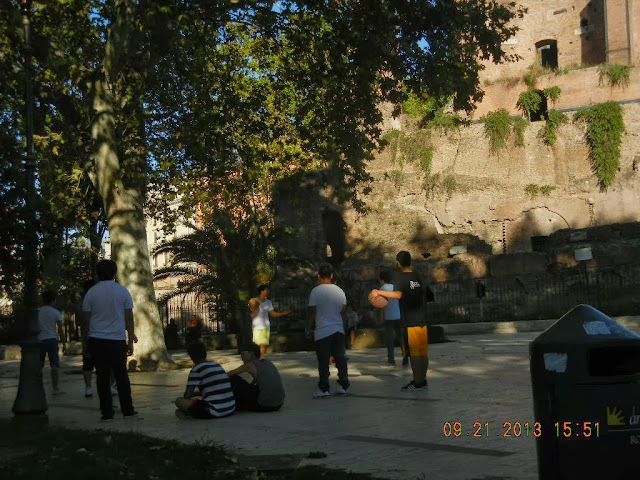
Boys playing basketball on a marble plaza, with ruins in the background.
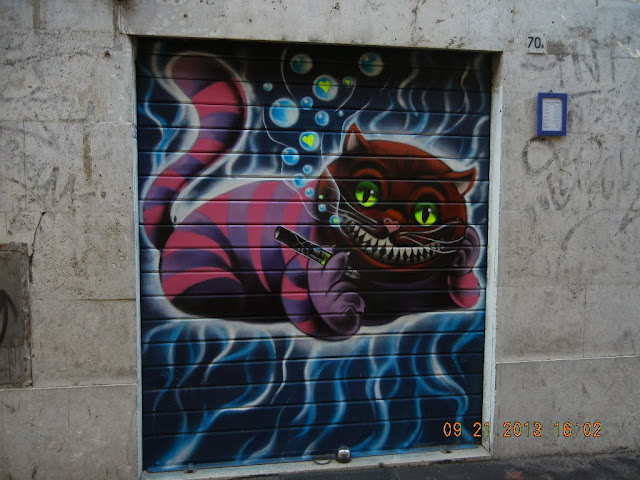
Picture on the roll-down garage door of a night club. Note that the cat now has an electronic cigarette.
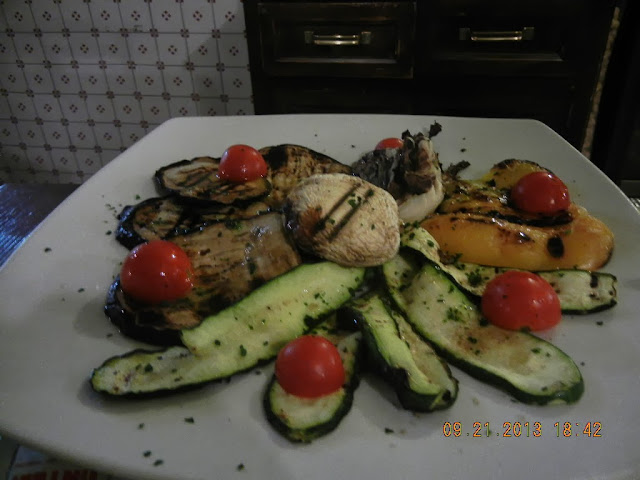
Grilled veggies for dinner at Al Grottino, a place we wish we could have eaten at every night.
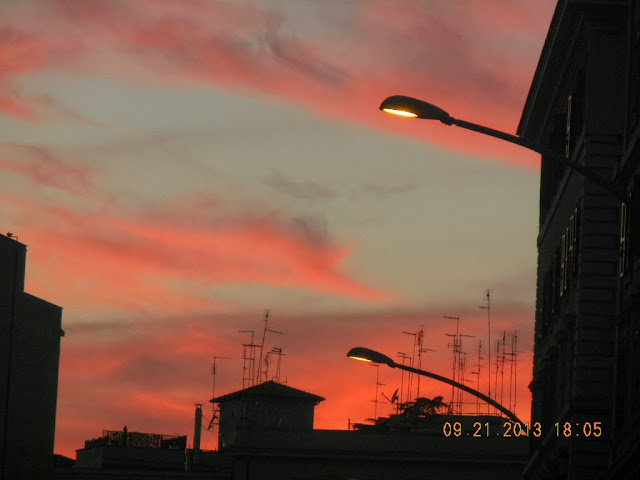
City sunset.

We will let you know how our return trip works out. We leave tomorrow morning for the airport, and expect to be in Seattle very early Monday morning (Regina got a better flight, so she will be there tomorrow afternoon). The forecast is for rain — a Seattle September, so our day there may be spent dashing under umbrellas from Trader Joe’s to meetings with friends, and other appointments. We get back to Anchorage very early on Tuesday morning, and are hoping that the snow that’s forecast decides to stay in the mountains.
At 12:30 a.m. the street outside is filled with the sounds of dozens of cars honking their horns, and motorcycles gunning their engines, for the past ten minutes. This has not been typical of the area. Something is going on, exciting for the participants, but a bit disruptive for people thinking that sleep on a Saturday night is a good thing (not me; I still have to pack).
Thanks for coming along with us. Your comments and good wishes have been much appreciated. Ciao for now!
 

Posted in Uncategorized | Tagged , , , , , , , , , , , , , , | Leave a comment

Sicily to Rome, September 20, 2013

At 8:15 this morning, we said good-bye to Tom and Peg, who are on their way to see Tom’s cousins and relatives in Termini-Imerse near Palermo, and to Guiseppe at Hotel Trieste. Aetna was steaming as we passed her on the way to the airport.
We arrived at the T&V House at Piazza San Croce 4 in Gerusalemme, and got someone coming out to let us into the courtyard of the set of buildings that holds the “B&B” (it was listed as a hotel, but that’s a stretch). The landlady came out to meet us, in a tither because our room wasn’t ready. We assured her, no problem, but could we put our bags in it? Yes. So, through a locked door, up a flight of steps to a tiny typical European elevator. Through one locked door into a large entryway, with several rooms and a kitchen around it, and then into our room. To leave, one must lock our door, go through the “B&B” door, go through the outer door to the building, and go through the locked gate. Then you are on the street. So very different from home. All of our lodgings here have been similarly protected. The cities don’t seem particularly dangerous, so we wonder whether these are left-over habits from a different time, or are really needed precautions today.
That took us to about 2:30, badly in need of lunch since we hadn’t had a real breakfast. Regina found us the correct bus to Campo di Fiori (the market that we went to last week), and a bakery with excellent pizzoli. We perched on the rim of the fountain in the market, watching the crowds and the vendors. We shopped too, the essence of the Market experience.
Woman trimming roses at the Campo di Fiori, “Field of flowers.”
After lunch comes gelato of course. Today’s choice for Regina, caramel with Himalayan salt, and chocolate with Grand Marnier. For Jim, lemon something, smooth and cold, perfect for the mid-80s and hot sun.
We walked along the Tiber, eating gelato, and noticing the sizable number of people fishing today. No, it’s not elbow-to-elbow on the Kenai, but for the middle of Rome, it’s not bad.
In a bar where we stopped for coffee as we were walking home, we saw a young guy who had passed us on the street a block earlier. He was sitting at the back of the bar in his Roman soldier outfit, playing the slots.I think there was a photo of one of these guys last week; they encourage tourists to have their photo taken with the Roman soldier, or they dress the tourist up and take the picture, all for a fee, of course. It’s a bit odd to think of Rome as a place where one can just sit down in a bar and gamble.
We came to Rome with the idea (my idea, at least) that we would see all of the seven pilgrim churches, as a way of rounding out our trip to Jerusalem, and the Camino. Rome was the third of the great medieval pilgrimages. These seven are among the oldest in Rome, and would give us a chance to see the whole range of architecture and decoration. Last week we went into a church every day, but only St. Peter’s counted as a pilgrim church. Today we stopped in at St. John Lateran (St. John the Baptist), which is huge and gilded to add a second to our list. Rick Steves says that this is the first church in Rome, but the signs at Santa Maria in Trastevere where we were last week said much the same thing. Until 1870, all of the popes were crowned in St. John’s, and even today, the new pope must sit in the bishop’s chair at St. John’s in order to officially become pope.
The design for the mosaic dates from about 450 C. E.; this mosaic was actually made about 1300.
This view of the altar with the paintings above and around it gives you a little idea of the scale of the church. There’s someone in the lower left corner of the photo. In a Rome tourist attraction, it’s hard to avoid. But that’s OK — most of the places that people want to see always were places where people gathered, and they were meant to impress and be admired. They are still being used for at least part of what they were intended to be and tomean.
This is much older than the rest of the church. I need to find out the story.
The Egyptian obelisk in the piazza in front of St. John Lateran. It’s the oldest (dating from 1600 B.C. E.) and tallest (105 feet). Big as this obelisk and the others in Rome are, they have been moved around from spot to spot. This originally stood in the Circus Maximus (where the chariot races were run and Julius Caesar paraded before his death. When it stood in the Circus, it represented Rome’s victory over Egypt. When Constantine conquered Rome, he had a cross put on top, representing Christianity’s victory over the earlier beliefs.
Our hotel is across the street from another of the old (around 320 C. E.) churches, Santa Croce in Gerusalemme.
The front of the church is late Roman baroque (says Rick Steves), massive and grand. In a chapel behind the altar, wood from the true cross is displayed, ensconced in elaborate gold decoration and behind thick glass. No touching anything, not even the glass protection.
I
Jim took a well-deserved rest later in the evening while Regina and I went to seek out yet another good place that Lonely Planet recommended. So far, they’all been at least above average, and most of them have been excellent. Tonight was no exception — Regina had  smoke-flavored dark beer from Germany, and we ate oven-fired breads (mine was just foccacia) with simple tomato toppings.
About 9:45 p.m. —  the full moon rides over the Church of the Sacred Cross in Jerusalem.
What will we do tomorrow? Maybe a guided walking tour, or perhaps the self-guided type, following along in a book, and stopping for espresso at every opportunity. Lovely (well, too hot for some) weather is promised for tomorrow.


Posted in Uncategorized | Tagged , , , , , , , , , , , | Leave a comment