Anchorage snowstorm, December 14, 2013

View from the front of our house.
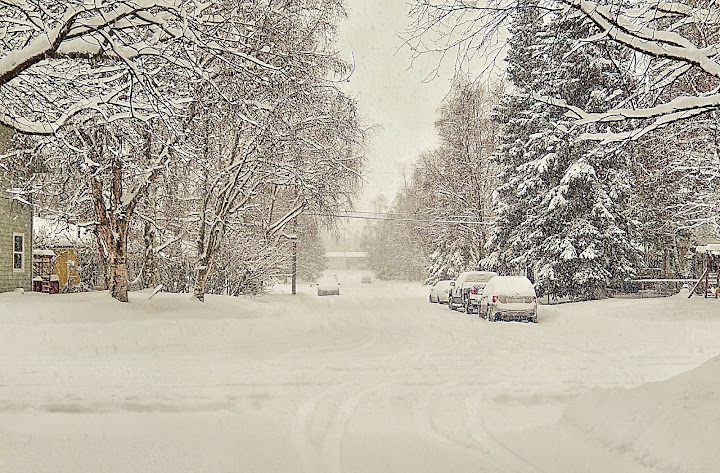
Sounds like most of our friends are getting enough snow for a white Christmas. Just in case Anchorageites were feeling that theirs was a little grubby and worn out, we got about a foot yesterday and today, with more coming. Here’s what it looked like today.
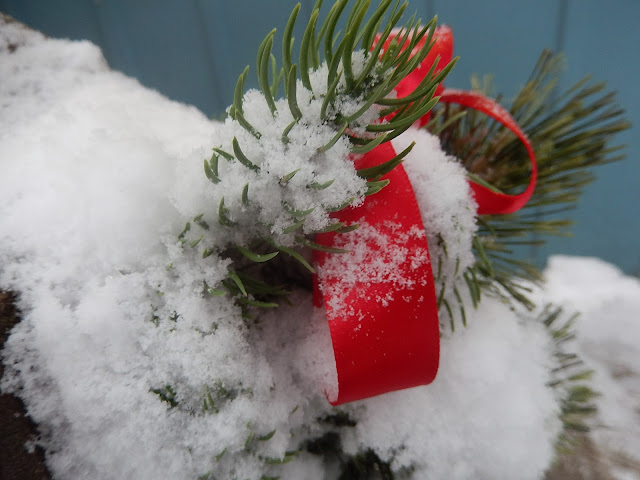
A snow-covered Christmas bow at Fire Island bakery where we began the day.
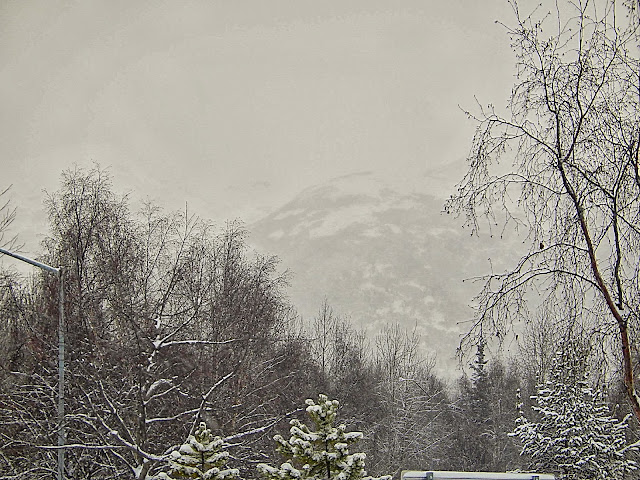
View from the Costco parking lot, looking toward the Chugach mountains, 11:30 a.m.
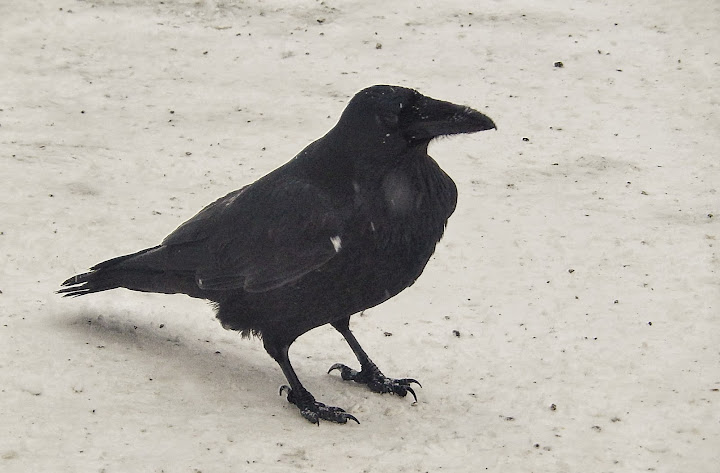
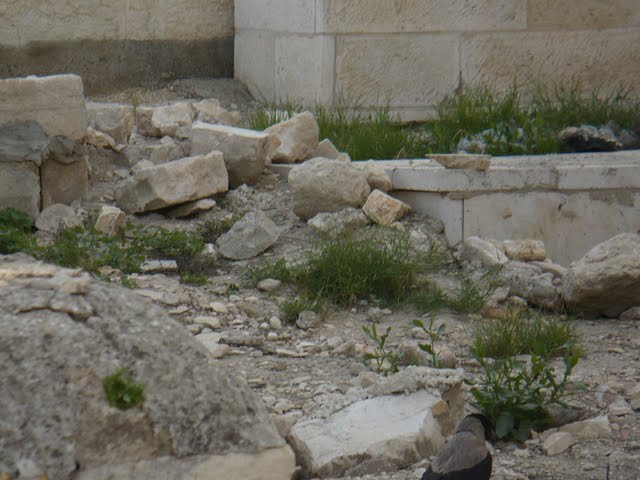
Parking lot raven. They are remarkably black — eyes to toenails.
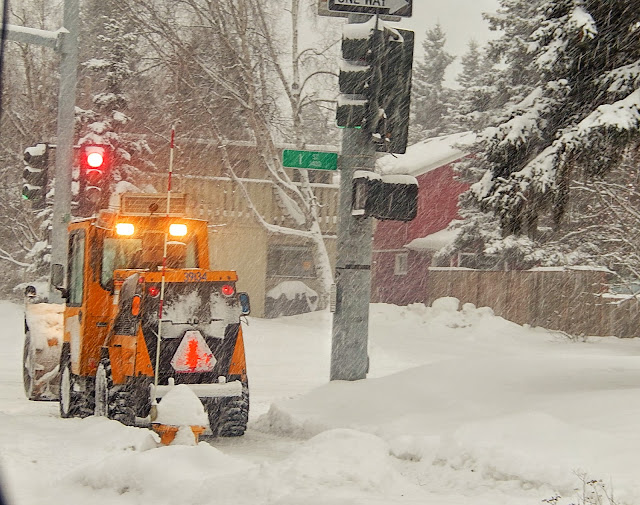
Sidewalk plow at I Street.
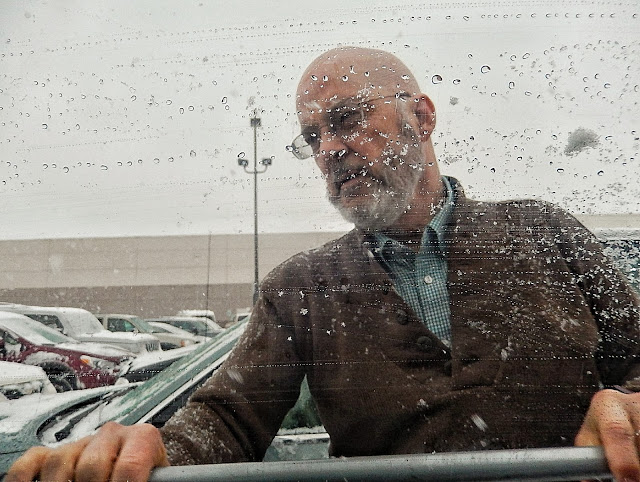
Jim cleaning the car windows, one of many times today (I offered to help, but he was having too much fun).
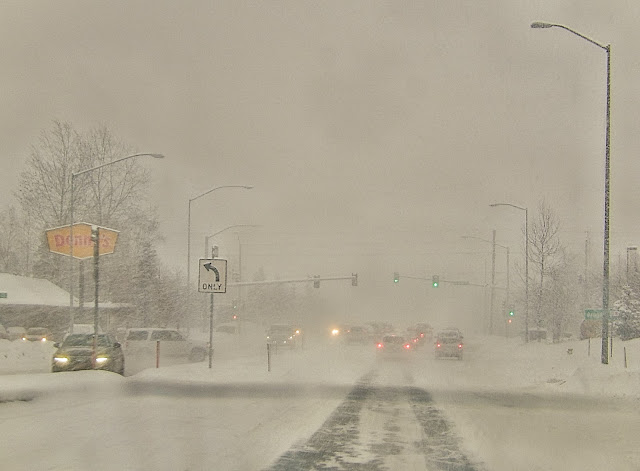
Low visibility on DeBarr Road . . . and everywhere else.
Catkins contemplating winter.
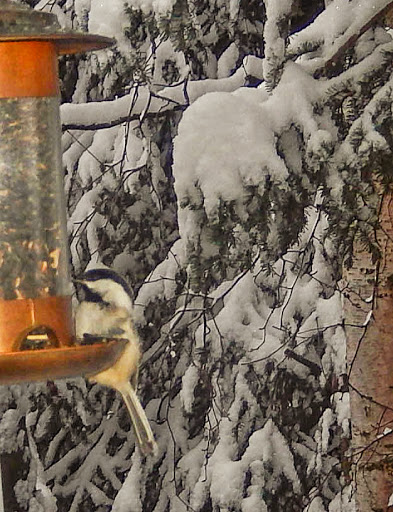
Black-capped chickadee at the bird feeder.
Neighborhood moose, browsing at 5:00 p.m. — too dark to get a clear photo.
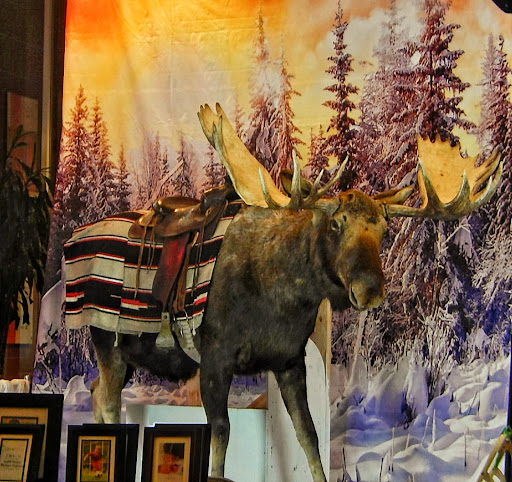
Stuffed moose at the Fifth Avenue Mall waiting for people to come and have their pictures taken.
Christmas bling at Nordstrom’s. 
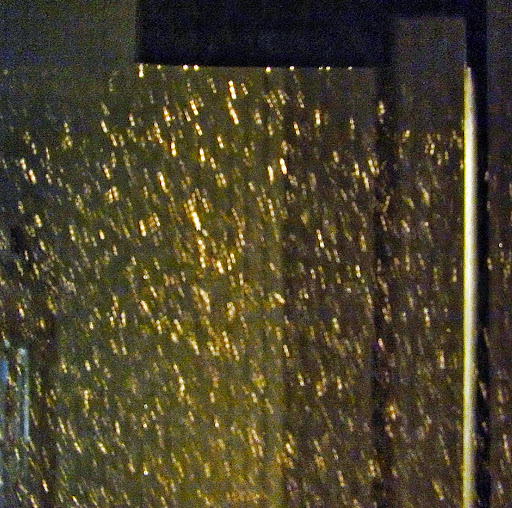
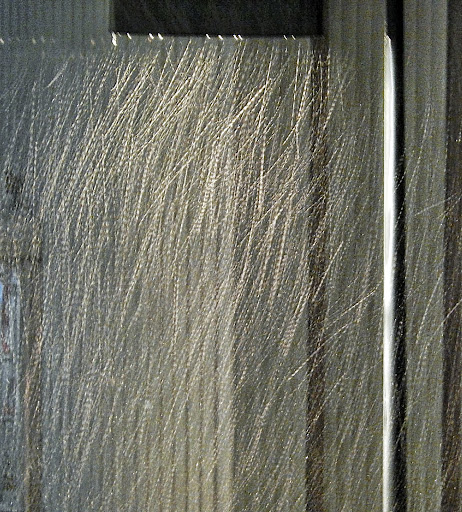
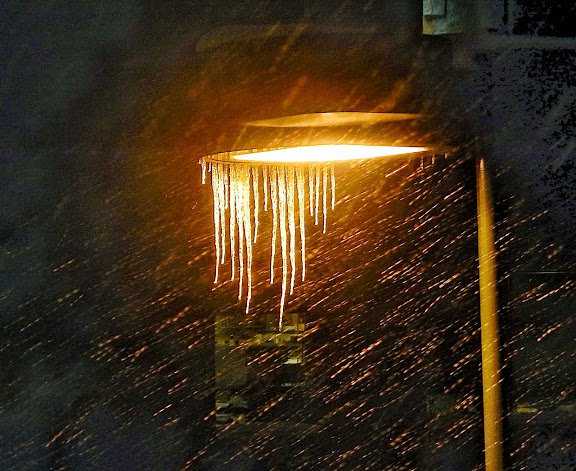
Snow abstractions at night.
We wish all of you delightful days in the next few weeks.
Posted in 2013, Alaska Travels | Tagged , , , , | Leave a comment

April 7, 2010 — Hotel Carolina and Kerameikos, Athens

April 7, 2010: Kerameikos, and a new hotel

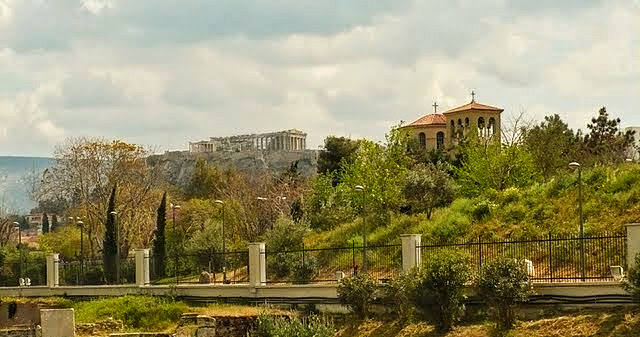
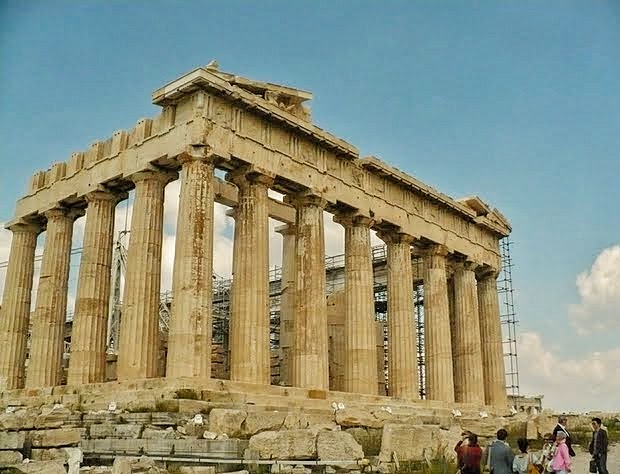
A graffitied wall, and the Parthenon on the Acropolis.

Jim says:

“It’s Thursday, and we checked out of the Athens Studios and checked into the Hotel Carolina, a little trepidatiously since it sounds so much like the “Hotel California” as sung about by the Eagles. (“Such a lovely place…”).  It is priced about the same as the Athens Studios, but the room is much smaller, and we don’t have access to a laundromat. But it is nice, the desk clerk is very friendly and it is in the heart of the city and near the Parliament building. And there is a Starbucks nearby. So far we have seen two in  the city. I can remember when there was just the one in the Pike Street Market. There is something simultaneously comforting and disconcerting about having a little bit of Seattle wherever you go.

View from the balcony of our room at the Hotel Carolina on Kolokotroni Street.

To get here, we caught a cab instead of taking the metro. It cost 4 euros instead of 2, but there is less walking, and we didn’t have to hassle with our bags up and down the stairs to the subway, and rolling through the busy streets here in the city center. Especially because Teri’s bag has a broken wheel. Alas, she may have to consider replacing Old Paint when we return to Alaska.

This part of the city is grittier than near the Acropolis Museum. Narrow streets lined with “antique” stores, hardware stores, coffee shops, shoe stores, religious icon stores, fabric stores; few wider than 20 feet. The pattern through much of the city is to have the first floor of the 4 to 7 story buildings dedicated to retail, and the remaining upper stories used for residence. It makes for an interesting mix of activities with women shaking our throw rugs on the fourth floor balcony, a couple having coffee on the 3rd floor, and the shops down below. Everywhere there are pigeons and doves.

Street scene on the way to Kerameikos. Note the graffiti, and the lavender flowering trees.

After we checked in, we walked to the old Athens cemetery, which dates back to Socrates, Plato and Pericles [Pericles is buried somewhere there, but not the others]. It has a nice little museum with statuary and artifacts from the area. Much of the material for the museum came from the wall of the city of Athens that was erected in great haste with whatever material was at hand to fend off the Spartans.[We aren’t entirely sure about this, but some quick research isn’t settling the question. At some point, someone decided to put at least part of the grave markers on the walls, rather than the ground below.] And so it was preserved all these centuries. Parts of the wall are still there in the cemetery. We walked down the Sacred Way that leads to the Sacred Gate (one of 13 into the city. Not superstitious those old Athenians). I have a photo of Teri standing where the Sacred Gate used to be. The high points were spotting a 10-inch tortoise, tadpoles in the Eridanos “River” (a small stream by our standards) that flows through the cemetery, and a woodpecker.

Part of the city wall, with the Sacred Way running alongside it.

We had lunch alongside the railroad, led to our destination by a student who spoke good English and offered to help find our way (we were, in fact, heading in quite the wrong direction).  He was very nice, and hoped to get into the London school of Economics after he graduated from college. We dined in the shade [on delicious Greek salad with the freshest, most flavorful tomatoes and cucumbers you could hope to eat], outside next to the sidewalk. The passing crowd was fascinating, from North Africans selling watches and sunglasses, to the five-piece gypsy band (3 accordions, 1 guitar and 1 tambourine, which was used more for collecting change than playing). I realized that they were playing the same five bars over and over, with some slight embellishments. It made sense. Because they were strolling musicians nobody was going to listen to them for more than a minute or two, so they didn’t really need much of a repertoire.

Teri says:

A new week, a new home. We’ve been in Athens seven days. The Hotel Carolina features a filigreed elevator door on each floor, with the elevator itself having no doors.  The neighborhood is all retail stores of every description – hardware, antiques, shoes, lots of jewelry, bags – and cafes, fast food shops, and lounges (bars) for blocks in every direction. There’s a church every couple of blocks, including the head cathedral for all of Greece, the Mitropolis that sits at one end of a marble-paved square.

We spent parts of the afternoon and evening walking through the streets, looking for the cheap Greek pies (spanikopita – the spinach pie, tiropita – feta cheese pie, and many other varieties – potato, vegetable, and meat) at the Everest chain of pie and salad fast food restaurants, and for chocolate. We found the pies, along Ermou Street which has British and American chain fashion stores, and lots of street vendors. Today’s sellers included some selling guns that blow bubbles, coconut juice stands,and Greek men selling lottery tickets.  They leave the sunglasses and bags and toys to the Indians and Africans. In the past few days we’ve actually seen customers buying sunglasses and bags, and I saw a teenage boy on the ferry to Aegina with a splat tomato – we are relieved to see that they sell things. It was a chillier day, with a west wind blowing off the ocean, and clouding up later in the afternoon.

Gravestones at Kerameikos, some that didn’t get used by the Romans to pave over the river.

As Jim mentioned, we walked to Keramikos, the potters’ field  and graveyard since about 2,500 B.C. ( Pausanias writing about 160 C.E. says that Keramikos was named after the hero Keramos, son of Dionysus and Ariadne; our word “ceramic” came from Keramikos). About 600 C.E., people stopped using it as a cemetery, and it lay unremarked until the mid-1800s, when someone found a grave marker while digging. The Eridanos River runs through it – two thousand years ago it was a wide marshy area with enough water to make it good for potters. The river today is maybe two feet wide and a few inches deep, with tadpoles and dragonflies, and one sizable tortoise crossing a bridge ahead of us. Tall orange canna lilies and reeds stand along the banks, and red anemones (one of Demeter’s flowers), beds of chamomile and grasses spread across the cemetery grounds. In later days, the Romans covered the river over through most of Athens to use it as a sewer, often using gravestones.

Tortoise on the footbridge over the River Eriadnos.

Hoopoe bird at Kerameikos. Back behind the museum the area is littered with gravestones, bowls like these, and other fragments that haven’t been put back into place  and weren’t considered worth a display.

One reason I wanted to go is that the route from Demeter’s temple in Eleusis to the Parthenon ran through the cemetery along the river. Every year, a procession honoring Athena started in Eleusis, and went through Keramikos to the Parthenon atop the Acropolis. This was the biggest event in the Greek religious year, and many of the statues and carvings on the Parthenon show scenes from it. A small stone marker says, “Sacred Gate.” Looking up to the southeast, the Parthenon stands out against the blue sky. Pilgrims walked the route the other direction as well, going through Kerameikos and Piraeus to get to Eleusis to participate in Demeter and Persephone’s religious ceremonies there.

A view of the Parthenon from the Sacred Way in Kerameikos.

Jim found an area called the Dromos, a road that ran through the cemetery between Athens and Plato’s Academy. It was at a spot along here that Pericles gave a famous funeral speech honoring the dead in one of the wars by speaking of how great the Athens form of government was. Pericles, by the way, paid for many of those temples on the Acropolis, including the Parthenon, by taking money from the alliance of Greek city-states that Athens dominated. One Greek scholar termed it the greatest embezzlement of all time, but at least Pericles didn’t spend it foolishly.

A group of German art students shared the space with us; they sat in front of the museum for an hour and drew the statues taken from the graves. We walked through the museum before going to the cemetery itself. The marble statues and grave markers there are free to be touched –so unlike the American museums with which we are familiar. One shows a grandmother holding her infant grandchild, with the inscription, “I hold here the beloved child of my daughter which I held on my knees when we were alive and saw the light of the sun, and now dead, I hold it dead.”

Memorial for a grandmother and her grandchild, in the museum at Kerameikos.

The museum holds hundreds of grave offerings – vases, jewelry, cups, toys – and one wonders – how did you come by these? When your grandmother died, did you go to the potter’s shop and say, “I need two of these, and she would have liked this, and I should probably have three of those?”

Covered box with octopi at the museum at Kerameikos.

Vase with chicken heads at the Kerameikos museum.

Tomorrow we think that we will head to the modern market, and then to explore our new neighborhoods. Anthea is on Crete with her class and without much access to the Internet. I’ll pass on the links to her blogs when they show up.

An old (1600s?) stone church behind Kermeikos, with its adjacent modern concrete tower next to it.

Posted in 2010, Greece, travel | Tagged , , , , , , , , , , | Leave a comment

April 1, 2010 — Getting to Greece

The Parthenon from the Keraimekos Cemetery in Athens.
Getting there is half the fun
                                April 1, 2010, midday

We have gotten as far as the Milan airport – it’s a gray day – doesn’t look a lot different from Newark on the outside. One the inside? Not an American airport – the halls are narrower, the ceilings lower, the lights much brighter. The traffic pattern in the airport routes you through the middle of shopping areas. Many of the shops have no walls – they’re larger than kiosks, but small enough to keep track of all of the goods easily. And they’re not American shops – no “buy the goods made in this state here” stores. No stores devoted entirely to souvenirs and T-shirts and stuffed animals. No Burger Kings.  No, in Milan we have glove stores, a mozzarella bar, Mont Blanc pens, Swatch watches, lots of designer name stores, and perfume. Lots of perfume. The airport smells like the Nordstrom cosmetics section, dense with fragrance in the shopping areas, with an undercurrent of scent everywhere else.

April 1, 2010, Midnight

About midnight in Athens.

Our cab driver from the airport knew a little more English than I did Greek (which is to say, very little). We passed by the “First Cemetery” which is the recent (last couple of hundred years) one. People there are “in the ground three years” – she gestured – “and then out. They pull them out. Me – I am [buried] in my village. That’s good. I stay there. People with lot of money – 50,000 euros – they can stay in that cemetery all the time. Most people, three years.” We agreed that being buried in the village was probably a lot nicer than in the graveyard where they dig you up after three years. She drove us a different route, she said (as if we would know,– but she quoted a flat rate, same as the one in the guidebooks, so we didn’t care) because everyone is leaving town to go to their villages for Easter – everyone, yesterday (Wednesday), Thursday; “tomorrow more will go. Then Athens is very quiet.”

She drove us past the local Catholic Church so that we could go there on Easter Sunday, pointed out Syntagma Square (the preferred location for demonstrators because the Parliament Building is there; it also was the location of a Christmas bomb that failed to deliver), Hadrian’s Arch, and more. Then she left us a couple of blocks away from what we thought was our checkin location, and betook her dyed hair, black-fingernailed, big-sunglassesed, tight purple dress off for her next fare. We tipped her well and liked her a great deal better than the New York cabbies.

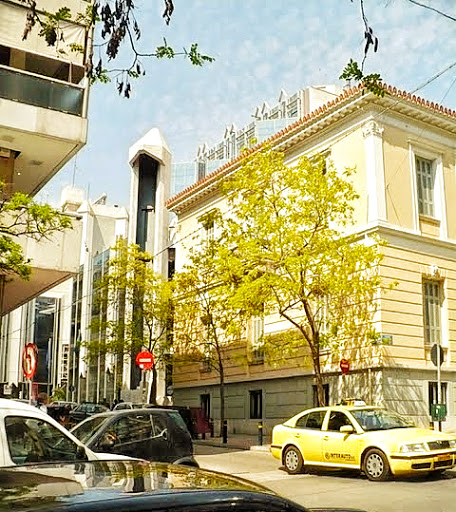
Athens street.

It wasn’t our checkin location, however. We had to walk another couple of blocks. My small roller bag which needed a tape job on the corner at the beginning of the trip now developed a broken wheel, which made even louder clattering on the cobblestones. We got our studio, retrieved the password for the free wifi, connected with Anthea,  and set our clocks forward another hour. At about 7:30, she arrived at our doorstep, fresh from class, and we set off on a twenty-minute walk to dinner at a taverna near her school.

Jim was vowing to lose weight on this trip – if that happens, it will be because of the miles of walking, not because of the food which is excellent and served in generous amounts. We hoped that the wait staff found our attempts to decipher the menu and speak a little Greek entertaining.  For dessert, they brought us complimentary halvah and mastic wine in one-ounce glass mugs (a side note – mastic is the gummy sap of a tree grown on Chios. The ancients considered it a great prize for medicine, cooking and wine; pirates and others raided the island on a regular schedule to steal it. The wine tasted a bit like vodka with a pleasantly sweet exotic flavor, and eminently desirable).

taverna-in-the-square.jpg (550×368)

A typical taverna.

We walked Anthea to her apartment in the Pangrati neighborhood above a cookie store and bakery (half an hour), and then back to our apartment (another hour). By that time, the bars and restaurants were winding down a bit – Athens stays awake late. Only a few pedestrians were out as we made our way back past Hadrian’s Arch again, the Olympic Stadium, a view or two of the Acropolis, and many Athens streets. Two scents predominate in the city night – orange blossoms and cigarette smoke, often mixed. The orange trees grow along the streets, like mountain ash in Anchorage, or small fruit trees in the Midwest – except that they have oranges on them that fall to the ground, and no-one bothers to pick them up and eat them. [Update – one of Anthea’s classmates had the same thought – he did pick one up and found it to be extra-bitter and unpleasant. So that’s why they lie where they fall. But they make good marmalade. A later note, from Rome, 2013 — those same trees were planted in Rome because people wouldn’t strip the trees of their fruit.].

What about knees? you ask, because Jim and I, especially Jim, left home with some major questions. For Jim the answer is, “Doing great so far, thanks to the wonders of drugs (anti-inflammatories).” For Teri, the answer also is, just fine. I’m very cautious about steps and steep slopes – the mostly-healed broken and wired-together kneecap still doesn’t work perfectly. We racked up four or five hours of walking during out first day in Athens, so we’ve passed the first test. Tomorrow we’ll see more.

Lycabettus Hill and the Acropolis from near the top of Filloppapos Hill.

Posted in 2010, Greece, travel | Tagged , , , , , , , | Leave a comment

March 30, 2010 — Seeing the ancient Greeks in New York


New York, New York, what a wonderful town
The flowers are up, and the rain is down . . .

2595293694_02f6450383_z.jpg (640×426)

Manhattan street in the rain.

That was the scene in Manhattan yesterday, with sheets of rain driven by a cold wind. The umbrellas were inside out, the puddles deep, and the taxis not nearly frequent enough. Nonetheless, we did the town.

When we landed at Newark near midnight on Monday and taxied to the gate, my impression was of vast plains of concrete, shiny with water that reflected row upon row of lights. When we took the shuttle to our hotel, the impression remained – more desert stretches of concrete, water, lights, and little else. No wonder people in the rest of the country think that Alaska is their personal wilderness treasure!

In the morning, the trek from hotel to Grand Central gave a more varied picture of the landscape – what we could see before clouds and rain obscured it. It was a non-trivial trip: shuttle to airport, AirTrain to the other side of the airport, and an hour and a half on the bus through Lincoln Tunnel and into the city. Of course, the last two miles took a third of that time; the other 18 miles were slow, but not mostly motionless. My commute in Anchorage is about seven minutes from driveway to office; people do this New York commute twice a day.

We met a friend from Anchorage who has moved to Connecticut – for less snow and ice, and to be closer to her kids in Manhattan. She suggested that our initial plan of wandering around Soho and the Village should be traded for something more indoors. So we hailed the first of several cabs and headed south to Chelsea Market at 15th Street and 9th Ave.

New York cab in the rain.

The way you hail a cab is to stand out in the street, just even with the parked cars and lean out to wave. Sooner or later, one pulls over, lowers his window (didn’t see any female cabbies), and (sourly) says, “Where to?” At which you say your destination, and he motions for you to get in. Later in the day, we were at the corner of 83rd and Madison (which runs north) trying to get to Grand Central (south). Every one of six or more cabbies who stopped, said, “I can’t go that way; going uptown.” The New Yorkers assured us that they are not supposed to say that, but none of them hesitated for a second (we eventually went over to Fifth, south-bound, and found one). The other important thing to know is that when you are at a spot with dozens of soaking wet people all trying to get a cab, you have an advantage by positioning yourself upstream, or maybe even at a corner where the cabs are turning onto the street you want to take. I thought – briefly, and a bit ashamed – about studies showing how selfish people are, and then got right out there and waved.

Cabs in New York are not like cabs in Anchorage or Juneau. They have little TV screens for the back seat that show ads, the weather, snippets of shows, with a crawl for breaking news. When you arrive at your stop, the screen shows your fare, along with a choice of tips pre-calculated – 15%, 18%, and 20%. You punch in the tip you want, and cash or credit. If it’s credit, you swipe your card, and a receipt prints out that the driver hands back to you. You accept the receipt, offer a silent thank you that you’ve survived another trip, and scramble out while the driver argues with the next set of passengers standing at his window.

Chelsea Market, like Pike Street in Seattle and many other reclaimed areas, was full of upscale food stores, a book store, kitchen supplies, and little restaurants and delis. We ate brunch and bought chocolate. I looked through a few tempting shops, but thought of trying to zip my bags closed with even one more pack of gum, and resisted buying. Chocolate was OK – we ate it on the spot.

Then we caught another cab, during the day’s one brief rainless hour, and headed for the Metropolitan Museum, to see the Greek statues there before we see their companions in Athens. After a couple of months of intensive reading – Greek history, maps of Athens, dozens of accounts of what to see – the beige marble statues struck me differently. They looked so familiar, suddenly, because everything in the West since then shows their influence. Many of the actual statues there were Roman copies of Greek statues that had vanished centuries earlier, and in the European statuary court, the influence of the Greeks spoke from every limb and drapery. We looked at small figurines from 2400 years ago, models of comic actors – they could have been made yesterday. Swirled glass vases? Their counterparts are being made today. It was as if time vanished because so little has changed in all of those centuries.

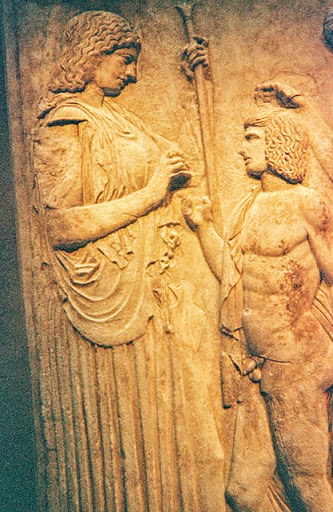
A reproduction of a relief of Demeter, the Greek grain goddess, and Triptolemus in the Metropolitan Museum in New York. Because the Eleusinian prince Triptolemus was kind to Demeter when she was looking for her lost daughter Persephone, Demeter taught him the arts of agriculture. She gave him a winged chariot drawn by dragons so that he could travel the world spreading her gifts of grain and farming, and made him a demi-god.

Other relics of early Greece came from another world entirely. The orange and black vases? Even though the lady with the bound-up dreadlock ponytail had a most contemporary hairdo, her clothes and face and gestures told an entirely different story than she would recount today. The men on the vases with their shields and helmets and short draperies lived in a time completely at variance with ours. The gold jewelry too, although some pieces were familiar from the museum reproductions, was breathtaking in its intricacy and perfection. So perhaps it was just the statutes – a head of Zeus looking very much like a boy friend from the late 1960s; Triptolemos in a panel with Demeter and Persephone closely resembling a kid I used to babysit – in their three dimensions that echoed today.

After the Met, we sat and drank coffee with Jim at an elegant chocolate shop (Voisges) that was run by an Indiana boy from Goshen (not far from Teri’s hometown of Buchanan in the southwest corner of Michigan). So we traded stories of northern Indiana, and how he loved chocolate and sought out the best chocolate maker he could find to work with. Getting the cab from there to Ali Baba near Grand Central was when we really got soaked, drenched, soggy – it was nearing rush hour and we trekked from one unrewarding cab-hailing spot to another. One friend said that the cabbies had decided to end their shifts at 4:30 or 5:00, despite the city’s best efforts to get them to change at 3:00 or 7:00, or something less disruptive of everyone’s lives.

All in all, it was a nice transition from daily life in snow-bound Anchorage to sunny Athens where we will join Anthea tomorrow. Here’s her latest blog, for anyone not keeping up with her on Facebook: http://antheaellinika.wordpress.com/2010/03/30/milao-milate-milai/

“Miláo, miláte, milái –  I speak, you speak, he/she speaks. – How awesome is today? Today I don’t have class until 2, and then it’s a class on ancient Greek theatre and the cult of Asclepios, followed by my first Greek lesson. That is a lot of awesome today.

. . .   Yesterday, Rachel, Dani and I walked to Syntagma Square to pick up Dani’s friend and our fourth roommate, Lauren. We took the tram home — which meant buying metro tickets from a ticket kiosk. I went first, since everyone looked uncertain. (I was uncertain, too, but . . . nobody else speaks any Greek.) “Ena?” [One.] I tried, and gave the guy a €2 piece — and got a €1 piece and a ticket back. Success! “Efcharisto!” [Thank you.] Rachel followed my lead, with similar success. When Dani and Lauren went up, they looked uncertain, and as I was coaching from the sidelines, the man in the kiosk was laughing and prompting them. “Ena,” holding up one finger. “Ena.” One.

Moments like that give me a little firework burst of delight in my chest, the same display that goes off when someone asks me a question about a play that I can rattle off the answer to. I know something useful, and I know how to apply it. I try to keep those fireworks inside, because I hate coming across as a know-it-all, but the triumph is there anyway.

Just a little bit of prep has made such a difference — and it’s still not nearly enough. I wake up every morning thinking in English, and the sound of people conversing in something other than English is a much needed part of my morning routine. I am not where I was; this is not home.

Except the truth is, it’s just not home yet. Maybe, by the end of my time here, I’ll be able to write a whole blog post in Greek — very simple Greek, but Greek. That’s when I’ll know I’ve arrived.”

We’ll be back in a day or two with the best from the ancients.

Posted in 2010, Greece, travel | Tagged , , , , , , , , , | Leave a comment

March 29, 2010 — Getting ready for Greece

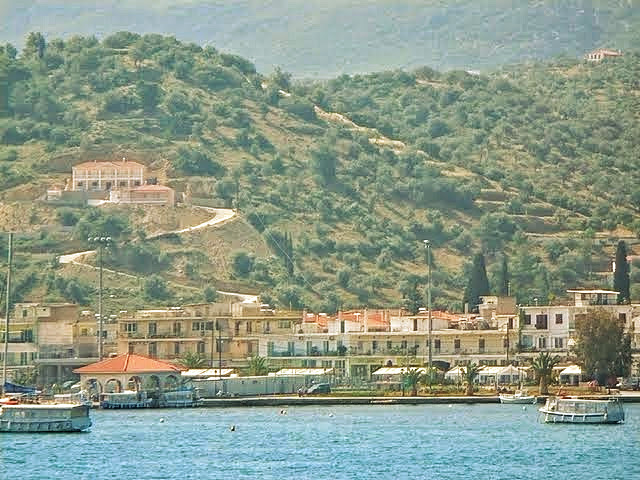
The island and city of Poros, taken from the ferry — what we were looking forward to seeing.

. . . Just getting to Greece is an adventure. Here are the first few installments of our travelogue for the Athens trip, which I’ve been jotting down for the past couple of weeks. It’s Saturday night right now. On Monday morning we’ll be leaving Anchorage, and on Wednesday, we’re off to Athens. Anthea’s safely there; she’s got an actual blog: http://antheaellinika.wordpress.com/2010/03/27/peripeteia-kai-routina/#more-45 – “Adventure and Routine” is the most recent. Look on the right-hand side of the page for the earlier posts.

If you’re dying to know the best vintner for retsina, we’ll do our best to track it down. But if you need to know about the Greek Mafia, we’re not your best choice. Myself, I’m looking forward to a few sips of Metaxa brandy.


March 13, 2010
The Carns family is heading east – Jim, Anthea and Teri, that is. Regina set foot on her seventh continent last August, when she spent nearly two months studying light and algae on the Antarctic ice. We are leaving her to her Ph.D. studies of glaciology and astrobiology in Seattle (although she will have been to Death Valley and Hawaii for spring break in late March and early April, so her travel itch will be slightly mollified).

Anthea decided on Athens for her study abroad semester. The program is run by AHA at the University of Oregon, and because student visas for Greece are a nightmare to acquire, the organizers have designed an 87-day program to fit snugly within the 90-days maximum time allowed in Greece without a visa. Classes start on March 23, and end on June 19, in between capturing many of the major Greek holidays and events – March 25, Independence Day; April 4, Easter; May 1, Labor Day; the opening weeks of the summer theater and music festivals. And the weather is better than at most other times – the end of March may be cooler and a bit rainy, but April and May bring wildflowers covering the mountainsides, and by June the beaches will begin to be covered with tourists.

The program offers full semester credit, and the friends who told Anthea about it (University of Alaska drama professors who taught there in 2005, and again last fall) assure her that she can expect to be writing at least a paper a week. Classes include “Modern Greek,” “Monuments”– that is, field trips to as many of Greece’s antiquities as can be squeezed in to 87 days, “Myth and Journey” – a writing class, and “Theater and the Healing Arts in Ancient Greece.” It’s a respectable curriculum that assures that Anthea will see as much of Greece as anyone taking the Great Tour in the 1800s, and will come away with perhaps more of it firmly ingrained in her memory and psyche than most.

Jim and Teri decided that this was an opportunity not to be missed. We both spent a decent chunk of the 1970s abroad, but having married in 1981 and proceeded to do the parent adventure, we haven’t left the northern hemisphere in thirty years. Time to find some traveling shoes and a passport and head out, we thought, and Anthea agreed that we could take her out to dinner a few times while we are in Athens. So the household has been accumulating guidebooks on Greece, dictionaries, new shoes, new backpacks, long lists of things like flashlights, duct tape, and notes for the esteemed house sitters.

Our days, the past few weeks, have been spent scouring pictures of the Athens riots for clues about the weather – “See? They’re all wearing jackets and scarves along with their designer sunglasses – must be chilly.” We squint at the guidebook photos – “Look – they all say dress modestly, but everyone in these café pictures is wearing shorts or short shorts, tank tops or less, and sandals.” Clearly the guidebook photographers are concentrating on the summer crowds, leaving out the less appealing winter weather and trips to monasteries (skirts required for women, if they let you in at all). We have taken a set of Greek lessons from a wonderful teacher who has tutored us in ordering food, being polite, how to count, and how to read all of the letters – epsilon, alpha, omega, and pi – that we know from math books and signs on fraternity houses (surprise – almost none of them are pronounced the way we are accustomed to).

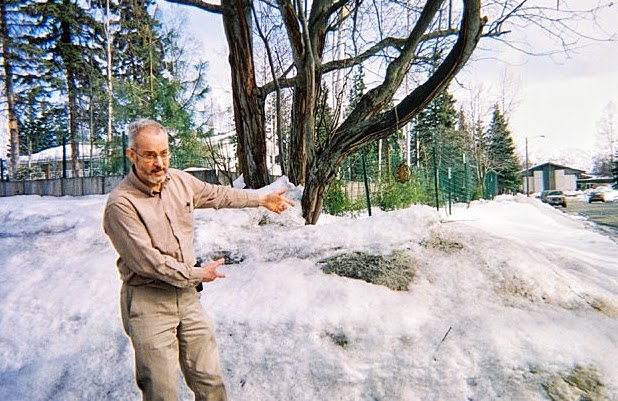
We’re leaving behind a city buried in snow from the past few weeks. The driveway on March 13 is hemmed in with banks that are six feet high now, and extend ten feet back to the fences on either side. At 7:00 a.m., the light is just seeping in from the east; at 8:00 p.m., there will be a little color left in the west. We’re leaving behind snow boots, heavy coats, winter hats, and packing swim suits. We’re leaving behind a lot, having decided – even Anthea – to go with carry-on only. This is hard on the Carns family – only a couple of books each, not so many gadgets, not the extra thermos . . .

Jim showing off the snow in our driveway on March 28, 2010.

Much of the time has been spent making travel arrangements. Getting from Anchorage to Athens is expensive and time-consuming, involving at least two plane changes no matter how much you are willing to pay. And we weren’t willing to pay  much, so our trips are staged. Anthea leaves on Wednesday, March 17 for New York, where she’ll spend a few days with drama students from Carnegie in a Manhattan apartment with a Riverside address. Then she wanted a taste of London, so she gets there on March 22, spends just about 24 hours, and boards a plane for Athens. We booked a hotel for her at Heathrow last night – it’s Yotel, and provides seven square metres (about ten feet by six feet) into which are squeezed a bed, a bath with shower, a “luxurious mattress with organic cotton cover” (according to the website), and a heated mirror (huh?) – all for about $95 for seven hours (they charge by the hour). But it’s in Terminal 4 at Heathrow, with direct and free bus access to Terminal 5, so it’s reliable and convenient. She’ll meet up with three of the other students from the program on the flight from London, and they’ll be able to get from the Athens airport to their school as a group – reassuring when you know little of the language.

The parental units leave on March 29 for a day and a half in New York, and then a Lufthansa flight toAthens via Milan. The interesting part about the intercontinental legs of these flights is that British Airways is scheduled to go on strike on March 22, and Lufthansa workers are talking strike at some undefined time in the near future. And JFK, from which Anthea leaves (if she does) announced soon after we had booked her flight that all planes out of JFK for the next four months are likely to be substantially delayed because of construction on its major runway. Will the Carns family even get to Athens? Probably, but quite likely not on time. Will they get back from Athens? Also probable, but the timeliness is equally doubtful.

Another exciting feature of the trip is that Greece is in turmoil over its financial situation. At the best of times, apparently, the Greeks are likely to strike – today the transportation system, tomorrow the garbage collectors, next week the police or hospitals or hotels. They demonstrate their dissatisfaction with wages, benefits, hours, and life in general on a frequent, albeit random schedule. But these days they are more upset than usual, giving us many opportunities to see Syntagma (Constitution Square) from the vantage point of thousands of demonstrators. The photos on the Internet show squads of riot police with heavy black body armor and big clear plastic shields.

Beaches are a major feature of Greece. Swimming, according to one guidebook, is quite safe. There is the occasional shark. There’s a fish whose razor sharp fins can kill. And the occasional infestation of stinging jellyfish, which are usually harmless, but . . . The sea urchins the litter the sands in the shallow waters? Well, if you do step on them, you’re sure to get spines in your feet, and must use a lot of patience and olive oil to get them out. Other than that, swimming is great.

Sunday, March 21, 2010

I’m still reading guidebooks by the dozen, but it occurred to me today that for answers to important questions – like whether there are Starbucks and McDonalds outlets in Athens – the Internet was the place to be. And sure enough – there are, at last count, 39 Starbucks stores in the Athens area, and 48 McDonalds in Greece. McDonalds notes that it has special foods for the Lenten season in Greece, including shrimps, veggie burgers and spring rolls. Don’t ask me how spring rolls became a traditional Greek Lenten food – we will try to solve that mystery once we’re there.

Friday, March 26, 2010
True countdown time. I got back late last evening from an overnight trip to Juneau for work, and put in a hectic day at the office trying – but not succeeding – to finish everything.

Jim’s been having trouble with his left knee for most of a year, and recently added a difficult hip to his repertoire. After several ups and downs, the recent one being yesterday and today, he finally got a doc who understood that the purpose of this was to get him to Greece and back with as little pain as possible. So he has more drugs, and better ones, and now is feeling like he might get there.

More in the next few days.

Posted in 2010, Greece, travel | Tagged , , , , , | Leave a comment

April 4, 2010 — Athenian Easter

 April 4, 2010: Athenian Easter and other notes from Jim and Teri

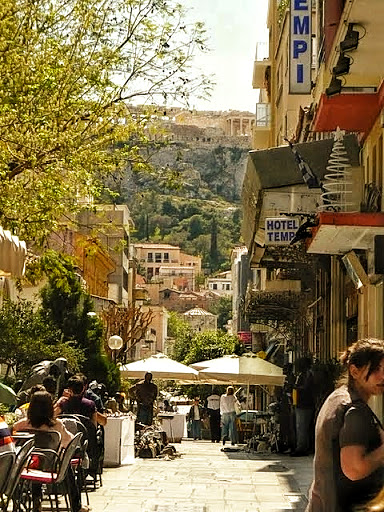
A street in the Plaka, the old section of Athens. At the top of the Acropolis is the Parthenon. The trees are just getting their spring leaves, and the sun is warm.

Jim’s notes: Jim summarized his view of our travels thus far, and his perspective is the focus of today’s news:
“We have only been here a few days at this point. We are in sight of the Acropolis and just a short walk from the Acropolis museum and its Metro subway stop. We only get to stay in this apartment a week, and then we move to another place not too far from the Parliament building. We will stay there a week, and then take a 5-day side trip to Israel. And then we return to our original apartment in the hostel for the last few days of our stay.

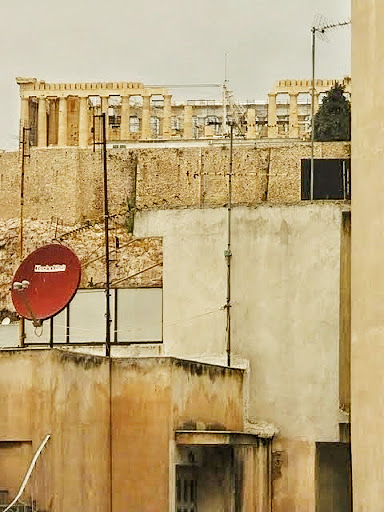
View of the Parthenon from our studio apartment. Granted, there’s a fair amount of urban clutter between us and it, but it’s the Parthenon. We can see it from our balcony. It’s worth a pinch or two to be sure that we’re really here.
So far we have been to the Epitafios ceremony on Good Friday (Big Friday in Greece) and followed the crowd of worshipers up one of the main streets as we all marched,  carrying candles, behind the ceremonial bier of Jesus. We have seen the guards in front of the Presidential Palace changing places in a extraordinarily stylized march. That was kind of cool.

File:Evzone Presidential Palace Athens Change 1.jpg

Changing the guard, Wiki photo.

We have seen a host of beggars, North African street vendors (sunglasses, “name brand” hand bags, and splat toyshttp://www.youtube.com/watch?v=Ri69ZkW1nvQ). The vendors spread their wares on a sheet and stand around waiting for a sale. The splat toy vendors throw their toys against a square board in a slow rhythm that has a certain meditative quality. Nobody says anything and they periodically roll their wares back up in the sheet and move to a new spot. There are dozens of these guys and I haven’t seen a sale yet.

4146492552_d5d6b0782d.jpg (500×384)

Street vendors, Flickr photo.
We have ridden the subway (one stop). We have seen the 1896 Olympic stadium, always empty, and a fine marble and limestone structure. In fact we walk past it every time we go to Anthea’s apartment.

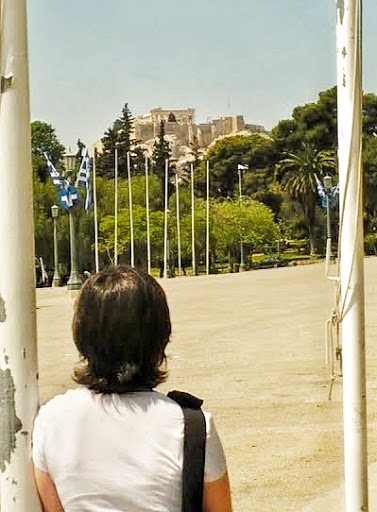
Anthea looking up at the Parthenon and the Acropolis from the Olympic Plaza.
The streets are about as far from a rectilinear grid as is possible, and we have to pay close attention to keep from getting lost, even when we are walking from Anthea’s apartment to our own, which we have done daily. It’s nice when we can spot the Akropolis and get our bearings.

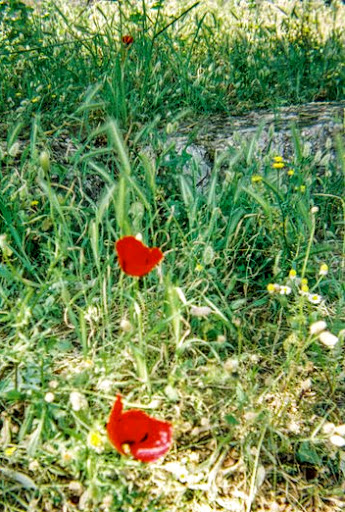
Anemones and yellow hawkweed, with new grasses, at Kerameikos (the ancient cemetery for Athens).
Ah but the weather is fabulous. After five months of winter, it is good to jump straight into summer.

Teri’s notes: A few other notes on Greek Easter. After the midnight bells and guns and fireworks and chanting broadcast for blocks around, actual Easter Sunday was very, very quiet. Jim and I walked the mile and a half (so Google says – it’s all uphill and takes us about 45 minutes, so I’m inclined to call it at least two miles) to Anthea’s and attended the Catholic Mass at a little church in her neighborhood. We recognized bits and pieces of the liturgy – especially the Alleluias, which despite having a different pronunciation were set to melodies we know well.

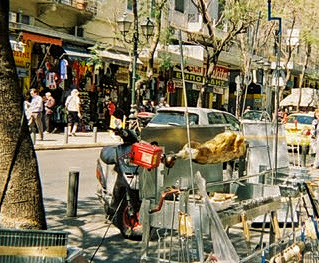
Fake lamb on a spit, advertising the spits and grills (on Athinas Street, the day before Easter).

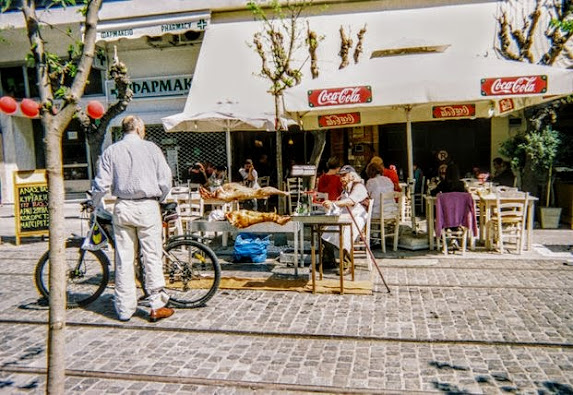
Roasting a pair of lambs on spits outside a cafe, Easter Sunday, Athens.

We got back to our studio at noon, passing a nearby café where a man sat turning a lamb on a spit. The smell of roasting lamb filled the neighborhood for the rest of the afternoon and into the evening – we went by the café several more times, and each time someone was turning a lamb on the spit. Once it was an old lady; another time an old man. I asked at 6:30 how many lambs they had done today; the person on spit duty at the moment said that it was the third or fourth, and they would be doing at least a couple more.

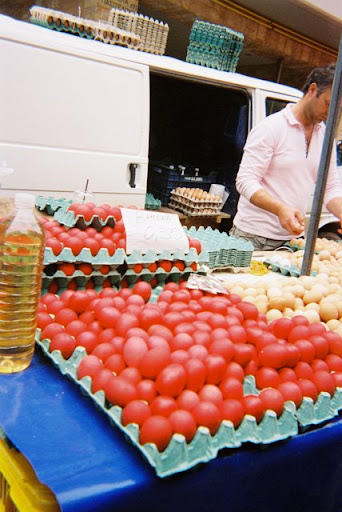
Greek Easter eggs, all dyed red.

Another featured food of the day was dyed hard-boiled eggs. These are solid colors, most often a traditional deep rich red. There were red eggs nestled in the middle of round loaves of bread, red egg shells on the sidewalks, red eggs handed to us by the Greek family dining next to us in the taverna this evening. I don’t know that they are meant for eating – most have been out of refrigeration for hours or more, and I didn’t see anyone indulging.
Jim stayed at the apartment for the afternoon, still catching up from jet lag, and I went back to Anthea’s apartment where all of the students (and two of the teachers) in the group were watching the 1981 “Clash of the Titans.” Part of the course studies, sort of. Tomorrow the group plans to watch the remake that just came out, and we may join them. The 1981 version appears to have been shot largely in Arizona. It features lines for the gods that would earn a thunderbolt for corn if the gods cared (Laurence Olivier played Zeus, for heavens’ sakes, and Zeus didn’t strike him down or sue him for mis-portrayal), and a robotic owl that rivaled anything Disney ever produced for cuteness.

Clash of the Titans

Bubo, Athena’s robotic owl in “Clash of the Titans (1981).”
It was another gorgeous day in Athens – mid-60s with a sweet breeze, and the golden-brown Parthenon on the Acropolis hill against a deep blue sky at random moments as we walked along. It’s beginning to seem like this could go on forever, but by June and July and August, it will be 100 degrees and merciless. Luckily, we’ll be in Anchorage by then, enjoying mid-60s with a sweet breeze – possibly a brown moose silhouetted against the deep blue sky. It’s not exactly equivalent, which makes being in Athens all the more fun.

Posted in 2010, Greece, travel | Tagged , , , , , , , , , | Leave a comment

Tower Bridge to Greenwich — November 25, 2011

On Thursday evening, plotting out our Friday doings, I picked up 25 London Walks. We wanted to take the boat to Greenwich, but this book suggested walking the distance — between four and five and a half miles, it said, from Tower Bridge. That sounded well within our ability, so we set aside Westminster Abbey for yet another day and got ourselves to Tower Hill at 11:30. When we arrived at the Greenwich pier at 3:00, we had logged six and three-quarters miles. The difference in part was the fact that the description of the walk was written around 2000, following as much as possible a walk that Samuel Pepys liked to take in the 1660s. In the intervening decade, someone has spent substantial chunks of money to finish the work of marking out and putting up signs for a path all along the south side of the Thames. Places where the author had to cut inland  in 2000 and take a fairly straight route now follow the edge of the river more closely, which means that the whole route is more intricate and longer — but also, almost entirely along the river. [For the record, my research says that the Thames Path runs about 180 miles from the origins of the river to its mouth; this was only a small part of the trail.]
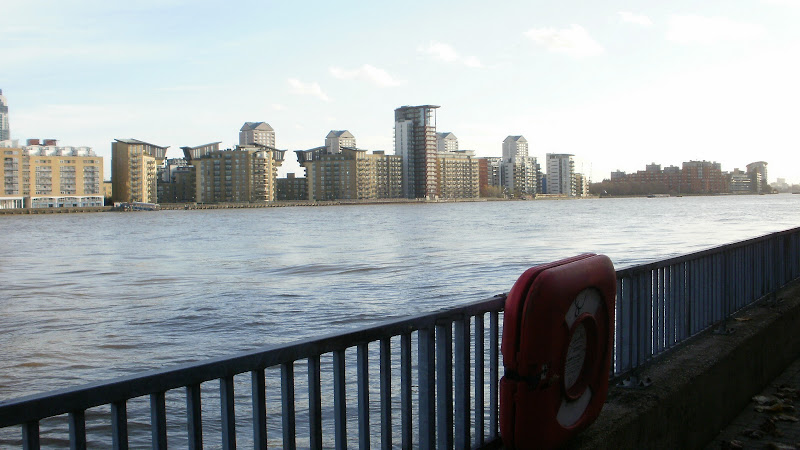
The Thames is a big river, brown and rolling, and as we got closer to the ocean, grew waves and whitecaps, and began to look much more like a trapped sea than a river. A fresh wind blew off it all day, and the sun warmed its chill. The trail, on a Friday midday, had a few bicyclists and joggers, here and there someone pushing a child in a stroller, and maybe two dozen other pedestrians in the six-plus miles. Most of the distance the paved path ran between the sea walls and expensive apartment buildings, many of them modern. Old landmarks, a few parks, and some detours punctuated the stretches of uninhabited (as far as we could tell) blocks of glass and brick.
The Thames Path where we picked it up just south of Tower Bridge on a street called Shad Thames in the old city of Southwark, the site of much of the shipping and some industry in the 1800s and earlier.
A baker putting bread into the oven in his narrow shop on Shad Thames.
The north side of the Thames, east of Tower Bridge. An actual barge is speeding past; most of the boats on the water seem to be cruise boats and ferries for people.
An attempt to keep the riff-raff out. We saw signs for “anti-climb” paint elsewhere too. It is described as a thick oily coating that keeps intruders from getting a grip.
A churchyard in Rotherhithe with old gravestones and new children’s playground equipment juxtaposed. Rotherhithe Street is the longest in London, all of two miles.
A very odd and recent statue of a Pilgrim and a boy reading the “Sunbeam Weekly” — which apparently has the story of the Mayflower’s sailing. It commemorates the fact that the Mayflower set out from an inn near by on its way to pick up the Pilgrims bound for the New World. The plaque for the statue says that if someone from the New World (that would be us) puts a small object in the Pilgrim’s Pocket (visible on his hip) that person will have new and interesting changes in his or her life. So we put in 2 pence (Jim) and a binder clip (me), and will report on the outcomes.
London is full of history, but also of large numbers of big new buildings. These are on the north bank of the Thames.
The west entrance to Surrey Dock Farms along the Thames Path. It’s described as a two-acre working farm, with bees, gardens, animals, a blacksmith shop, cafe, and so forth. Similar beautiful and intricate gates appeared several other places along the path.
Violets, a spring flower, blooming in the Surrey Farms herb gardens on November 25, 2011. I had read that London has had exceptionally warm weather and that the spring flowers were blooming — here’s proof.
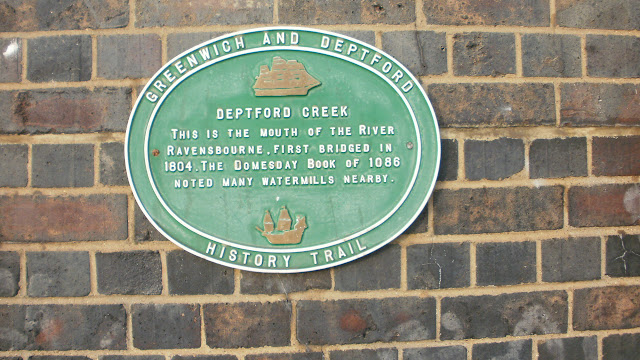
Old locks mechanism at South Lock, near Deptford. These locks appeared to be abandoned, but there were others at work further on.
Cormorant on an old boat docked out in the river, doing a mating display for its intended.
A mulberry tree that was bearing fruit in the 1660s, and still is today. It’s in the (large) garden, Sayes Court, that belonged to Pepys’ friend John Evelyn.
The etched glass door window of the Dog and Bell in Deptford where we shared a half-pint of Fuller’s Black Cab ale, a very tasty, very dark brew. We will miss the Annual Pickle Festival competition tomorrow evening, to which the locals will bring homemade breads, pickles, art and photography, and cakes for judging and awards. The pub is 186 years old, according to its website, and between the pool table in the back, and the several small rooms, the garden out back, and old wood bar in the narrow front room, it epitomizes the classic English pub.
A fine old car on a back street in Deptford.
A strange set of statues in Deptford commemorating Peter the Great, Tzar of Russia, who visited London in 1698 and 1699. He spent a good part of that time living in Deptford at the home of Pepys’s friend, John Evelyn while he was studying English ship-building. Accounts of the time suggested that the Tzar and his household destroyed a great deal of the furniture, broke windows and generally wreaked havoc — perhaps more from high spirits than maliciousness? One blog says that the dwarf is in the group because Peter was fascinated by people with “genetic anomalies.” [http://sarahjyoung.com/site/2010/11/23/russians-in-london-peter-the-great/]
A sign at a bridge going into Greenwich.
The river lapping up against a beach of brick and pottery shards, with shells and stones, at Greenwich.
Jim standing in front of the marker (white sign on the wall behind him) for the Prime Meridian, 0 degrees of latitude. He is standing with one foot in the western hemisphere and the other in the eastern hemisphere.
A view of London, looking upriver from the Greenwich Observatory hill.
Old and new in Greenwich. Most of the main street in Deptford appeared to be working-class Vietnamese and other immigrant cultures. The Vietnamese restaurant in Greenwich was more upscale.
Tower Bridge, about 4:25 p.m., from the front of our boat that took us from Greenwich to the Embankment at Westminster (well, sort of to Westminster; it was still a half-mile walk to the Tube station).
The London Eye at 4:50 p.m., from the Victoria Embankment on the north side of the river. Dark already.
And that was most of our day. We went to dinner at a nearby Greek restaurant, and came home to research the news that a general strike of 3 million workers is planned for Wednesday, November 30. It’s expected to severely affect air traffic because all of the people who staff the immigration booths at the airports are joining the strike (the basic transportation workers are not striking, however, because everyone else will need to travel to the sites of demonstrations). In theory it shouldn’t affect our travels because we leave about noon on Tuesday, and are outbound, not in-bound. But  . . . we are hoping for the best.
Posted in England, travel | Tagged , , , , , , , , | Leave a comment

The next trip — the Thames Path

View of London from the Thames Path along the south side of the river.

For our next adventure, we’re thinking of walking along the Thames River, from its source to its mouth, just past Greenwich. We walked most of the last few miles of it in November 2011, not knowing at the time that it was possible to walk the entire length. Think of it — you’re following a river, so it’s downhill all the way!

Signpost along the path between Tower Bridge and Greenwich. Note the acorn symbol, which is the guide all the way along the trail like the scallop shells for the Camino de Santiago de Compostela in Spain.

This evening has been spent tracking down information about the trail, on the official website at http://www.nationaltrail.co.uk/thamespath/. The site describes the trail as:

“Follow the greatest river in England for 184 miles (294 km) from its source in the Cotswolds almost to the sea. Passing through peaceful water meadows, unspoilt rural villages, historic towns and cities, and finally cutting through the heart of London to finish at the Thames Barrier in Greenwich.”

Map of Thames Path

Map of the Path, about 184 miles.

Working on the Cutty Sark at Greenwich.

Cormorants and gulls in the Thames.

We’ll keep you posted, as we find out more about the weather, the accommodations, the cost, and all of those practical matters, along with more of the history of the river and the experiences of others who’ve walked the distance.

Posted in 2013, England, travel | Tagged , , , , | 1 Comment

April 17, 2010 — Around the Old City of Jerusalem

April 17, 2010: Around the Old City

Damascus Gate, evening — still busy with merchants and buyers.

Yesterday, we walked through the Old City and today, we walked around it. Not that we actually set out to do that. These things happen.

After our pita bread and wake-up black olive jolt, we sat with the hotel’s instant coffee cooling beside our computers and tried to figure out how to get to Masada and the Sea of Galilee [Europeans actually like Nescafe; they have special drinks, hot and chilled, made from it, and they offer it on their menus as a specific choice.] The difficulties sprang like hydras, and twisted and knotted around one another until we threw up our hands two hours later and said, forget it. The problem is that to get to either of those places you have to spend about $100 per person for a bus trip that is subject to the whims and traffic jams of Jerusalem streets, and the delays of stopping at a dozen different hotels to pick fellow travelers up, that takes you to a lot of places you don’t want to go. They advertise Nazareth, etc. [don’t want to go], several other places [don’t want to go], a sweeping panoramic view of the Sea of Galilee [don’t want a panoramic view, I want to wade in it and walk its shores], and a stop for shopping [don’t want it]. So most of the long and tiresome hours you spend and pay for aren’t at places you want to be (which is why they would be long and tiresome).

We left late as a result – just before noon, and stopped at the Notre Dame of Jerusalem Center to find out about evening Mass. Jerusalem is filled with people’s dreams about what Jerusalem should be and mean, in the form of institutes and gardens and parks, dedicated monuments, places of worship, and organizations meant to help others. Notre Dame of Jerusalem Center was originally for French pilgrims; the Count of Piellat in 1883 or so provided the initial land. After a series of misfortunes in the various wars, the Vatican took it over, and now has the Legionnaires running it as an educational and pilgrimage center with hotel rooms, classes, and a nice restaurant.

From there we headed toward the King David Hotel, thinking that it would be a good place to find out the cost of hiring a taxi for the day so that we could see our choice of dreams rather than other people’s ideas of what the dreams should be. Our not-at-all direct route [we were more or less lost] took us along the Azriel Promenade donated by the Jewish Foundation of Canada – many blocks of shade and plantings of white calla lilies, lavender, rosemary, exotic flowers and pleasant trees – and into a plaza where we stood looking helplessly at the map. A nice English-speaking native came along and accompanied us for a ways up the hill and pointed us the right direction – very often standing around looking helpless with a map is the best way to get to where you want to go.

There were more gardens up the hill toward the hotel, with nasturtiums, pansies and honeysuckle, and the hotel walks were lined with white shrub roses. It’s a delight to be so far from home and find so many friendly plants – but un-nerving too. Where are the plants from 2000 years ago?  These familiar flowers seem yet another overlay of people’s dreams onto the land of the Caananites, a grace-note version of the embodied dreams and ideas of all of the different peoples who have inhabited or ruled this territory.

The King David is, by everyone’s standards, the luxe hotel in Israel. It features a long hallway of marble, inlaid with a strip of white stone on which are imprinted the names, signatures, and visiting dates of Barack Obama, Nelson Mandela, Dick Cheney, Bill Clinton, Arnold Schwarzenegger (probably some women too, but not many), and so on. The King David is as far as it is possible to get from the Arab Quarter where our hotel lives. It was nice to go there and see the other side of things, and nice to know that the Rivoli and the Palestinian District have their place in the city too.

As we headed across the street to the Jerusalem YMCA, which is only a short step down in quality from the King David, a taxi driver accosted us and asked us where we wanted to go. We said, “Masada, but not today, Monday.” “OK, I take you for $320 round trip, both of you. The north shore of the Dead Sea, the south shore, the . . .” “OK,” we said, “What about the Sea of Galilee?” “I show you everything for a little more. $480 – Nazareth, Capernaum, . . .” “No, no, we only want to see the Sea of Galilee and the River Jordan.” “But you will like . . .” And so forth. “Today, I take you to Jericho. Just half a day, $220. You will want to see.” “No, we don’t want to see.” “No . . . We took his card and walked away. Twice as much (with tip) as the bus, and still just as likely that we would see a whole lot we weren’t interested in.

Now what? Jim thought he’d like to walk around the Old City, and I wanted to go to Mt. Zion to see what was there. We headed downhill again – most maps don’t show topography, so when you see a road that runs more or less the direction you want, it doesn’t occur to you to think that you will descend a few hundred feet down steep stairs along the way. And what goes down is likely to come back up, at a time when you are more thirsty and fatigued than when you started down the hill. That was the case here, and we arrived half an hour later, with a sizable gain in elevation, at the Zion Gate on Mt. Zion along with today’s pilgrimages. Our favorite here was the middle-aged Japanese group who all wore white nylon vests with lots of zippered pockets, embroidered in black with “Cherubim.”

Pilgrims and others outside the Old City wall.

Mt. Zion’s buildings include an area marked off as King David’s Tomb (a low arched stone area blackened with candle smoke), a museum, a building honoring the Holocaust victims, and a church that is believed to be the room of the Last Supper. Like many other churches in the city, it was built by the Crusaders on the site of something earlier, and then turned into a mosque during the Turkish centuries before being returned to its current use by the British in the early 1900s. The mosque’s prayer niche, and one of its domes are still in the room.

Arched remnant of  a mosque that at one time occupied the Upper Room.

The room itself, while we were there had three other pilgrim groups. At the foot of the steep stairs leading to the Upper Room, as it is known, were the “Dos and Don’ts” – most notably, “You are at a holy site. Please respect the sanctity of the site. Absolutely no religious services allowed.” A bit contradictory, and not noticed by many of the groups apparently. Above the voices of the guides for the three different groups rose the chatter of the members of the groups, and then a loud “Shhhhh!” or two from other members. Soon, two nuns in one group chanted for a while, and when they were finished, men in the group went into a different chant, possibly Latin. Over in the adjacent corner the orange hats pilgrimage group were exiting, singing their own song. And as we came down the stairs to a courtyard, a French guide began leading his group in a French carol/folk song, very charming.

The “Upper Room,” believed to be the site of the last supper that Christ had with his disciples. I don’t recall where the shadow that looks like a bug came from.

They weren’t the only people in the area chanting. Near the Chamber of the Holocaust was a Jewish area, divided into a courtyard, and a large room. The room was for Men’s Prayers, and a section of the courtyard against a back wall had a sign, “Women’s Prayer Station.” Two dozen girls, ages four to about nine (and one four-year-old boy) were lined up on benches yelling out their lessons in chorus. Leading them was a nine-year-old girl in a floor-length gray satiny, swirly-skirted gorgeous dress; long black hair; she twirled and conducted and led them in their rousing choruses of Hebrew prayer that drowned out the men and echoed off the stone walls. I’d have given a lot to have a dress like that at the age of nine. Nineteen too, probably.
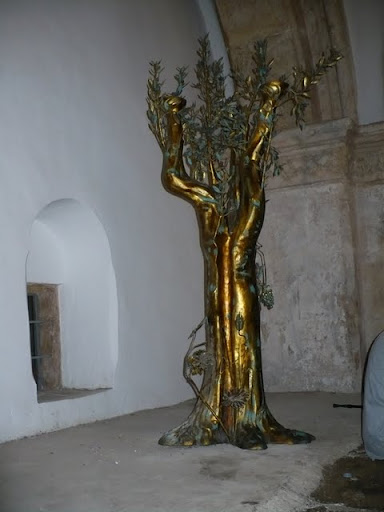
Tree of Life sculpture in the Upper Room.

From there we headed downhill, past a weedy area alongside the bus park. We met up with a long-legged black beetle, some butterflies, sparrows, lots of grasses, and a few of the red poppies that in Greece were sacred to Athena, but here are probably sacred to a saint. It was 3:00 p.m. and the walk led along open streets with little shade from the very hot sun, down the hill to the Valley of Kidron. This area is also called the City of David, with a long stretch of archeological excavations on both sides of the road that runs through the area. Across the valley is the Mount of Olives, with its own rich history, including a Russian church with half a dozen of the distinctive gold onion domes (it’s the Church of the Ascension, built over the rock which is believed to be where Christ ascended into heaven; it tris now managed by the Muslims). A couple of Roman tombs from the second century C.E. are cut into the rock in the valley – they look entirely Roman, and are called Absalom’s Tomb and Zechariah’s Tomb.

Jackdaw (crow cousin) on steps outside the Old City of Jerusalem.

We started uphill again, and came closer to the Golden Gate which was blocked off by the Muslims in the seventh century to prevent the Messiah from coming through as the Jews believe that He will do at the second coming. It’s worth noting that some Christians share that belief (I had not heard of it before), and that the Muslims also believe that Allah will come through that gate at the end of history. The walk runs through an Arabic cemetery with graves all the way up to the wall, and spilling down the steep slope on the other side of the walk. There was no mention of this very large cemetery in our guidebooks, even though it continued up the hill  nearly all the way to the end of the east side of the wall, a distance of several blocks. It took some research on Google to discover that the Muslims began to bury their dead there (according to a couple of web sites) because they believed that high priests were not allowed to go through cemeteries, and that because the Messiah would be a high priest, he would not be able to go through.
Part of the Muslim cemetery outside the eastern wall of the Old City.

For a long hot half hour we saw almost no-one. There were a few soldiers and a couple of little boys playing by St. Stephen’s Gate, a German tour group (not breaking into song), and a couple of random other walkers, but it mostly we had the walk to ourselves and the occupants of the graves. Only two out of the many hundreds there looked recently cared for – one with fresh paint on the unpolished white stone (they all were the same material, and all simple), and one with a low clump of yellow daisies blooming – but they could have been there twenty years or more. Some of the graves had large palm leaves laid across them, gray and brittle with years of weathering.

At about 4:00, we turned the corner onto Suleiman Street which was choked with buses and cars, and crossed over to the market side, almost overwhelmed with the contrast. There were even more people and vendors, more noise and smoke from the grills, more families and teenage boys, and the heavily coated and scarfed (but not veiled – we have seen almost no women veiled) women always carrying bags of something than when we left at noon. We pushed through the crowds, anxious for the hotel and a glass of water, stopping only to notice that the women in the front of the hotel were counting stacks of grape leaves.
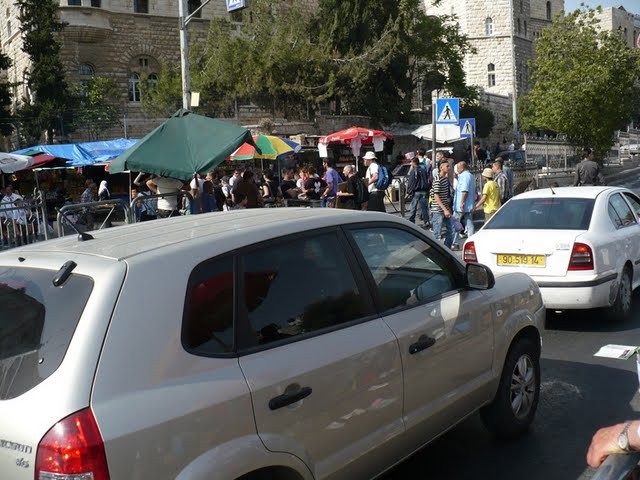
Suleiman Street, a main street that runs alongside the Old City. The umbrellas and shades each protect a street food vendor from the sun.

Later in the evening I asked the guys at the baguette restaurant where we dined about the vendors. The women, they said, come in from the West Bank, bringing their own vegetables that they grow – without fertilizers or insecticides [perhaps because they can’t afford them?]. They said that these are the best vegetables and fruits in the city, and they themselves always buy from the West Bank women. I asked about the other vendors – they were still doing a bustling business at 6:15 when we walked over to the Notre Dame Center for Mass, and at 8:15 – well after sunset – they were just closing up. Where does all of that stuff go every night, I asked – all of the teddy bears and plastic dishes and pots and pans and table clothes and shoes and socks and stripy bras and bags of nuts and . . . ? They take it all away for the night, I was told – in their cars, or maybe to a storage place in the network of streets and alleys behind the main street. Every bit of it. The baguette guys also said that this was Saturday, and many more people come on Saturdays because the Israeli police aren’t handing out tickets.

We did walk to the Notre Dame Center, and sang through the 6:30 Mass that was half English and half Latin, with a small choir and a small organ, and a tall Irish priest who held a “birthday party” for Pope Benedict around the baptismal font at the back of the church afterward. He asked if anyone had a camera to take a picture of the brief event, so Jim obliged and spent some time this evening trying to get his computer to cooperate in sending along the photos which will go to the Pope himself. We walked back through the chilly desert darkness with a low crescent moon and Venus shining below it in the sky.

Legionnaire priest Fr. Eamon Kelly, holding a “birthday party” for Pope Benedict XVI after the Saturday evening Mass at the Notre Dame Center in Jerusalem.

Our present plan is to take the train to Caesarea – Roman ruins and beaches – on Monday. Tomorrow might be nice, but the Israeli soldiers can ride the trains free on Sunday and Thursday, so they are often crowded. [Another aside – we asked the baguette guys, who speak good English and are friendly, if they had ever taken the train to Tel Aviv. They were puzzled. No train, the bus goes to Tel Aviv. We insisted that the train went. They turned to a much older man who was chatting with a friend outside the restaurant. No, he said, bus. No train. The train goes for the Jews – no train for the Arab section. So although they could go on the train, we are sure, the fact is that it leaves from a Jewish section of town, and they won’t therefore go on it.] That gives us more time tomorrow to explore parts of Jerusalem that we haven’t seen. Like Athens, it seems to hold enough for months of exploration, so we shouldn’t have any trouble finding things to do.

Montefiore windmill, built in Jerusalem in 1857, to grind wheat into flour. There was not enough wind to turn the blades, and the Israeli wheat was harder than the grain that the mill was designed for, so the mill was not a commercial success.

Posted in 2010, Israel, travel | Tagged , , , , , , , , , , , , | Leave a comment

April 19, 2010 — Caesarea — Roman ruins and Israeli trains, plus Anthea’s blogs

April 19, 2010: Roman ruins and Israeli trains

Oil tanker anchored in the Mediterranean off the coast at Caesarea, with Roman column in foreground, and haze from a Sahara sandstorm.

Jim’s account of the day

Quite a day. Up at 5:00 a.m. (okay, Teri was up at 4:30 a.m.) and on the way to the Jerusalem train station by 6:30 in a taxi that the manager of the Rivoli Hotel rounded up for us. It cost us 70 shekels (shekels are worth about $.32). Than we got two tickets to Caesarea for 76 shekels each. The train left the station around 7:40 am and we were rolling through a pleasant valley of trees on terraced hills, some shrubs and dry grass. The stream bed running alongside the tracks at the bottom of the valley was dry as a bone, but its well-scoured rocks suggested it runs swiftly with water at least part of the year.
There isn’t a lot of habitation west of Jerusalem. The dry, green, brown, and rocky slopes suggest the American southwest. And what is more appropriate for the west than a train trip. It took us almost an hour and a half to get to the main train station in Tel Aviv, and the last half hour was out of the wilderness and passing through civilization. Tel Aviv is a modern city with freeways, lots of high rises, an IKEA and all the trappings of western civilization we have come to know and love in the US.

Israel countryside between Jerusalem and Tel Aviv, from the train.

We had to change trains in Tel Aviv to get to Caesarea, which took another hour. Binyamini is the end of the line. Everyone off! A cab took us the last few kilometres to the National Park at Caesarea, which is an archaeological site featuring ruins from the time of Herod onward. There are the remains of a palace that Herod built, and further along, a reconstructed amphitheatre on the site of Herod’s amphitheatre. There is a beach that is littered with small shells, a few of which ended up in our pockets.
Restored Roman amphitheatre.
On the horizon was a huge ship, probably an oil tanker, and off the in distance to the south, several very tall smokestacks and a long pier, which was probably there for the oil tankers –  industrial features that were not in evidence forty years ago when I first set foot on this particular beach. In fact, almost none of the ruins, with the exception of the palace, had been unearthed then. In the place of a half dozen up-scale restaurants, and an equal number of antique and jewelry stores, equally up-scale, there had been only a patch of grass and palm trees, with dirt paths, and areas to camp. Once again, evidence that the world had marched on without me. There hadn’t been a fee then either. In 2010, it cost us each $10 to get in. That price included a video portraying the history of Caesarea, but we passed on that, wandering among the various ruins instead.

Roman ruins; oil tanker off shore.

After a few hours we were feeling the sun and heat; we felt like we had seen the best the park had to offer and began our trip home.

The attendant at the park gate called a cab for us which took us back to the train station. We arrived minutes before a train arrived to get us to Tel Aviv, and our return trip was a comfortable, scenic and pleasant as the morning trip had been. The Israeli trains are new, smooth riding, comfortable and run on time, as near as we can tell. Not all the information we needed was in English and we were forced to confirm from other passengers whether we were on the right train and getting off on the right stop. But they were very patient with us, and steered us right. We made it to Jerusalem by 4:30 and caught a taxi home. A taxi that charged us only half of what the morning driver charged us, by the way. I know I am being taken advantage of pretty regularly here. And it isn’t for huge amounts. And we do get what we need. And everyone is very friendly as they pocket our shekels. But it is tiring sometimes. Not that taxi drivers, and other purveyors are necessarily any better.

Teri’s notes

I half-way woke at 2:30 a.m. and lay there wondering where I was and how I got there and how I would get back. Slowly I worked my way back – Hotel Rivoli in Jerusalem. Took a bus from the airport to get here. Took a plane from Istanbul, and before that, a plane from Athens to Istanbul. Athens – got there from Newark, via Milan. OK. And got to Newark from Anchorage via Seattle. And Meagan is taking care of the house in Anchorage. OK. So there was an identifiable trail of connections to show that I was indeed Teri Carns, and had gotten to the Hotel Rivoli by a route that didn’t involve magic of any sort, pharmaceutical or otherwise. Reassuring, but still left me feeling disoriented.

Jim has described the day’s events. He didn’t mention the wildlife: one weasel – long, low, and light desert brown – running across the road as we approached the ruins. A pair of storks on a piece of the breakwater a hundred yards from shore. Some of the same long-legged black ants (like they’re running around on stilts) that we saw near the ocean on Aegina. Another pair of storks sighted from the plane on the way home. And more of the crow-family birds we saw in Greece, who turn out to my delight (having never seen one, but having read about them for most of my life) to be jackdaws.

Stork off-shore at Caesarea.

The humans for the day included the ticket seller and the station master at the main train station in Jerusalem, both of whom knew exactly as much about the train schedules for Caesarea as the Palestinians in our area. After taking the trip, I understand why the Palestinians don’t know about it – there would not be any reason for most of them to go to Caesarea, and no reason to take the train. The stationmaster and ticketseller are less understandable. Nonetheless, once we got to Tel Aviv, a very helpful girl who was a train employee got us on the right platform at the right time.

The trip itself had all of the advantages of train travel – more comfortable than a bus or plane, better scenery than bus, plane or car (because the trains typically don’t take up nearly as much land as the freeways on which the cars and buses travel, they are closer to the scenery), no traffic jams on the runways or freeways to hold them up, and so forth. Leaving Jerusalem, the first half of the trip was, as Jim said, through a gorge with limestone outcroppings, pine and eucalyptus forests, wild roses, Queen Anne’s Lace and other wildflowers, and little sign of civilization anywhere. Add some blue sky and sunshine (a predictable part of the recipe for every day here), and a cup of coffee, and there’s little else to ask for. The land settled out into slightly rolling fields, a landscape that reminded me of northern Illinois at its best. The herd of cows, and an occasional horse completed the illusion. And even when the urban areas showed up, much of the land along the tracks was in fields – hay, a two-foot high green plant that I didn’t recognize, olive and orange orchards, and even palm tree orchards, sometimes with big prickly pear cacti for hedgerows.

Sheep grazing in the hilly areas along the train tracks.

We ate our lunch at the “palm court” – that is, shaded by a tall palm tree in a park area, with the Mediterranean breeze for company, and a chunk of Roman wall to contemplate while we ate our croissant from the Binyamina train station (the stop for Caesarea) and flatbread fresh from an oven in the Old City. I like the Palm Court at the Plaza Hotel in New York (the children’s story of Eloise takes place there in part, and we ate there on our 1995 trip around the U.S.), but this palm court had a great deal to recommend it. The view out to the ocean was hazy – Anthea mentioned in one of her posts (see below for the links) that a Sahara sand storm is doing its best to make Southern Europe not feel that it’s been left out by the dust from the Iceland volcano. I couldn’t find any information about it on the Internet, but Anchorage periodically gets dust from storms in western China and Mongolia, so it seemed possible.

The Roman ruins looked to my very untrained eye a lot like the Byzantine ruins – blocks of stone, a browner/redder shade than the honey color of the stones of and on which Jerusalem is built – stacked and cut and held together in buildings for which one of the main questions is: “How on earth did they do all that?” Although the site, like everywhere else around here is ruins that were built from other ruins and served in their turn as the building blocks for new developers, it lay fallow from the late 1200s when the invading Turks destroyed what the Crusaders had built, until the mid-1800s when the Turks settled a small group of farmers from Bosnia there. The Renaissance passed Caesarea by, as did the age of explorations, the age of reason, the French and American revolutions, and a great deal else. The result has been that the ruins were relatively easy to get at. Now besides the ruins that are a national park, there is the town itself which is characterized as middle class and up, a small community of well-off people.

The stage of the Roman amphitheatre at Caesarea, now used for open-air rock concerts and other events.

We dined again at the Alhambra Hotel in the Palestinian district of Jerusalem, a few blocks from the Rivoli. The chef sent out a complimentary bruschetta sort of appetizer, prepared a large plate of cauliflower, peppers, zucchini and a few potatoes sauteed in olive oil, sent a complimentary side of fresh potato chips, and brought two bowls of fruit (complimentary) for dessert. I felt well- fed (read, stuffed) for the first time on the trip. It was delicious. We highly recommend it.

Anthea says:

Here are the links to Anthea’s blogs about her trip to Santorini –
First day:  http://antheaellinika.wordpress.com/2010/04/19/santorini-day-1/
Second day: http://antheaellinika.wordpress.com/2010/04/19/santorini-day-2/
Third day: http://antheaellinika.wordpress.com/2010/04/19/santorini-day-3/

Posted in 2010, Israel, travel, Uncategorized | Tagged , , , , , , , , , | Leave a comment