Sarria to Portomarin — with the Lazios

The Lazios are awesome. They’ve been training, and although they and Jim kindly walked more or less at my pace, it was clear that they could have easily walked with Regina and Anthea who were in Portomarin long before we arrived about 5:30 p.m. It was  just about 16 miles total for the day, by my pedometer, give or take half a mile depending on who else’s pedometer you looked at. The first two-thirds we walked mostly uphill (about 1,000 feet altogether), and the last one-third downhill. The weather grew warm by 10:00, but at noon we got our pilgrims’ breeze from the west. Today it gusted and tossed up light brown dust from the paths and sighed in the pine forests as we walked through them. Closer to the farms we heard the roosters, an occasional moooo from a cow, and the coos of doves.

We had woods some of the way (oak, chestnut and pine), fields of corn — some harvested, some not, hay fields, and cows. The smell of the cows dominated, although at times we had pine forest scent, whiffs of the mint that grows in quantity by the paths, and sometimes hay. The stretch of the Camino that runs from Astorga to Ponferrada seemed like the wildest stretch; now we’re back to more farmland. Another difference between Galicia and the earlier areas is the tiny villages — a handful of houses and barns set close together along the Camino. Most of them have nothing other than their stone buildings, but a few have cafes and the occasional albergue to serve pilgrims.

Many people start their Camino in Sarria, and the trails were busier than we’ve seen them. Lines for the bathrooms in the village bars were something we haven’t experienced before. Souvenirs have become common in the cafes, and the plaza in Portomarin, our evening stop, offers peregrino-themed goods of every description. Interestingly, there seem to be fewer bicyclists than in previous weeks. Anthea and Regina met people from Virginia (??) who had come as members of a 14-person running group. Jim and I and the Lazios walked some of the day with a Vietnam vet and his wife from Florida (Mike and Ann). In some ways, the Camino is very democratic — it attracts people from every background imaginable. I thought that there also were more people of a retiree age today, compared to the past three weeks when plenty of older people were walking, but didn’t dominate the stopping places nearly as much as today. Another indication of increased numbers was the young woman at a cafe halfway along who was bemoaning the fact that she couldn’t find any place to stay in Portomarin for the night. We were glad that we took the time yesterday. tedious as it was, to make our reservations for the next week.
Portomarin itself sits on the rio Mino, and the guidebook notes that its strategic position made it important to the Romans and everyone since. In 1962, Franco dammed the river to create a reservoir. Before the area was flooded, several buildings were moved to higher ground, including the medieval church that now dominates the present town square.
We got to Portomarin relatively late in the day; took a little rest and unpacked; then met Regina and Anthea at the pizza place they had scouted out for dinner. Increasingly, the menu del dias at the restaurants look the same: for the first course, a meat soup, a mixed vegetable salad (including the Spanish vegetable of tuna fish), steamed asparagus with a thick coating of mayonnaise, and a couple of other choices that feature ham. The second course is always a choice among five or six meat or fish dishes, although you can occasionally get pasta with tomato sauce. The desserts are flan, custard, ice cream (almost always packaged novelties or ice cream bars, and maybe a cake. Pizza is a good reliable alternative, and there’s only another week to go. At tonight’s place, however, we were able to get Santiago cake for dessert — a thin rich almond cake with lots of eggs, topped with powdered sugar. Regina and Anthea ordered the local liqueur — called “orujo.” They got two shot glasses, one with coffee flavor and one with herb flavor, both made by the waitress’s husband — so truly local. It was very strong and sweet, with the herb flavor being the more interesting.
Sunrise over Sarria.
The small, busy cafe at Barbadelo, about 10:15 a.m. — a stop for more coffee.
Cows, one of Galicia’s more common creatures.
Half a dozen trailers carrying hunting dogs, in one of the villages. Later in the afternoon, we heard a number of gunshots echoing through the hills. We surmise that this was a local hunting group of some sort — possibly after foxes?? [A friend who has walked this section of the Camino before thought that they were probably hunting doves.]
The first horseback riders that we’ve seen on the Camino. You can walk, ride a bicycle, take a wheelchair, or ride a horse or donkey and qualify for your certificate at the end showing that you’ve completed the Camino.
Galician chickens.
People harvesting potatoes.
Regina at the 100 kilometer marker. Its importance is mainly symbolic. Like the Alaska Highway, the roads and paths have been realigned since the markers were set in place, so we passed the real 100 kilometer mark somewhere else today. But that’s all the further we are from Santiago — about 58 miles tonight. (Anthea’s photo?)
Jim next to an old stone building that he admired — mossy slate roof, wood slats covering an entrance, and a single large piece of slate incorporated into the design.
Old stone wall adjoins new one.
Another way to transport your backpack along the Camino.
A crib for drying corn; on stilts so that rodents  and other creatures can’t get at it.
An afternoon break in the shade — Jim, Peg, Tom and Regina. Anthea was far ahead of us, and Regina was only there because she took a long break in Ferrerios to wait for us.
OK, I don’t have any idea what the point of this assemblage of items is. It appeared to be things discarded by pilgrims because they weren’t useful to them any more, or weighed too much, or for some other reason, the previous owner didn’t want to carry the thing any longer.
The medieval steps that lead up  to the main square of Portomarin.
The cathedral  in the square, at night. This was moved from its original location down by the river before the dam flooded the area. It was reconstructed, stone by stone, in the upper town plaza in the 1960s.
Hello Kitty and Dora the Explorer peregrinos (you’ve already seen SpongeBob Square Pants, and Homer Simpson.

Ci
Posted in 2012, Camino de Santiago de Compostela, Camino de Santiago trip, travel | Tagged , , , , , , , , , , , | Leave a comment

A day in Sarria

A pleasant day — not too hot. Regina and Anthea enjoyed sleeping in. Peg and Tom, Teri and Jim went off to explore, starting at the monastery where Jim, Anthea and I got new credencials. Those are the forms on which you collect inked stamps (Regina says it reminds her very much of elementary school) from churches, businesses, hotels, museums and so forth, that are dated and slow where you have been along the Camino. At the end of the trip, a pilgrim presents the credencial(s) to an official in Santiago, and if the number of stamps is sufficient, a “Compostela” or certificate of completion is issued. From Sarria on, two stamps per day are required.
We toured the church and cloisters, looked in on the cemetery, and checked around at the ruined castle to see if we could get into it somehow. No luck, so we made our way down the hill to the sports shop that is conveniently located right next to the Camino as it enters the town. It was chock-a-block with ponchos, backpacks, walking sticks, guidebooks, and everything else that a peregrino might need. Jim acquired a very highly recommended poncho (made by Altus, a European company) and Peg found a daypack and smaller bag for carrying things while her bag is being shipped. We found a Pharmacia where I could re-stock on aspirin, and got to watch their order-filling machinery in action. They enter the type and amount of the drugs needed into a computer, and a robot system scurries around the back room of the pharmacy (visible from the front of the store), finds the package(s), and puts them onto a conveyor belt which spits them out to the pharmacist waiting by the cash register. Very slick.
For lunch, we went to the Italian place, Matias Locanda Italiana, and ate delicious pizza. Bear Tooth (our favorite place in Anchorage) has competition. The rest of the afternoon was spent in making travel arrangements. We bought our tickets from Santiago back to Barcelona. Not too bad a price for the ticket, but an additional 3 euros to choose each seat, an additional 15 euros to check each bag (and we had to check the backpacks because they are too big for Vueling’s carryon policy), and 11 euros to pay with a Visa card. But it was still not much more than half the price of the regular airline. We also booked all of our rooms from here to Santiago, and felt glad that we had. In the smaller towns, most of the hotels in our price range were full. In the larger towns, it seemed that there weren’t many rooms left. We didn’t even bother to ask about wi-fi (which we have heretofore been choosy about), in part because even when we are assured that “Yes, of course, it is in the rooms,” it often is not. And tonight, we had to make the arrangements to ship my backpack and Peg’s and Tom’s, which took another half hour or more because different services carry the bags shorter distances along this segment of the Camino. The advantage is that there’s a good deal of competition, so the price has suddenly dropped from 7 euros per bag to 3 euros per bag.
In the evening some of us went to Mass at the cathedral; others looked around the city a bit more. We met back at the Italian restaurant — yes, we spent half our day there, eating, playing with Blue the kitten (see below for photos), talking with the owner, and generally enjoying ourselves. The food is outstanding and the atmosphere welcoming.
Tomorrow we are back on the road, for the last six days of walking. It looks to be a longish day, with considerable up and down, about fourteen miles from Sarria to Portomarin. We’ll report back, as often as possible, but as noted above — we didn’t ask about wi-fi, and may find ourselves without. Wish us luck, and we wish all of you a happy and pleasant weekend –
Regina: “Chocolate and churros for breakfast (not at the Italian restaurant).” [Churros are very much like doughnuts — a light, fried dough; the chocolate is the very thick dipping/drinking chocolate.]
Can anyone tell us what these are? We think that they might be brussels sprouts plants, stripped of their sprouts. But we can’t figure out why they leave the plants standing, if that’s the case. We’ve seen these in gardens all across Spain. [Note from later: They are called walking stick cabbages. The lower leaves are stripped off as the plant grows and fed to the livestock. The stalks are harvested for walking poles, although we never saw anyone using anything that remotely resembled these.]
Peg in the monastery church. Note the crystal chandelier — we have seen these in a number of Spanish churches — I don’t ever recall seeing them in other churches. The alter is a heavily-gilt-covered work with several statue framed in elaborate Baroque curlicued niches — a great contrast to the very simple gray stone arches of the church itself.
Saint James – Santiago — as a pilgrim. This is one of his two representations (the other is as the Moor-slayer, Matamoros — we are less fond of that image). He has the pilgrim’s staff, gourd (for water), scallop shells, hat and cloak. Plus, he has a book because he was a writer. This was in the monastery church that we visited in the morning.
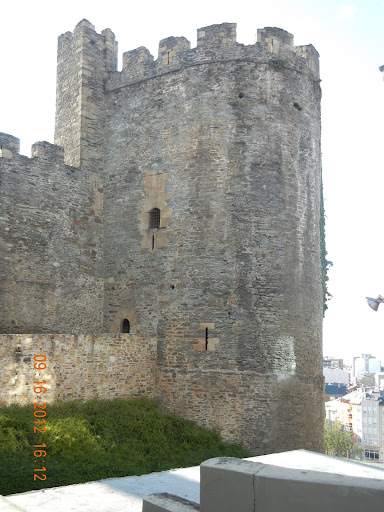
The ruins of one of Sarria’s castles, Fortaleza de Sarria. The guidebook says that it was destroyed “during the uprising of the peasantry against the aristocracy” during the 15th century. The owner of the Italian restaurant where we ate breakfast, lunch and dinner says that a group of people would like to buy the castle and restore it; to that end they are working on raising a million euros.
A Camino panhandler — or, if you prefer, a pilgrim who is making his way along the Camino existing on donations. I gave him a couple of euros earlier in the afternoon; he later came into the Italian restaurant a bit tipsy. By evening, he was back, soberer for the moment. I suppose he could make a very decent living never leaving Sarria. He characterized himself as a :libertarian anarchist,” and said that he had walked the Camino five times. [We saw him several days later, maybe in Santiago.]
Peg and Tom waiting for lunch.
Anthea: “The family and Blue, a brand new kitten, in Sarria [Blue lives at the Italian restaurant]. (My book about the Camino is going to be called ‘Cute Animals to Santiago’ and be sponsored by Can Has Cheezburger.)”
A kids’ birthday party at the Italian restaurant. They all trooped in with this cake (mound of candy? Not clear); they were delighted to have their picture taken. No adults were anywhere in sight — not something that you would find happening in an American restaurant.
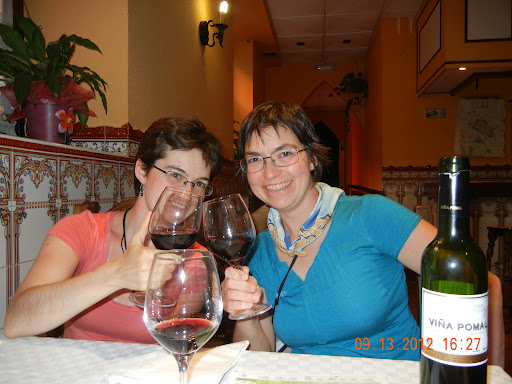
Our dinner wine — or at least the bottle it was served in. They didn’t pull the cork at the table, and Regina said it was possible that a wine bought in bulk had been decanted into a bottle for serving at the table. It was a pleasant, very mild wine compared to the wines we’d had earlier in the trip.

Posted in Camino de Santiago de Compostela, Camino de Santiago trip, travel | Tagged , , , , , , , , , , , | 2 Comments

Samos to Sarria

Today was a short walk, we thought, and set out promptly at 9:00 a.m. after breakfasting on toast, butter, thick local honey and coffee. Nearly four hours later we finally came to a place to stop for coffee, and by then, lunch. It’s been very unusual to walk such a distance without encountering a bar or restaurant.Much of the path was woodlands and meadows, with stretches along the rio Oribio and plenty of up-hill and down-hill. Luckily, we had shade much of the time because once again the sun shone bright in Galicia.
When we got to the main street of Sarria (at nearly 3:00 p.m.), Regina and Anthea snagged us — they found an Italian restaurant (owned by an Italian) an hour or two earlier and had been enjoying excellent pizza and beer. We helped them finish the pizza, and then all came back to our very pleasant pension and kicked back. This evening we climbed back up the hill for Italian dinner — an excellent thick spinach and potato soup, a couple of different kinds of pasta (one with artichoke and butter sauce, and one with arriabata sauce), and tirimisu. This was served as the “Menu del dia” — menu of the day — several choices of soups and salads for the first course, several choices (all meat or fish for the second course but they usually provide something like omelettes (tortillas) for vegetarians); plus bread, water, house wine, and dessert — all for nine euros, a very good price.Then it was time to meet Tom and Peg at the bus station, and settle in at a nearby bar so that they could have some dinner and beer.
It’s been a pleasant day — enough walking (11 miles to get here, plus another couple around town) to justify eating a hearty and delicious dinner, but not enough to entirely wear out. Tomorrow we’ll take it easy — we’ve been walking for seven days straight and it’s time for a rest. When we set out again on Saturday morning, the path will be more populated. We met an Irish couple at the Italian restaurant who is just starting from here tomorrow, and traditionally Sarria is the beginning point for people who have only a week or so to get to Santiago. This was our 26th day since we left Barcelona, and it is odd to think that we could be just now starting out.
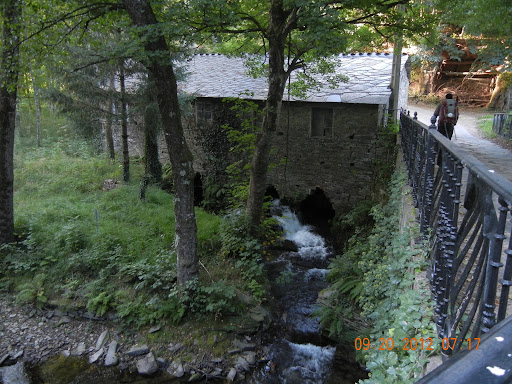
An old mill and mill race just outside Samos.
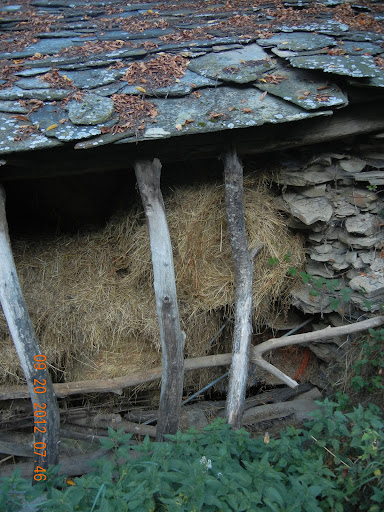
A hay storage shed, with tree trunks for supports, a couple of stone walls and a slate roof.
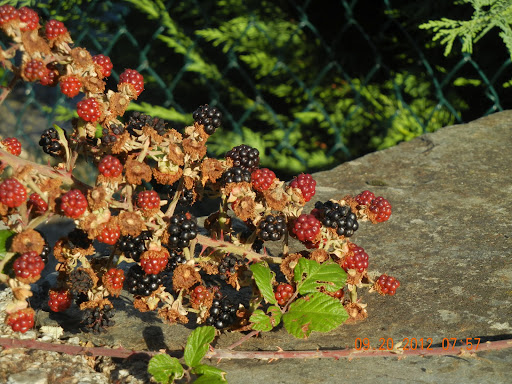
We’re still eating tiny black raspberries, a few for breakfast, a few for lunch, every day.
 
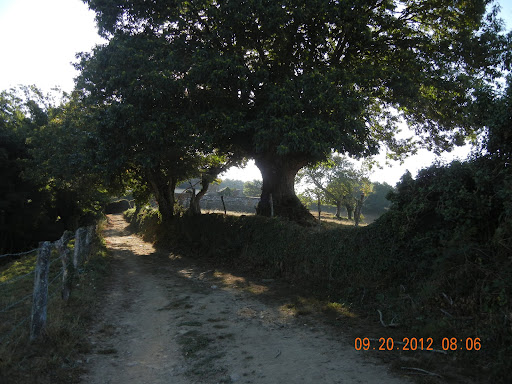
Part of our path, on dirt track beneath old chestnut trees.
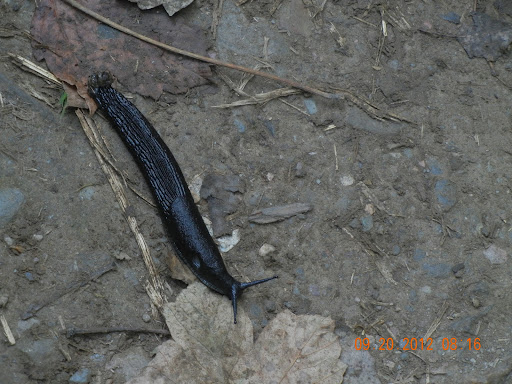
Today’s wildlife — a shiny black Spanish slug, ready to take on the Santa Cruz Banana Slugs.
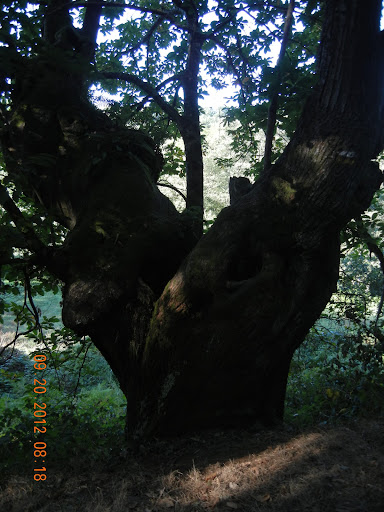
An old tree, one of hundreds along the way, that’s mostly hollow inside that twisted set of trunks but surviving quite nicely.
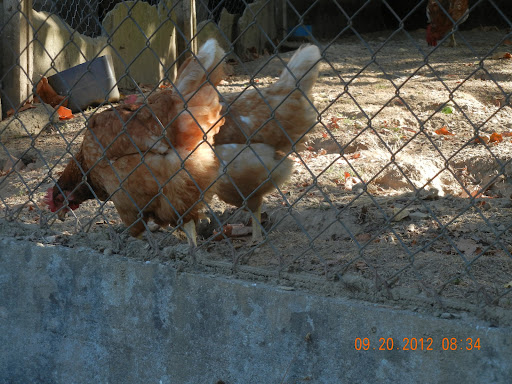
Village chickens.
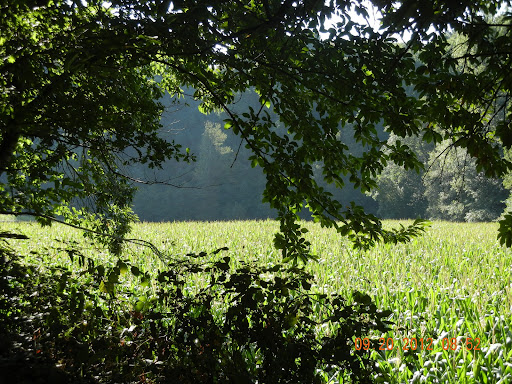
Galician corn — very healthy. They’ve harvested a few fields here and there, but it seems like they would have harvested more of it by late September.
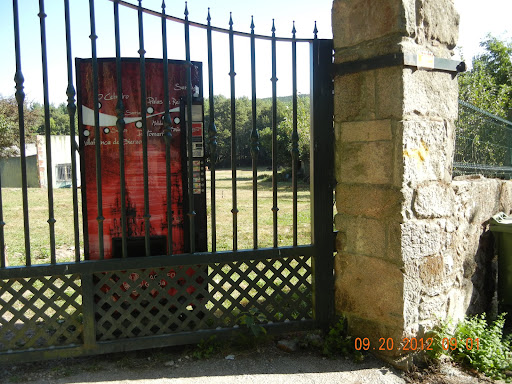
We have seen a few of these — vending machines set in someone’s front yard, accessible to thirsty pilgrims but protected by iron bars. Enterprising folks.
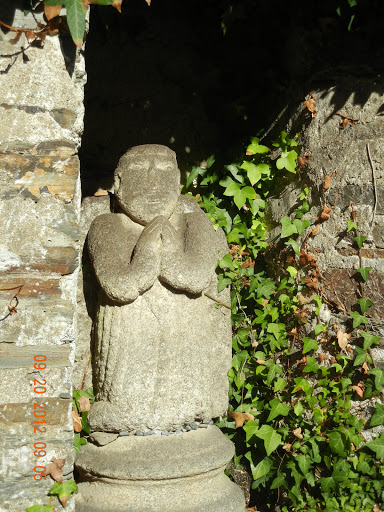
A roadside saint in a little shrine.
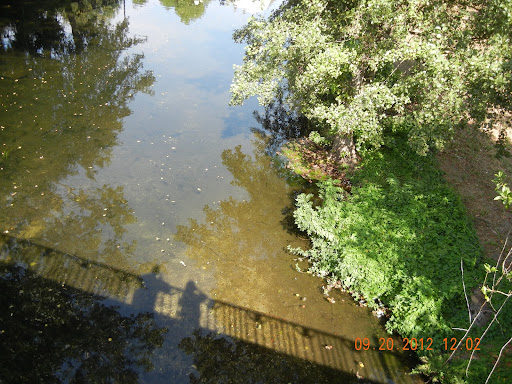
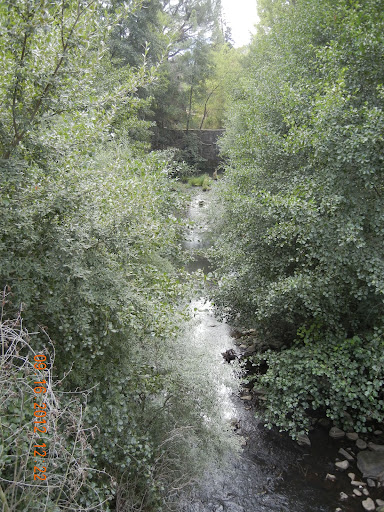
Jim and Teri standing on the bridge over the rio Sarria.
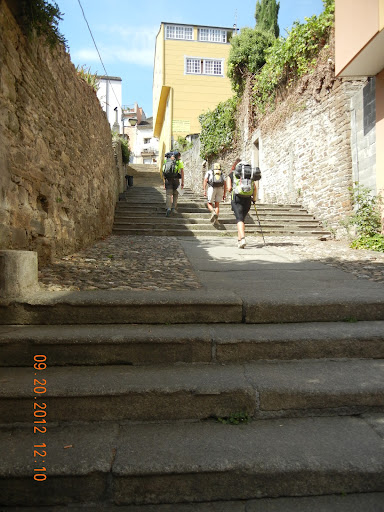
Peregrinos going up the steps into Sarria from down by the river.
The Carns family greets the Lazios at the bus station in Sarria — Anthea, Regina, Jim, Tom and Peg.

Posted in 2012, Camino de Santiago de Compostela, Camino de Santiago trip, travel | Tagged , , , , , , , | Leave a comment

O’Cebrerio!

We start with Regina’s photo of Galicia from the high pass of O’Cebrerio — 4,297 feet. Cruz de Ferro was higher, at 4,940 feet, but the climb up to O’Cebrerio seemed tougher. Luckily, we had blue skies and sunshine — by all accounts, not that common in Galicia, the province we are now in.
We left in good spirits from Herrerias at 9:00 a.m. Regina — who says she likes to go fast uphill — arrived at O’Cebrerio (a distance of about 6 miles and an ascent of something over 2,000 feet) at 11:00. Anthea — who got distracted by a yellow cat and a black puppy in a small town along the way, as well as getting briefly on the wrong track — arrived at noon. Jim and I — I am very slow — arrived at 1:00 p.m.
The town’s 50 permanent residents had been joined by a steady stream of peregrinos who arrived, got their pictures taken by each other and whoever else was handy, ate some lunch, and drank some beer. People milled around the souvenir shops in the small main plaza. Regina pointed out that much of what they sold — clay pilgrim figurines and weighty knickknacks of standard tourist sorts — would not be attractive to the actual peregrinos, who by the time they have reached O’Cebrerio understand intimately the weight of worldly possessions. The guidebook says that the town has become a tourist destination, and it had much more of a cheery holiday air about it than almost any other place we’ve been. It also had the other aspects of tourist towns — when we tried to order our standard lunch sandwiches — a baguette with cheese and tomato slices, the answer was “no tomatoes.” It was hard to find a table for sitting to eat lunch, and we were OK with leaving soon after checking out the church and getting our credencials stamped.
In order to meet my sister Peg and her husband Tom in Sarria tomorrow (they are in Santiago now, having left Des Moines yesterday), we took a cab to Samos, home to a famous Benedictine monastery. From here we will walk about 12 kilometers to Sarria. The cab ride down that long mountain and all the way to Samos took about half an hour, enough time for the girls to doze off after the morning’s climb and the celebratory (and cooling — it got hot by about 10:00 a.m.) beer. Thus we have had the rest of the day to do laundry (in a washing machine!!), give some thought to the next week’s scheduling (because it is rapidly becoming more difficult to find rooms), see the monastery (Regina and I took the last tour of the day; it was in Spanish, but we had a brief printed English guide that helped); and get some dinner (good pizza, actually homemade and not frozen). And, as is too often the case, we’ve spent a couple of hours trying to get the wi-fi working; finally the cheerful young manager figured it out, so we have it at least for the moment.
Other notes: Cows. Cows are big. Their bells jangle as they wander about the meadows or crowd you out on the narrow paths that constitute the Camino much of the time. They come in small herds — a dozen or two in a field is the most we’ve seen. They don’t look at you with much sense of recognition or curiosity. They leave cow patties on the paths, mentioned several times by the guidebook, and their smell often permeates the area.
The distracting yellow cat — this cat has figured out peregrinos. Its spot in the sun at the end of a stone wall next to the Camino path means that some goodly percentage of the people who walk by will say, “Ohhh — cute cat” — and want to scratch its head. The cat obliges, rolls over to let you know that it needs its tummy rubbed too, and generally entices you (me) to keep on paying attention to it long after your walking companions have grown impatient.
The hippies in La Faba — They run a bar for peregrinos. The guy fit into that category that I mentioned before — men in their 40s or 50s, deeply lined faces, bad teeth, scruffy hair, thin, and a general air of having seeing a great deal of many sides of the world. We went into the bar for a Coke, and I wandered around a bit fascinated by the beaded earrings for sale, next to the ankhs and peace symbols on cords, the Indian print bedspreads, the up-to-date TV, set so that the owners could be working in the kitchen and watch it. I pulled out my camera to take a picture, and the woman half of the partnership caught sight and said, “No photo!!” She was wearing the white peasant blouse, had the dark hair pulled back over her shoulders, had a frown that belied the atmosphere of peace and love — I’ve met a dozen women like her since 1966. I wandered back outside, and the guy brought out a plank of wood the size of a dinner plate with a wonderful smelling curry of fresh vegetables, served one like it to a couple of peregrinos, and then sat with them eating his lunch with chopsticks. Ganesh (the Indian elephant-headed god) smiled on them all from a niche outside the bar. They were part of the 1960s, part also of the medieval tradition of the Camino, but wholly in 2012 with the TV and appliances and no doubt a car and Internet.
A Casa do Ferrerio — we ate dinner last night and breakfast this morning at the bar here, and because the guidebook mentioned that there had been a forge here we asked if it still existed. The woman of the house took us in to see — it was her father’s most recently (and apparently his father’s before him), and when he stopped working it, no-one moved any of the pieces.
Anthea and Regina, ready to tackle the mountain — the morning started off cold and clear. At 7:00 a.m., Orion shone bright just above the mountains to the south.
The rio Valcarce — it continued as our companion for a ways up the mountain. It was such a pleasure to see and hear the rivers, after passing so many of them in the rest of Spain that had dried up for the season.
Yellow primrose, opening to the sun.
A cow on the path — there’s no question about whose path it is if the cow wants to use it.
A fence near the mountain top made of branches tied together. Scenery beyond.
Ganesh on the Camino, with some of the rinkets for sale at the bar in La Faba.
The boundary marker for Galicia, with standard amounts of graffiti.
Jim at the top of O’Cebrerio.
A dozen happy pilgrims sitting on the wall at the entry to the town of O’Cebrerio. Jim is at the far right.
The bustling plaza in O’Cebrerio; souvenir shops in the background.
A palloza in O’Cebrerio — a traditional round building with thatched roof, shared (I think) by a family and their livestock.
Nereids (Sirens) holding up a fountain in the cloisters of the Benedictine monastery in Samos.
Pilgrim laundry drying on bushes at an albergue in Samos.
Posted in 2012, Camino de Santiago de Compostela, Camino de Santiago trip, travel | Tagged , , , , , , , , , | Leave a comment

Villafranca del Bierzo to Herrerias

The route from Villafranca del Bierzo to Vega del Valcarce has been one of the most frequently described in the books I’ve read about the Camino, and most characterizations have ranged from “harrowing” to “terrible.” But much must have changed in the years between those accounts and today’s trip, which was the pleasantest day to date on the Camino. The weather cooperated — always essential — with overcast in the morning, and sunny, but often shaded and breezy in the afternoon. The road cooperated – for the first time, our entire route was paved, and was mostly a gradual uphill climb. Best, though — it was along rivers most of the way. The rio Pereje and then the rio Valcarce sang their way downhill as we climbed up, mostly through chestnut and birch and alder/aspen forests. The birds accompanied them, and the breezes in the trees added their whispers.
How to reconcile such a beautiful 12 1/2 miles with the horror stories I’d previously read? In the past, the road along the river was one of the main highways through this section of northern Spain with lots of cars and trucks. Recently (post-2005?) the traffic has been displaced to a freeway that runs parallel to the old smaller road. And subsequently, the road was improved for peregrinos by setting a concrete barrier along the shoulder, giving a several-foot wide paved area for walking, and a full two-lane road for local traffic. So there weren’t many cars, we had a safe, paved walking path, and the river and woods to freshen the day. For once, I didn’t get to the hotel room and have to spend the first half hour cleaning shoes, pants, feet and all else dusted from the day’s trails.
Regina and Anthea took an alternate route, a path that went up a little mountain and down again, with gorgeous views of valleys and peaks. They saw a deer, and felt that they’d made a good choice. We met them in the town of Trabadelo for lunch, and then walked the rest of the way to Herrerias together.
From Trabadelo, the road snaked through several small medieval towns along the rivers. We stopped at the first, La Portela de Valcarce, to experience a Spanish truck stop favored by the drivers on the freeway. We ordered our Cokes (in Spain, these always come in a can or bottle, are poured into a glass, and served with ice and a slice of lemon or lime), and watched as an older Japanese woman, a peregrino, tried to buy cigarettes from a machine. The cashier behind the bar/counter must use a remote control to allow the machine to dispense cigarettes, and the system wasn’t working well. After some frustrated miscommunications all around, the woman finally got her cigarettes, collected her beer, and went out to sit on the terrace to enjoy her break from climbing up O’Cebrerio. We finished our Cokes, got our credencials stamped with the official truck stop peregrino stamp, and went our way on up the mountain.
It was a leisurely walk and we didn’t arrive at our hotel until about 5:00 p.m. After cleaning up, doing a bit of laundry, getting some rest and nursing various blisters, aches and pains, making arrangements for tomorrow, and catching up a bit on email, we headed out for a late dinner. Herrerias appeared remarkably quiet — most of the peregrinos we saw during the day appeared to have stayed elsewhere.
On our way through town to find someplace open, I said, “Look, mint,” and grabbed a plant to pull a leaf from to demonstrate. Unfortunately, I got the stinging nettles instead of the mint, and am paying the price — it’s been a long time since I encountered nettles, and hope that it is a long time until I forget what they look like and grab them again.
We passed a field of cows (limited only by a small ditch and a single electric wire), a long stone bench with a dozen old women and men bundled up against the mountain evening chill and chattering, and not another living thing aside from the indow box petunias. Finally we found a restaurant, and went in to see if they were serving dinner, and whether they had vegetarian food. After negotiations, we agreed on vegetable soup, pasta with tomato sauce (and no tuna — tuna is considered a vegetable here, perhaps because it comes in a can?), and Cuban rice (rice with red sauce and a fried egg on top), plus a salad for Anthea, and the local Bierzo red wine — very nice, with a sweetness that captured mountain sunshine. We were the only people, probably for the entire evening, so good service — nice people. The gentleman said that it would only take us two hours to get to the top of O’Cebrerio tomorrow. We appreciated his faith in us.
Walking back we looked for the Milky Way, which tradition says is the Camino. It was faint, but present, with a satellite spinning through it and a multitude of other stars competing for our attention.
As we walk, we come up with variations on songs, to suit the Camino. Today’s, from Anthea, goes to the tune of “Yellow Rose of Texas:” — “Oh, the yellow shell of St. James is the only shell for me,/ I wear it on my backpack,/ I see it on a tree./ I followed where it pointed,/ A field of stars to see –/ The yellow shell of St. James is the only shell for me.”
We’ve also come up with, “You’ve got to walk that long Camino,/ You’ve got to walk it by yourself/ Oh, nobody else can walk it for you,/ You got to walk it by yourself.” There have been others, but not written down, and too late to reconstruct them — all the people who could help are good pereginos and long since asleep.
A few photos tonight; the Internet is slow to upload them so that they can go into the email.
Camino graffiti on a sign.
A street cleaner’s broom, in Villafranca.
The road sign for Pereje. We think that the replacement of the “J” with an “X” is a statement by the Basque separatists. Earlier in the trip (in and closer to Basque country) we saw much more graffiti urging Basque independence.
A view down to the rio Pereje from the Camino.  Fishing is allowed in parts of the rivers – some areas specify catch and release; one spot wanted only artificial flies.
The old highway, now little used, and with concrete barriers walling off the shoulder for the Camino users.  The terrain on the left, with the river and the lush green reminded us of Western Washington, while across the road the rock faces  and scrub lands going up the mountainsides more resembled eastern Washington.
We go under the new freeway, the N-VI.
A large garden and an isolated house by the rio Pereje — very unusual to see a house out in the country by itself.
A cat, uninterested in portraiture.

Posted in 2012, Camino de Santiago de Compostela, Camino de Santiago trip, travel | Tagged , , , , , , , , , , , , | Leave a comment

Ponferrada to Villafranca de Bierzo

There are several Villafrancas along the Camino Frances — it means “Town of the Franks” and referred to all of the people coming from France to get to Santiago. Tonight’s town is  Villfranca of the Bierzo region, which is hilly and agricultural. We’re seeing vineyards again, fruit tree orchards (apples and pears), and more variety of plants in gardens, from palm trees to rhododendrons (blooming now).
The town is impressive, only 5,000 people, but much more spread out than most of the towns we’ve been through. Like Ponferrada it has a big brown stone castle looking over the rivers that run along its edges — these are the first castles that we’ve seen, and they are in excellent shape, at least on the exterior. We haven’t the time or energy left at the end of the day to do more than snap a few shots as we trudge by. We’ve also seen more very modern houses, in both the suburbs of Ponferrada and here — largish fenced homes, often with vegetable gardens and fruit trees, but nothing that we would really identify as landscaping.
We put in another long day — Thursday the 13th was our post-Leon/hospital rest day. Friday the 14th, we walked 17 miles, to and around Rabanal. Saturday the 15th, was about 14 1/2 miles. Sunday the 16th we put in about 13 miles, and today Regina and I got in around 19 miles (we got three extra because we went out to hunt down dinner; Jim and Anthea stayed put at the hotel and found things to eat from our various stashes). Much of today was very pleasant walking, along pavement and often flat. The weather cooperated — overcast, with only a brief spell of afternoon sun. But the last stretch was mostly uphill, and it took an hour to get from the edge of Villafranca through town to our hotel on the other side. Admittedly, we spent some time on the bridge over the Rio Valcarce talking with Chad from Ireland, and one of his buddies. The buddy will meet his girlfriend in a few days in Sarria, we learned, and they will walk from Santiago. From there, they will take the bus to Finisterre (“the end of the earth”), and he will offer her the engagement ring that he bought in Burgos. It actually seems sort of reasonable — if they’re still speaking after walking 100 km in a week, maybe they’ll do fine married.
We saw plenty of interesting sights along the way. One of the most charming was a peregrino with a tiny black kitten. She didn’t speak a lot of English, but seems that she had found it along the way. Its mother was dead, and the woman adopted it and is taking it to Santiago — and I guess back home (wherever that is). It’s small and portable, and luckily there weren’t any more or the Carns family might have been tempted to acquire a new kitten too. We don’t see much in the way of wildlife — a squirrel or two, and birds. Now and then a lizard scurries across our paths; Regina is best at spotting them.
When we checked into the hotel this afternoon, the old gentleman at reception indicated to us that we had to go around to the bar in order to pay the bill. He walked down the street with us to the bar which was classic Spanish — at a small table next to the door, four older men were playing cards. A couple of other groups of men were watching futball on TV, more groups were standing at the bar talking to each other, and the two women in the place were waiting on them. Our old guy joined one of the groups, and left one of the women to the task of making note of my passport and running the credit card. Later in the evening (around 9:00) when we were walking home, Regina pondered the question of why we see so many clusters of old guys in Spain, hanging out at the bars or on benches, and why that doesn’t happen in the U.S.
Tomorrow is another pretty long day because we couldn’t find a hotel in the closer towns. But that means that from Herrerias, we will have only about 8 1/2 km (and 2,035 feet) to get to the top of O’Cebrerio.
A political sign lying on a sidewalk in Ponferrada — loosely translated, it says, “no budget cuts!.”
A stork’s nest in Fuentes Nueves. An Aussie with whom we were walking said that at times, the churches put poles near bell towers to encourage storks to nest because they keep other birds away that might damage the church bells. This nest may have been abandoned; a couple of dozen non-stork birds were calling it home and flew in and out making quite a racket all the while.
A mother cat and two kittens at home on a hot tile roof.
An ad for a school that teaches traditional Spanish music — Galicia (we’ll be there soon) is Celtic, and has bagpipers, which we hope to hear.
We are back among the vineyards for a while.
Three tired pilgrims with several hours yet to go – Anthea, Jim, Regina.
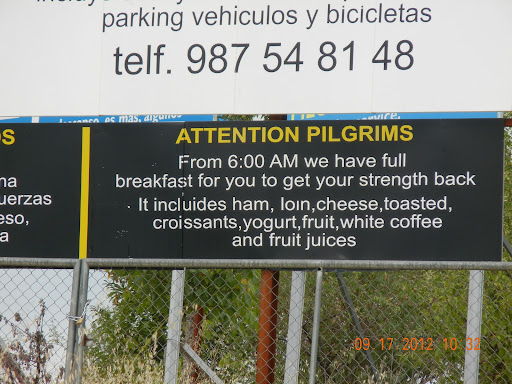
A billboard advertising a hotel and services for pilgrims, including parking for vehicles and bikes. The breakfast delights include loin (a cut of pork), toasted (which probably means toast), and white coffee (i.e., coffee with milk — which is the default here. If you don’t want milk in your coffee, you have to specify upfront and very clearly that you want it black. Also, most vegetable sandwiches and salads include tuna fish; again, if you don’t want it you have to specify).
A tree trunk  in a restaurant courtyard entirely covered with little crocheted things.
An old wine press carved from oak, in Camponaraya (I think).
A diagram of how the wine press worked.
An ad for a hotel in a town that we will pass through tomorrow, suggesting that you take a break there before starting up O’Cebrerio like the unhappy pilgrim at the lest side of the picture.
An encounter in the streets of Cacabelos between a car and a truck. People were trying to lift the car and move it the two inches needed for the truck to get clear.
Another close encounter between a car and a farm vehicle, in the streets of Villafranca. The castle is the brown thing in the background wearing a conical roof.
At the entrance to Villafranca an enterprising homeowner had set up a vending machine with Coke and beer. Anthea has a smile and a cold beer.
A view of the scenery. Mountains do make for gorgeous vistas.
A river view.
Ponferrada Camino sighting.

Posted in 2012, Camino de Santiago de Compostela, Camino de Santiago trip, travel | Tagged , , , , , , , , | Leave a comment

El Acebo to Ponferrada

Another awkward night for the Internet — we’ll see what we can get finished before the hotel bar closes or the whole thing cuts out entirely. No wi-fi in the rooms, despite assurances that there was (but even hotels in the U.S. that tell you you’ve paid for Internet in your room often enough don’t actually provide it).
We walked downhill from El Acebo (the small mountain town with the beautiful B&B (casa rural, in Spain)) to Ponferrada (means Iron Bridge), at one time a large Roman city that was important for iron and gold mining. From El Acebo down the mountain to the town of Molinaseca where we met Regina and Anthea for lunch was mostly treacherous rock with pebbles, stones and dust added to decrease the security of footing. Part of the section was designated “very difficult,” the rest was merely garden variety treacherous. Luckily the weather was overcast and in the low 70s for much of the day, making that aspect of walking pleasant.
I may have made this complaint before, and I may make it again. It seems highly unlikely that medieval pilgrims would have gone along these isolated paths through fields and woods — today’s trail was wilderness, with woods and no fields or sign of people for long stretches. They would have been too subject to attacks by bandits, and besides there were  (and are) actual good roads to take instead. One of my projects when I have time will be to match up traditional Camino routes with the routes designated today. The “rustic paths” do keep peregrinos off the roads making them safer for auto traffic. I am awed by the fact that just this year 10s of 1000s of people have already gone down these same difficult trails, knowing that many of them were in worse shape than me.
At any rate, we survived, and were pleased that most of the route between Molinaseca and Ponferrada was paved sidewalk and road. Two brief encounters: We saw a girl ahead who appeared to be favoring her feet. She stopped, and we stopped; she said she had bad blisters and that her feet were very painful. I was ready for a break, and pulled out the chocolate to share, which was well received. A little later, as we stood in a small plaza looking for street signs (which in Europe are often cunningly hidden or simply non-existent), a couple of peregrinos walked up and asked if they could help us. We chatted a bit, and the guy said to Jim, apropos of nothing, “So how old are you? 80?” His wife said, “Oh no! He’s not 80!” The guy said, “Oh, are you 40?” Jim laughed, and said, “We’re in our 60s.” I asked about his wife’s small bunch of green — “Is that rosemary?” They said yes, and gave me the name in Portugese, and a sprig to carry with me. I asked if she cooked with it at home, and they said yes; “We are John and Anna and when you come to Lisbon we will cook you something with it.” So when I go to Lisbon, I’ll try to find John and Anna . . .
After that, we found our hotel, discovered that the kids had arrived before us, made our evening plans, did our laundry and showers, got a little rest. We headed out about 6:30, walked down to the Pharmacia by the river to get Tylenol and bandaids, looked around in the plazas for a dinner spot, took some photos of the Templars’ castle that dominates the town (usually the churches get that position), and went for pizza. But — ahh, what pizza — real veggies on it — zucchini, capers, red peppers, artichokes, onions (everything in Spain has onions). A good tomato sauce, some parmesan cheese, a nice thin crust — pizza that someone made from scratch, not a box. And ravioli, with a ravishing tomato sauce and a bit of pesto, and plenty of olive oil — the best meal we’ve had this trip. For dessert, Regina ordered whiskey tart (she and Anthea agreed —  not enough whiskey). Anthea ordered Nutella pizza, which the two of them ate while discussing what else it needed — chocolate shavings? chopped salted nuts? whipped cream? All of the above? I have food fantasies — sitting at Spenard Roadhouse with a double order of their various veggies in front of me. Bear Tooth pizza. Orso’s various offerings. Tutta Bella flatbread (in Seattle). The food in Spain will not be the reason I come back, although if there were a few more places like this evening, it might help.
Tomorrow we walk to Villafranca de Bierzo; the next day, to Vega del Valcarce, and then up to O’Cerbrerio — one of the big challenges of the trip, at 4,300 feet. And then we will take a bus to Sarria to meet my sister Peg and her husband Tom on September 20.
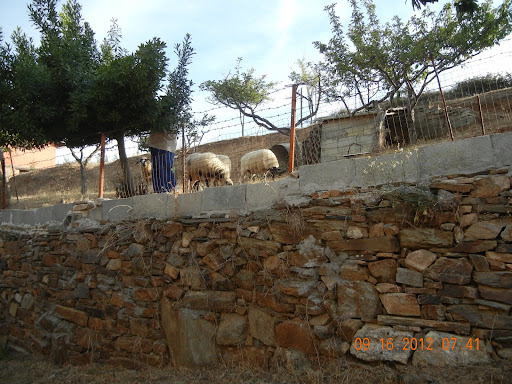
Sheep, and a man pruning trees on a Sunday morning in downtown Riegos (population, maybe 50). We went through Riegos on our way downhill from Acebo to Molinaseca.
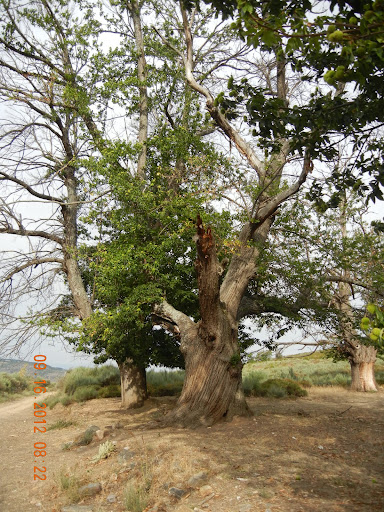
A grove of very old chestnut trees, partway down the hill between El Acebo and Molinaseca.
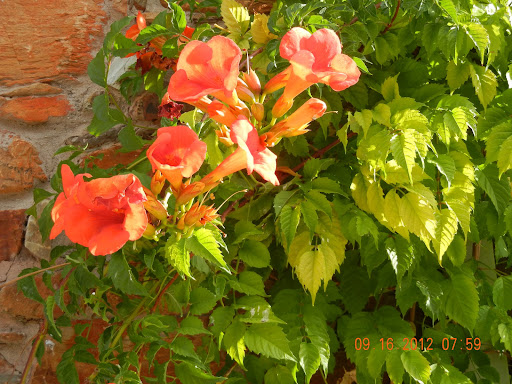
Trumpet vine in one of the small towns along the way.
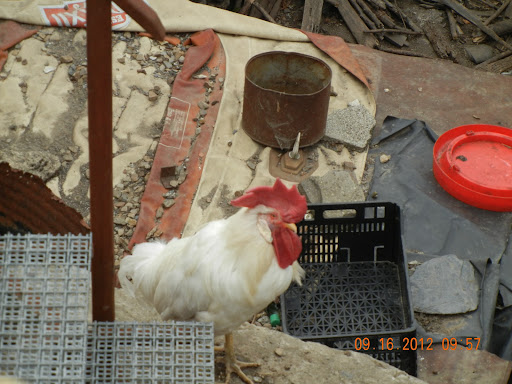
An urban rooster near the church in Molinaseca.
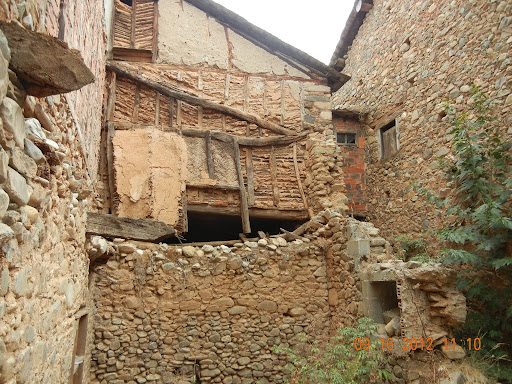
Exposed construction in Molinaseca — they just don’t build places like this any more.
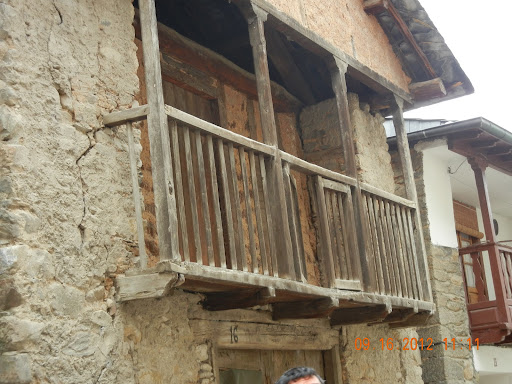
The guidebook says that these balconies are typical of the houses of this region. This one looks very old; many (even on the older houses) are much newer and look more securely attached.
Rio Boeza, running through Ponferrada underneath Pons Ferrada (the iron bridge).
The Templar castle in Ponferrada.
There’s more, but the bar’s Internet seems to have decided to quit for the evening.
Posted in 2012, Camino de Santiago de Compostela, Camino de Santiago trip, travel | Tagged , , , , , , , , | Leave a comment

Astorga to Rabanal del Camino

Short notes tonight — our Internet is limited to what comes with dinner, and runs out in about 20 minutes.
We put in about 14 1/2 miles walking uphill (but relatively gentle slopes, mostly) from Astorga to Rabanal — a medieval town that focused on pilgrims. Much of our way was through scrub, and at the end, some pine forest. Stretches of the views reminded me of the  Kenai Peninsula — rolling forests with no signs of habitation. Sunny, blue sky with few clouds. Cold in the morning — I had most of my layers on at 7:45 a.m., but warm by 11:00, and hot by 2:00.
I like this area — the towns are a mix of medieval ruins and modern houses; albergues and the Cowboy Bar in El Ganso. The Romans mined gold and iron here — another resemblance to Alaska.
News break — a set of drummers and castenets coming — oh — it’s a festival, happening as we speak — with a flute, drums, lots of castanets (20 people at least). The bar owner where we’ve been dining is pouring sangria out of a jug for everyone — onlookers and band. Awesome. Now, I think that they’re marching on to another part of town. Kind of like Christmas caroling. September is a month for festivals everywhere in the north of Spain, and this is Friday night so a good time for drinking and castanets.
Photos tomorrow —
Our feet hurt. Tomorrow we climb to the  top of Mount Irago, and set our stones on the pile at the foot of the Iron Cross –  Cruz de Ferro. Then we head downhill, and spend the night at Acebo. With luck, the Internet access will be more forthcoming there.
A happy weekend  to all — Hope your weather and adventures are as great as ours. Teri, Jim, Regina, Anthea
Posted in 2012, Camino de Santiago de Compostela, Camino de Santiago trip, travel | Tagged , , , , , | Leave a comment

A quiet day in Astorga

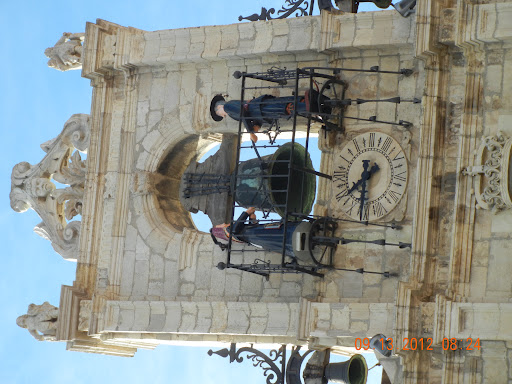
I have taken everyone’s excellent advice, and am taking it easy for another day — really easy. It’s 4:30 p.m., and I’ve only accumulated about 1 3/4 miles. But here’s how great Astorga is — we had the cab drop us off at one of the main albergues; we got a room for the night (shared bath); we went out to get more minutes on our SIM cards for Anthea’s phone and mine; we found Roman ruins (2 sets), 2 chocolate shops, several interesting churches, a pasta and pizza place for dinner, and a government building with a set of mannequins who strike the hours on the bells in the tower. Plus, we got breakfast, and rented a hotel room, which given how far Regina and Anthea have walked today (about 20 miles, I think), we may let them have and we’ll stay in the albergue.

I’ve spent a couple of hours in the lounge at the albergue this afternoon watching a steady stream of peregrinos come in. They haven’t turned anyone away yet, and there have been dozens, especially between about 1:30 and 3:00 p.m. We’re glad that we got the room here earlier, before the rush. In fact, since 10:30 this morning (we arrived by cab from Mazarife because I wasn’t ready to start walking yet) we have seen peregrinos at every turn, many more than in any other town. Astorga is the junction for the Camino Frances (the Camino from France, which we are on) and the Via de la Plata (which comes up from Cadiz and Huelva through Seville), so in addition to all of the peregrinos who started out from Leon rather than further east, people may be arriving from the south. Regina and Anthea said that they were never out of sight of other pilgrims all day long.
The girls left shortly after 7:00 a.m. and arrived here at 4:30 p.m. — making excellent time. We’ll take them to the sports store when it opens again (hours: 11:00 – 2:00 or so, and 5:30 to 8:30 p.m.) to get insoles for their shoes (we already bought them chocolate).
9:00 p.m. — Time to wrap it up for the evening. We had an excellent dinner — pizza and pasta, with a good Rioja red wine. Making our arrangements for tomorrow we found that the one hotel still available in Rabanal del Camino was completely full. This is a first, and must represent the greatly increased stream of peregrinos. We will have to begin making our arrangements further ahead of time if we want places to stay. So Jim and I stayed in an albergue last night, tonight, and another one tomorrow night.
Tonight’s albergue has one of the stranger music mixes — I’ve spent a few hours in the lounge today, off and on, and have heard a wide variety of New Age music, some David Lynch (“Twin Peaks”), “Chariots of Fire” theme, Gregorian chant (several times), a torch version of “Waltzing Matilda,” and more — but no rock and roll or heavy metal or jazz. Another source of music is one of the sets of town bells, which ring out from just across the street on the quarter hour and chime the hours.
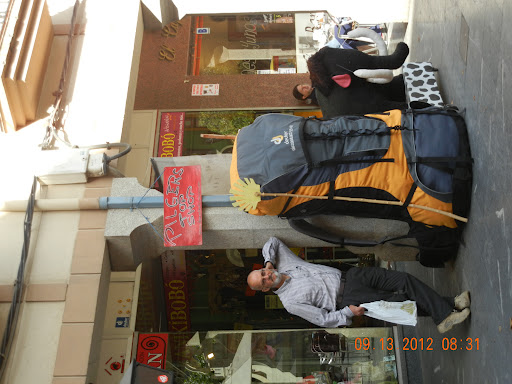
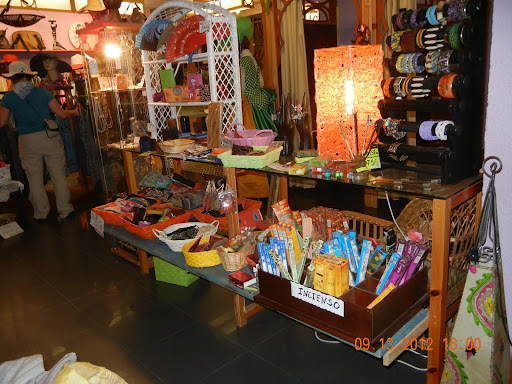
The guy who runs the sports shop (see giant backpack below) is Swiss and reminded us very much of other guys we’ve encountered along the Camino — maybe in his 40s, but with the lined face of a 70-year-old, tanned, terrible teeth, grizzled, and something deeply attractive about him. For whatever reason, they’ve ended up in places like Los Arcos and Astorga, greeting and serving in one way or another the people who pass by from all over the world on their way to Santiago. One could do worse. We bought insoles for the girls’ shoes, and a scallop shell for Regina, and then admired the hippie shop upstairs from his sports store. Yes, hippie shop, with the Nepalese dresses, the Guatamalan purses, the Indian cotton prints, the beaded trinkets from everywhere, the incense — all of it, right on the main square of Astorga.
Regina’s photo (about 7:40 a.m., west of Mazarife): “The problem, of course, is that the route runs west, so if one wishes to watch the sunrise one must walk backwards.”
Photo: The problem, of course, is that the route runs west, so if one wishes to watch the sunrise one must walk backwards.
Regina, at the end of the day: “Ay, mis pies. (Except according to the guidebook today’s stage was 31.2 km/19.4 miles, so I walked at least a mile further than the pedometer says. AY, MIS PIES.)” We are all still working on getting our pedometers set correctly. Anthea’s seems to be best; it’s an app on her phone.
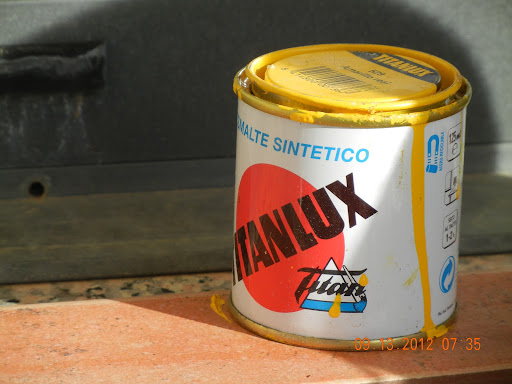
A can of yellow paint at last night’s albergue — this is where the yellow arrows come from.
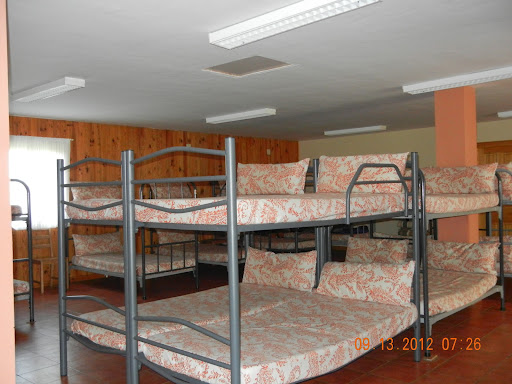
One of the Mazarife’s albergue dorm rooms — fairly typical of what we’ve seen. Tonight we have a private room with  a bunk bed, and shared (multi-gender) bathrooms.
One set of town bells — the mannequins take turns striking the bell to count out the hours.
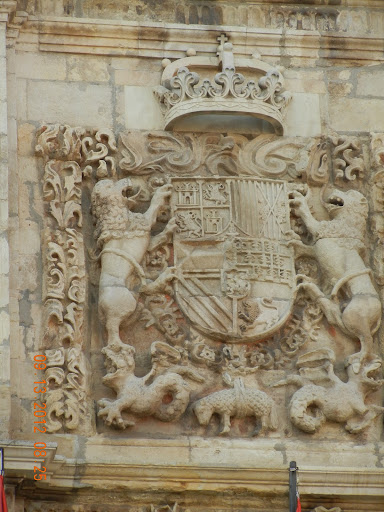
This is the crest just below the bells with the mannequins. I think that the lions are for the province of Leon, of which Astorga is a part.
The books did suggest carrying a slightly smaller backpack. . . Jim at the sports shop in Astorga.
Hippie store in plaza at Astorga.
Regina and Anthea, with a Rioja red at dinner.
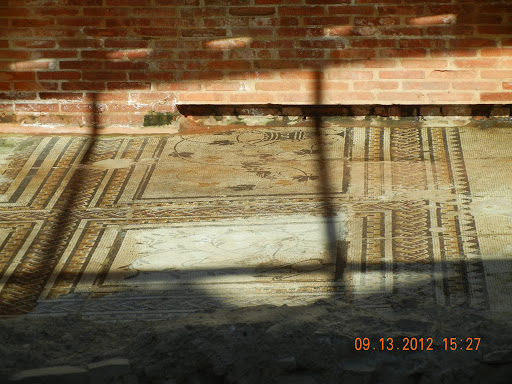
Mosaic floor of a Roman villa, preserved in Astorga (the brick is modern).
Tonight’s albergue (for Jim and Teri; Regina and Anthea are staying in the nice hotel). It’s a remodeled building of some sort, possibly a school.
Posted in 2012, Camino de Santiago de Compostela, Camino de Santiago trip, travel | Tagged , , , , , | Leave a comment

Day 18 — back on the road, to Manzarife

Another sunny day in northern Spain — they keep coming, and we are deeply grateful for each one. Regina and Anthea walked about 12 miles today; their goal tomorrow is around 19 to get to Astorga. From there, it’s about 164 miles to Santiago. Pamplona was about 450 miles, so we are past the half way point. I’ve walked 182 miles (in 18 days), some of it around the cities we’ve been in, and not on the road. Anthea’s got the most miles under her belt; not sure that she’s tallying them up, and Jim’s got a few more than me. Regina’s catching up fast.
 Jim and I got through the first eight miles; I realized that I wasn’t really over this bug (I attribute it to that tasty chocolate mousse on our first night in Sahagun). We called a cab to take us to the albergue San Antonio de Padua, very highly recommended by some Italians she’d met, we were assured by Karen the violinist from Leon who we came across in the bar in Chozas de Abaco.
I haven’t really experienced all of the benefits of San Antonio, aside from the clean room and comfortable bed. It doesn’t have the private bath that I was assured of on the phone last night, but I spent most of my time after arriving asleep. Jim and the girls reported an excellent communal dinner of tomato gazpacho, veggie paella, cake, and a salad. They spent their time at dinner regaling a group of Belgians, Aussies and Germans with reasons to visit Alaska.
The albergues and Camino make me think of an intinerant, international summer camp. The facilities tend  to be basic — our room has two beds, one chair, a small table, and two hooks on the wall for towels. Most seem to be very clean, and a number are quite new, attesting to the increasing popularity of the Camino. Much of the space is shared with others, but people appear to be reasonably respectful of others. Some have more rules than others — La Fuente at Los Arcos turned off the Internet at 10:30 p.m., but luckily San Antonio is not as concerned that everyone get a good night’s sleep. You are guaranteed to meet a fascinating and ever-changing group of people each day — tonight’s hostel group included (in addition to the Belgians, Germans, and Aussies), a nurse from Victoria, B.C., with a fairly complete pharmacy that she was willing to share if needed; Karen the violinist from Idaho, and others whom I didn’t hear about.
Tomorrow we  will sleep in a bit and take a cab to Astorga (a good-sized medieval city); the girls will walk. Depending on how I’m feeling, we may walk back to meet them and then get a few miles back into the city. But there are errands to run as well; our phones have all run out of minutes and have to be re-charged; we need to stop at an ATM again, and so forth.
Best wishes to all for a great day wherever you are.
Anthea on the road (portrait by Regina).
Little crocuses growing up right in the middle of our path, a little ways out of Leon. Flowers similar to these grow in the U.S.; they send up their leaves in the spring and summer; the leaves die back; and the flowers appear later in the summer.
A pair of boots abandoned on the Camino. Jim said that the soles were pretty well worn through. We have seen other boots, a flip–flop, a sneaker, and more — usually only one shoe, not a pair. The path-markers often have little cairns of stones piled on them.
For much of the day, we walked through scrub land with no fields at all — a contrast to most of our previous miles, which have wound through cultivated fields and vineyards.
Someone’s roses and zinnias along a wall.
The road goes ever on — still more like meseta, but presumably we’ll be getting into new landscapes in the next few days.
Another hobbit hole/wine cellar (?) built into the side of a hill; this one with a shaded window and tarp door.
Regina’s photo: “Walking. Fields, sun, road, awesomeness.”

Posted in 2012, Camino de Santiago de Compostela, Camino de Santiago trip, travel | Tagged , , , , , , | Leave a comment