-
Recent Posts
Archives
Categories
Meta
Day 17 on the Camino, a day in Leon
One of the questions often asked of people on the Camino is “why are you doing this pilgrimage/hike/adventure?” Not so often from others that we’ve met, although we occasionally ask the question or are asked. In that case, the answer is often simply, “I heard about it and wanted to do it,” and that’s sufficient. But thinking about it now and again as we go along, one of my answers is that I’m curious. For more than a thousand years (actually much longer — since the Celtic days, well before the Romans arrived around 100 or so B. C, E.) people have been drawn to walk across northern Spain to get to the Atlantic Coast, or somewhere close to there. The Celts saw it as the end of the world; the Romans saw it as a trade route and a source of ores, wine, and grains. The Christians saw it as a way to save their souls. I like the idea of following in all of these footsteps to see what they found along the way, what they saw at the end, and what they went home with.
I was thinking today about someone in say, 1200, making his or her way (probably with a group of companions, for safety reasons) through the same medieval streets that we were walking on today, but without the yellow arrows to guide them. The streets would not have been as clean. The cathedral would have been much newer then and missing much of its current artwork, and the medieval hospital, now a luxury hotel, would have been as welcome to those who needed it as the University Hospital was to me two nights ago. Probably there would not have been as many trees or flowers to greet them — those were out in the fields and copses, or along the rivers.
I also wonder what the land looked like to them. By 5000 B.C.E., the cultivation of wheat had spread from the Middle East and Northern Africa to Spain and other parts of the Mediterranean. I would like to know, a little more definitively, if these same fields have been growing wheat for 3,000 years or more, why they are still fertile and growing wheat. We see some evidence of fields lying fallow, but not many signs of crop rotation. I haven’t been able to find out a lot about the agricultural details, but if I do, we’ll keep you posted.
By 20 C.E., the Romans controlled all of Spain. One of their primary interests was in the vineyards; according to Wikipedia (sorry, my research time is limited, and I’ll go with what seems reasonable) Spanish vines from the north were exported to Bordeaux in France, and to Italy and other parts of the Empire.
One great difference (that I may have commented on already) between the U.S. and Spain is that no-one lives out among their fields. They all live in villages. It’s very striking, having grown up near the farms and orchards of Southwest Michigan, to have miles of fields and not a single house anywhere in sight. Now and again, we’ve seen farmers coming out to their acres or vineyards on tractors, or motorcycles, or in cars/trucks. The wheat harvest is long since done; there’s still hay drying and waiting to be baled in some fields; and it’s apparently been too early for the grape harvest. The truck gardens are thriving, and a few times, we’ve seen people picking produce from them — enough for an evening’s dinner, but by no means a major harvest given the amounts of fruits and vegetables in their tracts. But no-one lives out there.
On a different note, while looking for Roman wheat fields, I found an itinerary for a variation on how to do the Camino. This is a 7-day trip from Sarria to Santiago, that features yoga stretches, OMMMMs, and on the last evening “a huge celebratory dinner and off to the local clubs to dance all night.” The participants are actually walking 11-12 miles a day, to get the 100 km needed to get their certificates. It will cost you $4800, and there’s no mention of possible bad weather. Maybe they let you know that once you’ve signed up.
We ourselves spent the day in Leon, walking from the hotel to the Cathedral, and then to the 12th century monastery/hospital for pilgrims at San Marcos. We fortified ourselves with breakfast from the buffet at the hotel — American bacon and scrambled eggs were available, lots of meats (sliced, mostly) and cheeses, breads and pastries (3 variations on chocolate croissants), coffee, orange juice, canned and fresh (bananas, oranges, apples) fruit — quite acceptable.
The cathedral here is considered one of the best examples of Gothic in Europe, and its stained glass among the finest. The guidebook says that a king of Leon had built his palace on the site of Roman baths; he donated the palace in the 10th century for a church. But at the end of that century, Arabs razed the city; within another hundred years or so, the Spanish had taken it back and started to re-build. It took awhile, as many of these projects did, and it wasn’t until 1253 that the present set of stones started being put into place. My photos don’t do the place justice, of course.
We spent a few minutes at the Mass that was being said. As is the case in many (most?) churches, people are allowed into the services for free, but they are often held in a side chapel, and the main part of the church is roped off, with a charge to get in. On the Camino forum on-line that I’ve been following some people have objected to a charge for a church. But I am inclined to agree with the viewpoint that it costs a great deal of money to maintain these buildings, and the people who want to see them should help with that expense. Otherwise, it falls to either the people of the parish or the government, and there are good arguments against either of those groups having to pay so that people from other places can appreciate the art work and history.
After that, we had an errand to run that took us to the Hospital San Marcos, now a luxury hotel. If you saw the movie “The Way,” this is the hotel at which they stayed along the Camino. The Spanish government has converted several of the old Camino buildings (this one was a monastery and hospital for pilgrims) into “paradors” — high-end hotels. We looked around the cloisters — old cobblestone floors, now partially covered with oriental-carpet-patterned runners, with cushioned sofas on which to sit and admire the statues and gardens.
The rest of the afternoon was devoted to stocking up on food for tomorrow’s walk, doing laundry, getting some more rest, and making our plans for tomorrow. Regina and Anthea will head out early, and meet us at the very edge of Leon (about 10 km) at a small town. We’ll walk another 12 km or so to Villar de Mazarife to spend the night. The forecast is for another warm sunny day (today was in the 80s; not as noticeably warm in town as out in the fields).
Octopus cookies in a bakery near the cathedral.
Jim and Anthea admiring art work near the medieval city walls of Leon. Note the bee on the wall at the back of the photo, and the horned Rhino?? head hanging from a crane in the foreground.
Spires on the cathedral; Jim points out that these helped balance other parts of the cathedral’s weight (he’s asleep and I can’t ask him for the exact facts).
St. George killing the dragon. This is one of many walnut carvings in the choir area, which the guidebook dates to mid-1400s. You can see the princess, just above George, watching anxiously; I’m not sure what the people up above her are doing.
A bat, carved in the choir. The guidebook says that in addition to all of the Old and New Testament scenes, the carvers were allowed to create fantasy figures, all sorts of natural carvings, and representations of myths and fairy tales.
A frog, beneath a small seat in the choir.
A couple of women above the chairs in the choir.
One altar in a chapel in the cathedral, with stained glass above.
A chapel honoring St. Anthony of Padua, and the Virgin. Most of the chapels seemed to be honoring the Virgin Mary in one way or another.
Another chapel honoring the Virgin Mary, with a bouquet of lilies scenting the whole area around it.
A chapel with a Nativity scene.
People going about their daily business in the plaza by the cathedral, including a couple of the dozens of little school kids in uniforms who were getting out for lunch time.
Karen P. from Sand Point, Idaho, who is playing her violin as she makes her way along the Camino. She played “Oh, Susanna” for us, and also “Amazing Grace,” and we sang an old song, “I am a happy wanderer along the mountain track . . .” for her. Anthea posted a video on FaceBook, I think, but I’ll have to send the link later. Note the yellow Camino arrow painted on the pavement behind her, and the pilgrim’s scallop shell in her violin case.
Harley-Davidson in Leon, for Chester and Dan, and our other friends with Harleys.
Regina admiring the statues (taken from the cathedral because they were “too Baroque” and placed here) in the cloisters at the Monastery/Hospital San Marcos. Note the carpet laid over the old cobblestones, and the nice furnishings exposed to the open air. Clearly, this is not a climate even remotely resembling Alaska.
Regina at the Hospital San Marcos.
Posted in 2012, Camino de Santiago de Compostela, Camino de Santiago trip, travel
Tagged "The Way", Camino, Celtic, history, Hospital San Marcos, Leon, octopus, Roman
Leave a comment
A quiet day in Leon
We didn’t do much — slept, caught up on Internet life, slept. Jim and Regina went out on a couple of errands, and we all walked down a hill to the University District looking for an Italian place that advertised good dinners. We found a “Casablanca” themed pizzeria instead, and decided to come back to the hotel dining room/bar. Regina and Anthea ended up with potato-egg sandwiches, and I had soup that Jim and Regina bought earlier (a pleasant veggie puree, completely innocuous, and reasonably tasty).
Tomorrow we hope to see the cathedral, which is reputed to have some of the most spectacular stained glass in Europe. Along the way, there will be more of interest as well — Leon, like many of the cities here, goes back to the Roman days.
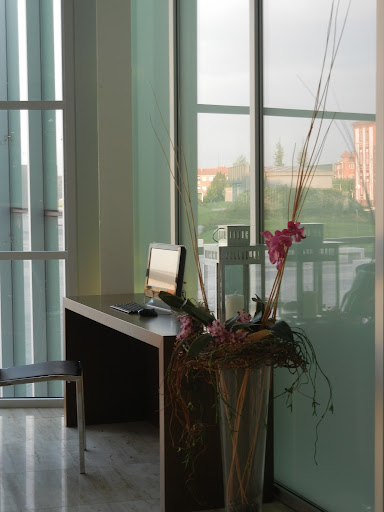
Trying to capture the essence of the extremely modern, but pleasant, hotel. Here is a corner of the main lobby. Lots of glass, dark wood,beige tones. Spacious.
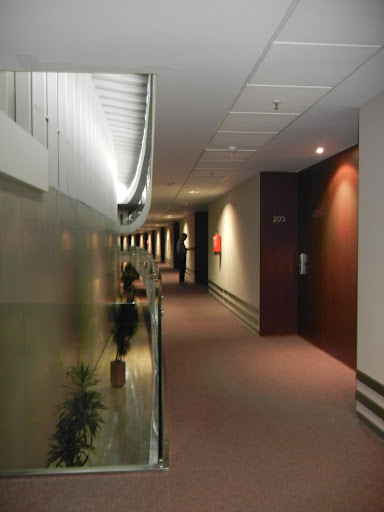
The hallway, with our room. All of the doors fit flush with the walls.
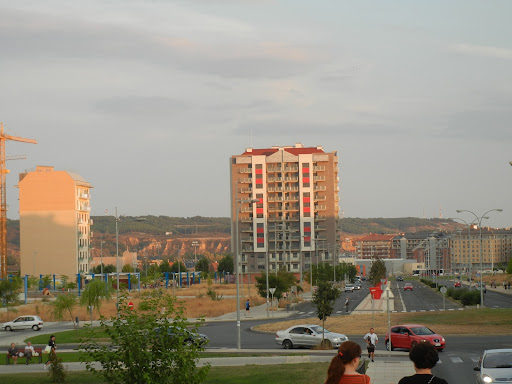
We are at the north edge of the city; just beyond the tall buildings are the fields. The cities here seem to end much more abruptly than in the U.S.
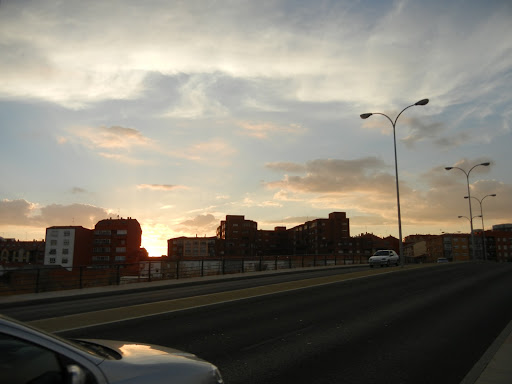
Sunset, about 9:00 p.m.
Posted in 2012, Camino de Santiago de Compostela, Camino de Santiago trip, travel
Tagged Leon, Roman
Leave a comment
A brief digression on the Camino
Hello all — no mail yesterday because after we walked from Sahagun to El Burgo Ranero (and no, we can’t find anything to confirm that it means city of frogs — one suggested derivation of the name related to granero, or granaries) I got quite sick and we took a taxi to the university hospital in Leon. I spent the night there, and Jim, Regina and Anthea got a room at the very modern hotel associated with the hospital. Diagnosis was stomach upset of unknown origin, but resulting in some bleeding. All seems OK this morning — discharged with prescriptions and instructions to take it easy for a couple of days.
The experience was somewhat different from American hospitals — we hypothesize that there are fewer worries about litigation. I signed one form saying that I agreed to an endoscopy — I could figure out what some, but not all of the fine print, referred to — and added my own note to the effect that I was agreeing, but that no-one had translated this for me. People wore either white or hospital-green scrubs (many American hospitals allow much more choice), and many had colorful Crocs for footwear. The ER cubicles were titled “Box” — I spent most of my time in “Box 15,” with a couple of other people in and out during my stay.
Anthea and Regina translated, of course — they are invaluable, and we give great credit to their high school Spanish teacher, Nina Bonito Romine, and to cousins Rory and Cuchi who hosted Regina in Peru one year and helped hone her speaking skills.
And that’s enough of that digression. What next? We’ll spend at least today and tomorrow in Leon, and see about the future possibilities. We can assure you that we are tired, but seem to be pretty good otherwise.
Sahagun to El Burgo Ranero
We put in a full day walking, about 12 1/2 miles to El Burgo, for Regina’s first day. Good weather — sunny, not too hot, and a breeze along the way. The meseta had a few hills in it, little ones, and most of the paths were lined with trees that some blessed people had planted enough years ago to be shady now.
The moon was still high in the dark sky, near Jupiter, when we got up. The hotel owner made us big plates of toast and butter and jam to start the day, along with plenty of coffee, and we set off following the yellow arrows out of Sahagun.
Our road led across several running rivers, to our surprise — most of the ones we’ve seen in the past few days were dry beds waiting for winter rains to fill them again.
An arch made out of pipe that we thought might be more likely to be seen in Anchorage (Jim and Regina).
Sky over the meseta (taken from the cab on the way to Leon). We got a little rain on the way into Leon — we were happy to be in the cab.
Red poppies along the path.
A welcome roadside cafe, about two-thirds of the way to El Burgo.
A house on the outskirts of El Burgo Ranero with pilgrim motifs and typical (i.e., charming and well-kept) window boxes.
Exotic fruits ripening on a bush. No idea if they’re edible.
Storks’ nests on church on El Brugo Ranero.
Exhausted pilgrims in Box 15, Leon University Hospital.
Posted in 2012, Camino de Santiago de Compostela, Camino de Santiago trip, travel
Tagged Camino, El Burgo Ranero, hospital, Leon, meseta, pilgrims, Sahagun
Leave a comment
Day 14 on the Camino
Saturday in Sahagun — sunny, with a few clouds and a little breeze. I’m sitting in the hotel dining room, listening to the clatter of dishes from the kitchen and smelling the food. The family who runs the place are having a late lunch for themselves.
We walked to the market today, which has booths set up along the streets surrounding one of the main squares, and in the plaza. It’s like the Athens markets, with more of an emphasis on clothes, shoes, etc. than on food. We bought nectarines and sweet little green grapes to eat tomorrow (or the next day — the nectarines are far from ripe), a walking pole for Regina at a store on the plaza, and bandaids for blisters.
Lunch was at a busy cafe with outside tables. The menus are often printed, with photos, and in five languages. So today’s menu for the paellas appeared to be identical to that offered in the diner back a week ago, as did the menu for the pizzas. We may have seen the pasta menu before, but no matter — we ordered the spinach linguini with 4-cheese sauce, and the mushroom spaghetti. The poor waiter was harried — the only one for at least 16 tables — and the bartender inside was entirely dissatisfied with his life and ours. The pasta dishes were fine — lots of carbs because it’s difficult to be vegetarian and actually find veggies to eat.
[Later] — Evening now, and finishing up to get an early start on walking tomorrow. We went to Mass at a convent this evening — maybe 60 or 70 people, about 20 of them nuns, mostly in modern white habits (knee-length white dresses that looked like what nurses used to wear) with veils, but some in street dress. Much of the congregation was older women; the place was weighted with the denseness that people acquire as they get older. But they sang — everyone sang, and because it was a small modern building, they filled the space. The priest called up all of the pilgrims — about 15 of us — at the end of Mass and gave a blessing in Spanish (Regina translated as along the lines of God give you shade from the sun and get you safely to Santiago). Afterward we chatted briefly with a 30-ish woman from Galway, who was doing the Camino in sections — many people seem to do that.
Then we ate a pilgrim dinner at a restaurant near our hotel — a mixed salad, and bowls of fideos soup. It turned out to be chicken noodle soup, which I suspected, despite assurances that it was entirely vegetarian. Dessert was chocolate mousse cake with dark caramel sauce, and the wine was very local, with a label written in both English and Spanish — it had a bit of bite and fizz, that I liked, but you would not call it smooth.
That’s it for the evening — we walk about 10 or 11 miles tomorrow; Regina will just be starting out, and we will take it a bit easy after only walking about three miles today.
Hope you all are having a great weekend.
To market, to market . . . with the Carns family in Sahagun.
Again, enough garlic to supply Forks for a month or so (we saw another garlic booth at the Barcelona market).
A dry-goods store, with all of the wooden drawers, the ladder, and everything still in active use.
An African man selling purses. He must be more legit than the Athens purse-sellers because he is sitting in the shade, and doesn’t look poised to wrap his goods in his sheet and take off running as the Athens street merchants did when the cops came around.
Cucumbers and eggplant.
Pasta for lunch — a day without bocadillos!
A weed growing in a crevice of a church wall has caught a dozen pigeon feathers and held on to them.
A family coat of arms above a house door. Regina observes that the heads on the sides of the shield appear very chicken-like.
A modern gargoyle water spout.
Dandelions and white clover in the grass by a church — I felt suddenly at home.
Brickwork on a church. This shows Moorish influence in the ways that the bricks are used to pattern the surface, and in the arches.
More Arabic influence, on a different church.
Regina, on a bench with gargoyle feet.
Posted in Uncategorized
Leave a comment
Calzadilla de la Cueza to Sahagun
Hello friends — short email tonight, and no photos — the Internet in the hotel room in Sahagun is fitful, despite assurances by the owner that last night’s guest had no trouble whatsoever.
We left our hostal in Calzadilla, with its friendly peregrino owner, and set out about 8:00 a.m. before the sun was really up. We treated ourselves nicely, on a hot, long day, by stopping several times for coffee and food before we arrived in Sahagun — big city, about 170,000 people. The sun was bright and shade scarce along the way. We’re still on the meseta, with wheat fields, some corn, a few small villages, and open gravel paths for the pilgrims. It’s more rolling now; closer to southwest Michigan or Iowa than to the flat openness of Illinois. Luckily, most of the bugs stayed back in yesterday’s territory.
It looked as if the day’s walk might be around eleven or twelve miles; it was more like 13 or 14; and we put in another 2 1/2 miles walking around Sahagun. So we’re exhausted from 16 1/2 miles+, and looking forward to sleeping in tomorrow. Regina needs to catch up also, given her 24 hours from Seattle to Madrid, and then a train trip to Sahagun.
Coming into the city about 4:00 p.m., Jim said “Buen Camino” to a guy getting onto a bike. He had panniers, and looked as if he might be a pilgrim . . . but he said, “I am not a pilgrim, I am a worker. Workers are pilgrims every day.” We agreed, and he came along with us, speaking pretty decent English, telling us about his girl friend from Ft. Meyers, Florida, and expounding on Spanish and American politics. He thought that the U.S. was responsible for Spain’s current economic woes.
Regina’s train arrived on time at the small station, and we got her to the hotel (1/2 mile away, on the Camino as it goes through the town) so she could shower and change. Our search for dinner before eight p.m. (we were all too hungry to wait until Spanish dinnertime) took us to a restaurant on the main plaza where dozens of little Spanish kids rode their bikes and ran around and screeched, having a great time. All of the cafes were busy, with most of the outside tables full; the stores stay open until 9:00 to serve the local clientele.
OK, I’m going to try to send this — more tomorrow, with additional photos.
Posted in Uncategorized
Leave a comment
Carrion de los Condes to Calzadilla de la Cueza, Day 12
Today was a day of flies and yellow jackets, of sun and a breeze, of a long walk without much in the way of breaks. This morning at 7:00 a.m. we spotted Orion in the little space of sky visible in the courtyard of the hotel. As we go west, and the days grow shorter, dawn arrives closer to 7:30 than to 7:00. Later in the morning, the waning half moon rode white in the morning sky ahead of us.
Our path led first along a country road, and then back onto the gravel. The gravel paths are usually wide enough for one vehicle, and we sometimes share them with farm equipment or people with a lot of local knowledge. Walking on them is often like the country roads around Buchanan — Briar Road for example — with equal amounts of dust and loose stones, but not as many potholes or trees for shade.
As the morning grew warmer, swarms of little black flies showed up, along with fragrant fields, mint plants by the roadside, bird song, and a soft breeze. For the first few miles, trees planted along the road kept us cool. Later in the day, the yellow jacket wasps came out and joined the black flies. It was the first day with so many bugs. They all must have something to do with themselves when there aren’t peregrinos around, and we sincerely wished that they would go back to doing it. Dozens of swifts and swallows dart over the fields, but there were lots more bugs than birds to catch them.
It was about a 12-mile day, but seemed long because there were few places to stop. One enterprising and most welcome fellow and his wife had set up a little cafe (un-remarked in the guidebook) in the middle of nowhere; and whoever maintains the Camino had a couple of picnic areas. The Camino rest areas that we stopped in had large wasp populations, and the benches that were away from the wasps were covered with bird droppings. Our stops were brief as a result, and Calzadilla de la Cueza (population 60) was a delightful sight when we pulled in at 2:30. Anthea arrived at the hotel before us, and was keeping company with a cold beer in the bar. I joined her for a cup of espresso, and Jim went to the room to test out the comfort of the beds.
Our Camino “miracle” for the day came in the form of Luis Angel (that’s his name on the Jacotrans van that carries backpacks from one town to the next). We called Jacotrans to make our reservations for Sahagun for tomorrow and Saturday; Senor Angel said that he was downstairs in the lobby. Anthea and I went down to talk with him in person; in half an hour, he had made reservations for us in Sahagun, and had recommended places for us to stay for the next two days, then made the reservations for those places. Turns out that he is the brother of the genial fellow who owns the hotel Camino Real, and both of the them seemed to greatly enjoy their conversations with Anthea.
After dinner, we spent our evening relaxing and catching up on news from home. Anthea and I went out about 10:00 to see if we could spot the Milky Way. A dozen or so people were still sitting out enjoying the calm night, including one fairly drunk guy sitting crosslegged on the stones in the middle of the patio with one of the half dozen local cats keeping him company. He introduced us to a friend, an older woman from New Jersey who also had been consorting with the house wine more than perhaps was advisable; they were of no help with the Milky Way. We saw a bat and a few moths; Mars and some scattered stars, but realized that we were going to hear a lot about New Jersey if we stayed around, so came back to the room.
The Camino often reminds us of the AlCan Highway, and the roads that connect Alaska towns with each other. It is a narrow strip of civilization, and the people along the road form a community with each other. The small towns exist in part to serve the numerous travelers, and they can tell you what’s ahead and seem happy to help you out.
A friend mentioned bicycling on the Camino. Each day, we are passed by dozens of cyclists, mostly fit guys with a sprinkling of younger women here and there. Once in a while we see an older couple, or a family with teens. On the meseta, they speed along, usually floating a “Buen Camino” behind them. On the steep and rough paths, they sometimes walk their bikes. About two-thirds are carrying all of their luggage with them in panniers and small backpacks; about a third must be using Jacotrans or some other method of luggage transport.
Tomorrow we meet Regina in Sahagun in the afternoon or evening (she’s flying into Madrid and taking a train from there). We will spend Saturday in Sahagun (about 170,000 people, and with plenty of history) to give Regina a chance to rest up, and start walking again on Sunday. It will change the dynamics of the trip to some extent, because she and Anthea will probably walk together much of the time; we will meet them for dinner we hope.
I’m sure there’s more, but 7:00 a.m. rolls around soon, and we’ll be back with more Camino stories tomorrow.
Early sun on the 12th century church and two peregrinos setting out for the day’s journey.
This angel on the Church of Santiago (also 12th century) lost part of its head as part of the destruction during the 1809 war of independence (from Napoleon).
A grove of trees catching the morning sun on the road leaving Carrion de los Condes. We see groves like this fairly often, planted in straight rows.
Peregrinos on the road.
A healthy field of corn — no Midwest droughts here.
Deer crossing — an unexpected sign in northern Spain.
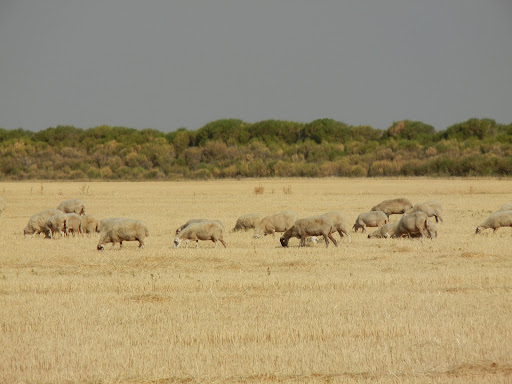
Part of a herd of sheep feeding in a harvested wheat field. There were at least a hundred sheep here, including several black ones. Few fields have fences, so someone must have been watching them to see that they didn’t stray. We see very few farm animals, but dogs and cats (especially cats) in the villages and cities.
The little rest area/cafe that appeared unexpectedly about halfway through the day. Pepsi never tasted so good.
An adobe wall — mud and straw — in the village of Calzadilla de la Cueza. We also saw adobe bricks in several places.
The Jacotrans van that carries my backpack (and others) in the Burgos area.
Our hotel, owned and personally run by a former peregrino. It was recommended in John Brierley’s guide and we would enthusiastically add our praises.
The evening sky and meseta, across the street from our hotel.
A typical hotel dining room — everyone comes in during the first half hour of meal service. Sometimes you can order from a printed menu del dia; at Camino Real, the owner/waiter told us what our vegetarian choices were.
Anthea with her white asparagus from the first course salad. White asparagus is a specialty of northern Spain and shows up by itself as a tapas or appetizer, in salads, in vegetable dishes — everywhere except dessert.
The house wine that we drank with dinner. It was fine, better than last night’s wine in a jug.
Posted in Uncategorized
Leave a comment
Day 11 — Fromista to Carrion de los Condes
We’re in Carrion de los Condes for the night; I’ve spent a chunk of the afternoon trying to find the meaning of Carrion in Spanish, without any luck. Carrion de los Condes was the Moorish name for the town, and the Spanish duke who took the area back from the Moors took the name Carrion, so presumably it’s OK.
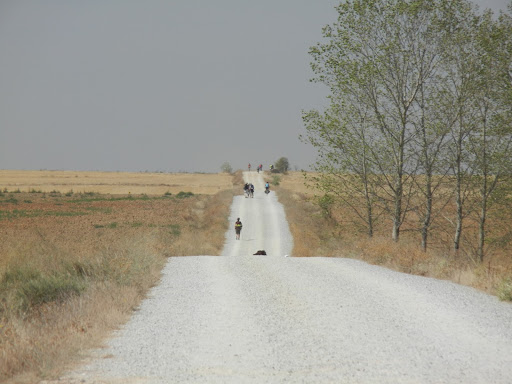
Today was our first stretch of meseta, and we liked it. Anthea says, “Simple.” Jim says, “It was a walking experience, not a visual experience. And you could see the towns a long way ahead.” This stretch was not really flat, not like Illinois, for example. It was rolling, and there were some slightly uphill stretches. Much of the way was along a nearly dry river bed filled with tall grasses, and the banks lined with trees. A strong north wind cooled us all day, and the nearly level walking was a real pleasure. The path was mostly the dusty, rocky, sometimes gravelly surface to which we’ve become accustomed. Little bits of the brown-gray dirt would fly up, revealing themselves as grasshoppers. Small lavender-blue butterflies, the color of the chicory flowers swooped across our paths, along with white sulphurs and some that looked like fritillaries (this is for the lepidopterists who might be reading the account).
We left Fromista a little after 8:00 a.m. with a dozen other peregrinos, mostly ahead of us. But between our several stops to eat or get coffee, and the fact that one could choose between two routes (the river road was slightly longer), most of them got ahead of us. We arrived at our destination, Carrion, just before 3:00 p.m., and found the town lively with pilgrim cyclists, pedestrian pilgrims, and even a group wandering about, all of whom had sizable orange scarves that they were supposed to wear to identify them — some did, some didn’t. Our impression is that the way will be busier as we get closer to Santiago (257.4 miles left from Carrion).
The rest of the day was spent washing, napping, looking for food for tomorrow’s trek (about 10 miles with no services), and trying to find a place for dinner. It’s either bar food, if you want to eat dinner before 7:00, or wait until the restaurants open. We sat in a bar that had a promising dinner menu for a while, watching a bull fight on TV and waiting for the dining room to open — only to find that just because they posted a menu del dia, didn’t mean that they actually served one. And by the time we did find a place to eat, we had accumulated a couple more miles — our total for the day is around 14 3/4.
Tomorrow we’re walking on Roman road again. The author of our guidebook points out that part of this section goes through bogland that didn’t have any rock suitable for roads, so all of the stone had to be brought in. There doesn’t seem to have been any lack of stone and gravel so far, so perhaps they didn’t have to move it too far — nonetheless . . . what a lot of work. On Friday, we have another twelve-mile day, and then we’ll be in Sahagun to meet Regina. She called on Skype this evening to make arrangements.
And finally, Jim came up with the Camino ABC’s — albergue, beer, and credencials.
I took a lot of photos, trying to get the essence of the land we were walking on today. This one shows the sunflower fields (we saw a lot of them near Pamplona, but none in La Rioja), and in the far distance, mountains, with the land rolling away to the horizon. These sunflowers look fairly healthy; in some of the fields, the stems were brown, the flower heads small, and the whole field saddened. Some fields looked as if they had been burnt.
The roadsides, and often the Camino paths are edged by grasses and weeds, often prickly thistles with small purple flowers.
These sunflowers were brighter, and looked as if they might be grown to be cut flowers, rather than to produce sunflower seeds.
Meseta, with a town in the distance, and more than average number of trees..
Another stretch of meseta.
Anthea waiting to meet us on the outskirts of Carrion de los Condes.
A little “hobbit house” built into the side of a hill, outside Carrion.
Pilgrim art in Carrion — nearly every town that we go into has some sort of representation of a peregrino. This gentleman has the traditional cloak, staff with scallop shell and gourd (for drinking water), and the perhaps not quite as traditional tankard of ale (or jug of wine?).
People enjoying the river in Carrion.
The bullfighter on TV. A number of people were in the bars watching; mainly older men, perhaps because they didn’t have TVs in their homes, or perhaps because others didn’t want to watch the fight, or maybe just for the camaraderie.
Jim and Anthea waiting for dinner to arrive. Note the small jug for the wine — a fairly common way for it to be served if they don’t want you to see the bottle. This was a harsh red, but wine nonetheless. Jim has fizzy water.
Here’s a bit more information about the Way (from Wikipedia).
Pre-Christian history
The route[which?] to Santiago de Compostela was a Roman trade route, nicknamed the Milky Way by travellers, as it followed the Milky Way to the Atlantic Ocean.[3]
The Christian origin of the pilgrimage has been well documented throughout the centuries, but no historical reference has been found forpagan origins.
To this day, many pilgrims continue from Santiago de Compostela to the Atlantic coast of Galicia, to finish their journeys at Spain’s westernmost point, Cape Finisterre. Although Cape Finisterre is not the westernmost point of mainland Europe (Cabo da Roca inPortugal is further west), the fact that the Romans called it Finisterrae (literally the end of the world or Land’s End in Latin) indicates that they viewed it as such.
Posted in Uncategorized
Leave a comment
Ciruena to Burgos
Maria at Casa Victoria made us toast with butter and honey (two kinds, one very dark and tasty) and marmalade for breakfast, and coffee and orange juice. We bid farewell to Francisco and her with European double kisses on the cheeks and “Buen Caminos” following down the early morning quiet of Ciruena streets. Our road to Santo Domingo de la Calzada led mostly downhill through wheat fields and patches of woods; many fewer vineyards now. The low clouds threatened rain, but never produced any — we were deeply grateful, both for the cool morning walk, and for the dry morning walk.
The town and cathedral at Santo Domingo are the source of some of the best Camino lore. Born in 1019, Santo Domingo (the story goes) was not allowed into a nearby monastery because he was illiterate, so he spent his life building roads, bridges and hospitals for pilgrims on the Camino — thereby of course gaining much more fame than he ever would have as a monk. He built the original church, and the story is that he prepared his own tomb in the road outside the church — it is now all part of the cathedral that was begun in 1158, and like many cathdrals has been worked on since (we took photos of people busy restoring sections of it today).
The other story for which the town of Santo Domingo is known is the cock and hen:
http://www.pilgrimpathways.com/pilgrim_pathways.asp?IdSeccion=1&IdNoticia=37 [This is the most common version that I’ve seen.]
“A German family-father, mother and son-on pilgrimage to St. James´ tomb stopped to spend the night at an inn in Santo Domingo. The innkeeper´s daughter fancied the son and propositioned him, but he rejected her advances. Furious at the refusal, she hid some silver vessels in the young man´s bag and notified the authorities of the theft the next morning after the family had left the inn. The boy was promptly arrested, hanged and, as was the custom in the Middle Ages, his body left hanging on the gibbet as warning to others who would commit similar crimes. His parents, meanwhile, continued their sorrowful journey to Santiago.
On their way home again, they once more arrived at Santo Domingo. Approaching the square where their son´s body still hung, they were startled to discover that he was still alive! Their son, calling out from gibbet, hailed them and told them that his life had been spared by Santiago (in some versions it is Santo Domingo who saves the boy), who had kept him alive by supporting his weight the entire time. The astonished parents ran to report the news to the city official, who was just sitting down to eat his lunch when they arrived. Scoffing at their story and unwilling to abandon the table, he replied that their son was as alive as the roasted chickens on his plate. No sooner had he said this than the chickens leapt up, sprouted feathers and flew away cackling! Needless to say, their son was quickly cut down from the gibbet and pardoned of the crime.”
To commemorate the event, a cock and hen are kept in a cage built high into one of the walls of the cathedral, and the rooster’s crow can be heard throughout the sacred spaces. The pair of hen and cock get switched out periodically so that they don’t have to always stay indoors.
The church itself was crammed with exquisite and very interesting sculptures and paintings. One altarpiece incorporates centaur fights, sirens and other pagan images that the Council of Trent banned from use in Catholic churches in 1545. It isn’t clear why the artist was allowed to get away with this, but many of the Greek and Roman images were used earlier in the church’s history as references to the Resurrection.
We caught a bus from Santo Domingo to the big city of Burgos — a total of three days worth of walking done in a little over an hour. Our Aussie friend from the first day in Pamplona was on the bus with us; we arranged to meet her for dinner. We walked to our hostel about a mile from the bus station (distance enough to persuade me again of the wisdom of shipping my bag), ate sandwiches that Maria had made for us, and nectarines and chocolate from a Najera grocery for lunch. Then we headed out to find the post office, because I had unthinkingly walked away from the Casa Victoria with the room keys in my pocket and we had to return them to Maria and Francisco. Mailing them was much easier than we expected — the postal clerk handed us a padded envelope; I wrote the address and gave her a couple of dollars (in euro equivalent) and the package was on its way.
Mission accomplished, we played tourist, walking around the Cathedral of Santa Maria, an enormous Gothic structure (we had paid several euros already to see the Cathedral of Santo Domingo, so didn’t go into this one, just admired the sculptures on the outside.)
Dinner with Lisa from Perth was at a slightly more upscale restaurant than we’ve all been accustomed to — not super fancy, but one requirement all around was that it have vegetables on the menu in some form other than tuna fish (“vegetal”usually connotes tuna fish and “other” vegetables, not just the green things that we usually imagine). You can’t get much in the way of veggies other than potatoes, onions, and mushrooms at the typical Spanish eating place. Our waiter accommodated our every (strange) request, and we tipped him accordingly. He brought out gazpacho, several vegetable dishes including remarkably excellent grilled zucchini, tomatoes, eggplant, peppers, etc. The main dishes were fish for Lisa and Jim, spaghetti for me and vegetables scrambled/fried with egg for Anthea. Dessert was cheese cake for Jim and big slices of melon for the rest of us (and, of course, bread, water and wine). We were pleased.
A late crop of raspberry flowers on the road down from Ciruena. We pick little handfuls of the tiny black berries every day; they are still ripening everywhere along the Camino.
Sunrise over the Camino west of Ciruena.
A pilgrim sculpture in the courtyard of a convent in Santo Domingo.
Pilgrim kitsch in Santo Domingo.
Santo Domingo in his cathedral. The silver was donated by Mexicans in 1763 (the word “donated” is used in the text of the guide without any indication of irony).
The famous chickens in their coop built into a wall of the church, about 16 to 20 feet from the main floor of the cathedral.
Centaurs fighting, in a frieze of the main altar in Santo Domingo.
The Resurrection, another scene in the same altarpiece.
Restoration work in the cathedral at Santo Domingo.
More restoration, outside the cathedral on the cobblestones. It seems likely that the techniques for this work are much the same as they were a thousand years ago, and probably in the time of the Romans as well. The broom is a little brighter.
Chocolate chickens in a shop in Santo Domingo (sorry that I can’t send these to my family in Michigan).
Anthea thinks that this is the Starbucks mermaid holding up a statue of the Virgin and child over a fountain in the plaza of Santa Maria cathedral in Burgos.
One the lower left, St. Michael the Archangel is letting people into heaven (including St. Dominic and St. Francis); on the lower right, people are being sent to hell.
Jim and Anthea with a bronze pilgrim in a plaza in Burgos. They don’t look quite as pilgrimesque without their packs and walking sticks.’
A promenade near the river in Burgos.
Somewhat grotesque burghers (well-off middle-class folk) of Burgos.
A Spanish group drinking and eating tapas at a bar in Burgos.
Posted in 2012, Camino de Santiago de Compostela, Camino de Santiago trip, travel
Tagged Burgos, chickens, Ciruena, Perth, pilgrim kitsch, Santo Domingo
Leave a comment
Ciruena — Walking, Day Eight
Sunday afternoon – we have been on the road for a week now, with a rest day. Tomorrow we will walk to Santo Domingo de Calzada, about 4 or 5 miles and take a bus to Burgos from there. We have a fair amount of distance to make up, because we plan to meet Regina in Sahagun on Saturday — it would take us at least ten days to walk there at our current pace.
At the moment, we are tucked into our large, cozy (if chilly — mid-60s degrees) room, with quilts, a huge gilt-framed mirror, oriental rugs over the decorative tiles on the floor, paintings on the walls, beamed and plastered ceiling. The Casa Victoria, as with most places we have stayed, is spotless. The wonderful woman who has been helping us transfer my backpack each day with JacoTrans, Pilar by name, recommended it. I promised that I would let people know how helpful she has been — it’s like having a fabulous travel agent. Yesterday she called and made the reservation here for me because the owners don’t speak English. It was also helpful of her because the phone number listed for the place in my Brierly’s guidebook was entirely wrong.
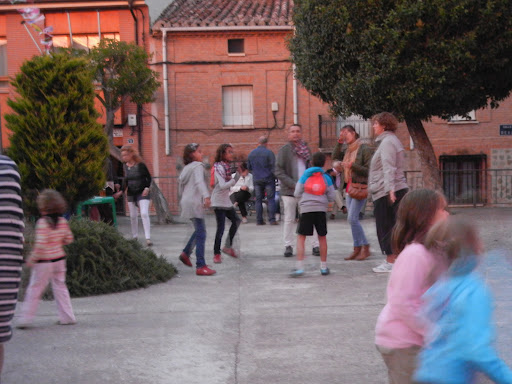
Just outside our second story window which opens onto the town plaza, a large stage has been set up, and an area group is singing Aires de Najerilla — songs of the Najerilla region (from about 6:00 to 7:00 in the evening). It’s a nine-day festival for the Virgin and to give thanks (Fiestas de Virgen de gracias). The songs often start with a sort of screech that’s very like cowboy music — aiyiyiyiai!! Some of the songs make me want to dance (but no-one in the square is dancing); others are more sorrowful. One song mentioned peregrinos and the Camino. Lots of clapping. The instruments include a guitar, a mandolin, a tambourine; the four men and two women range in age from mid-30s to mid-70s. The plaza’s benches are lined with 40 or 50 people bundled up against the cool breeze. Kids are running around the open area, and a dozen or more people are clustered by the bar drinking beer. Occasionally sounds like fireworks accent the music.
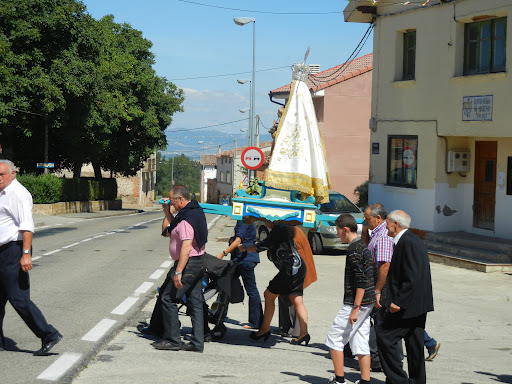
As we walked into town we saw the procession coming from the church carrying a large statue of the Virgin Mary,dressed in white satin robes around the plaza. When we went into the church, half a dozen ladies were sitting in the pews chatting; a young woman was sitting up near the altar, playing a guitar and singing hymns to Mary. It smelled of lilies from the huge bouquet on the altar.
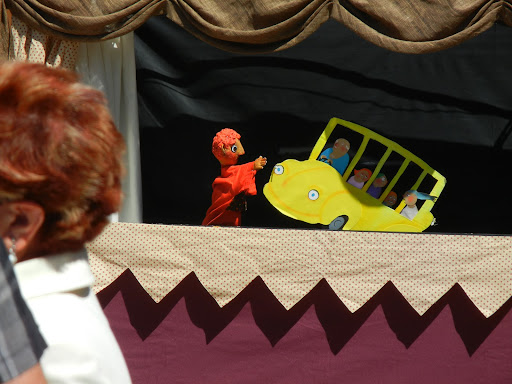
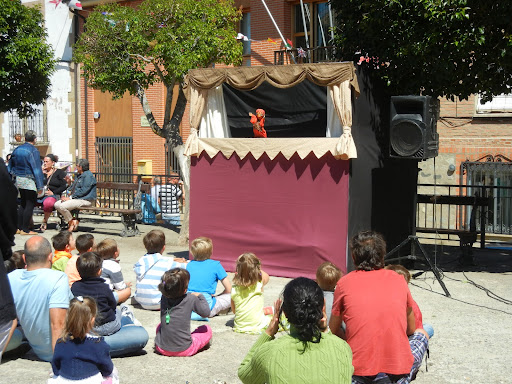
We ate lunch at the Bar Jacobeo, bocadillos as always, but satisfying with big chunks of cheese, and plenty of tomatoes. Back in the plaza, we watched the puppet show, “The Adventures of Jonasin,” that involved a great deal of battering about among the characters.
From the first floor (about 7:00 p.m.) we can smell dinner cooking. Maria and Francisco who own the place, offered to cook dinner for us — because of the festival, the Bar Jacobeo where we ate lunch, won’t be serving dinner.
Ciruena is near the top of another hill – we climbed about 1,000 feet today on our way up from Najera. Twenty-five people live in the town (all of the others who are here now came for the festival), and make their living from pilgrims primarily, I think. On the outskirts is a modern golf course (Rioja Alta campo de golf), and blocks and blocks of mostly empty condos for vacationers.
The walk was pleasant — never too hot, and mostly not too steep. The pilgrims’ wind blew against us from the west; when it died down a bit it carried the late summer scents of cut hay and green things. We were rarely out of sight of other peregrinos, cyclists or walkers, and sometimes walked along with them for a ways before they left us behind. The morning stop was in Azofra, another small town that might have died had it not been for the Camino. The early morning thoughts I’d had wondering why I was doing this had been dissipating in the early sunshine, but were completely eliminated by the coffee and croissant consumed at an outside table.
Later in the evening — Music again outside our room — this time, Spanish DJ with Spanish-flavored rock — perfect for dancing, and people are doing just that, both grownups and kids. It’s gotten chillier, so the dancing is well-timed. The DJ was playing the SpongeBob SquarePants theme (in Spanish) and stopping to get the kids to yell “SpongeBob! . . . SquarePants!”
We dined in Maria and Francisco’s “great room” — a table for six set up in their living room, open to a small kitchen. The TV was on in the background, with no sound. Our dinner companions were three lively Italians, especially Pasquale whose eyes got brighter and gestures more animated as the bottle of Rioja wine was emptied, and another one brought out. Maria, a little serious but so warm, and Francisco, with his white hair and constant dimple, stood and talked to us through the whole meal, as they served the various dishes — first a salad with white asparagus (a specialty of the area; we passed a few fields a couple of days ago), tomatoes, lettuce, onions and green olives. Next, the segundo — for me, a dish of mixed vegetables from a jar; for the others potato omelets (called tortillas here). Dessert was a large bowl of whole fruit — nectarines, pears, apples, peaches. Francisco encouraged me to take a peach — it came from a tree that produced only 3 per year, he said. We followed the example of the Italians and peeled the fruit with the knife provided, then cut sections off and ate them with our fingers. The wine was a red Rioja served in lovely glasses (Maria said that they were for Rioja wine), and after dinner Francisco brought out a coffee liqueur from Santiago and poured it into little tea cups (special for the pilgrims, they said). We liked the liqueur even better than the wine. [In Galicia, we discovered that this is orujo, which is made in a variety of flavors.]
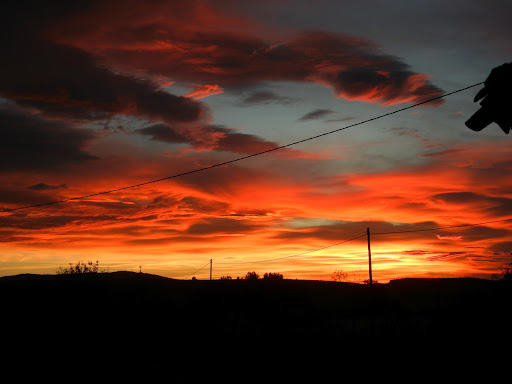
We went out into the plaza to photograph the dancers, then discovered a gorgeous sunset. Up to the terrace outside the laundry room (yes, washing machine for 2 euros — we did do a whole batch and then set the clothes out to dry in the fresh mountain air) to take more pictures. Maria joined us and said that when she was a child, people said of a sky like this that it was the Virgin Mary putting her laundry out to dry.
It was not too painful a walk (except for Anthea, whose arch was bothering her still). As we walk, we stop now and then to take pictures, and as the day progresses, for drinks of water. We stop often to adjust clothes to suit the weather– put on a scarf, take off a sweater, pull out the hat and put on sunscreen. It was cold enough this morning for light gloves; by 1:15 when we arrived in Ciruena our main interest was not getting any more sunburn.
Time for bed (nearly 11:00). Maria and Francisco are serving us breakfast at 7:00 a.m. so that we can get an early start for Santo Domingo.
Vaya con Dios to all of our friends, and have a great start to your week.
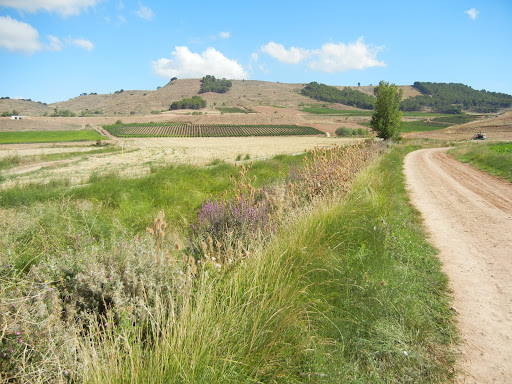
A look back to the land behind us, going from Azofra to Ciruena.
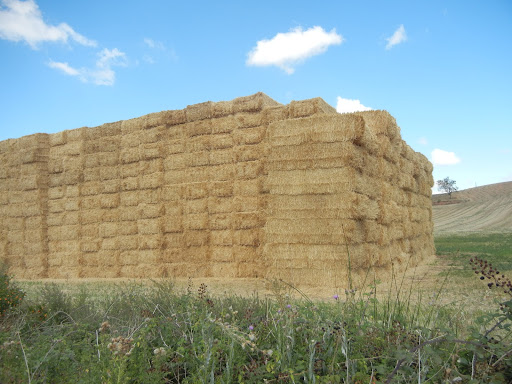
A giant pile of hay bales, eleven high. We can’t figure out how that get them stacked up there.
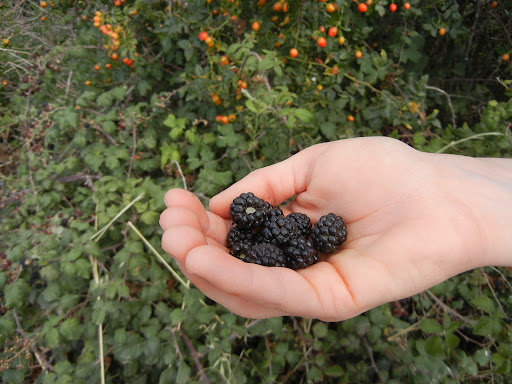
A handful of tiny black raspberries (orange rosehips in the background).
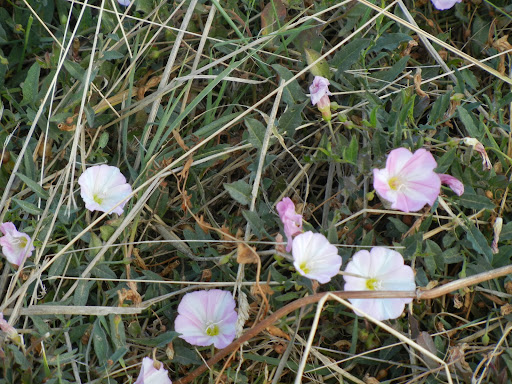
Bindweed along the roadside (cousin to morning glory).
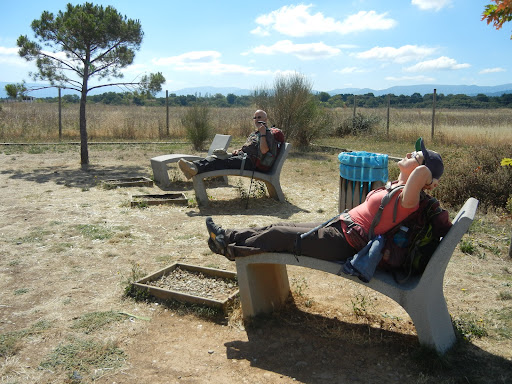
Jim and Anthea relaxing on concrete chairs set out for the pilgrims at a rest area near Ciruena.
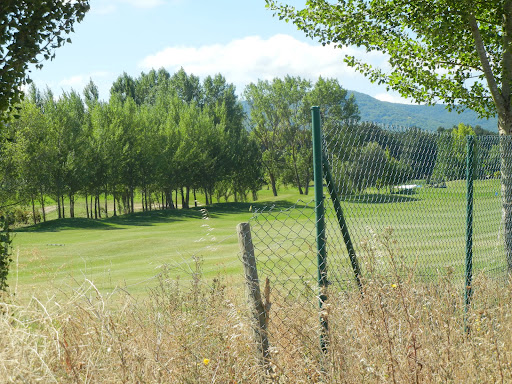
Edge of the golf course. Maria and Francisco (our hosts) said that the Camino used to go through this area, but was re-routed to accommodate the golf course.
The statue of Mary being carried back into the church after the procession around the square.
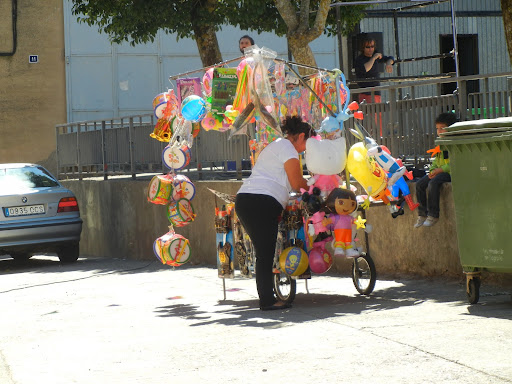
A vendor setting up for the festival at the square in Ciruena.
Jonasin encounters a car.
A happy crowd.
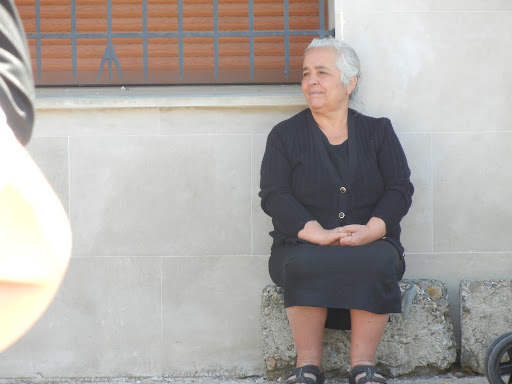
A classic Spanish woman (but you could see her in any Mediterranean country).
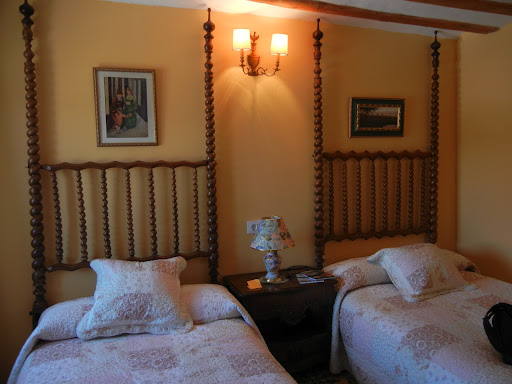
Our very pleasant room.
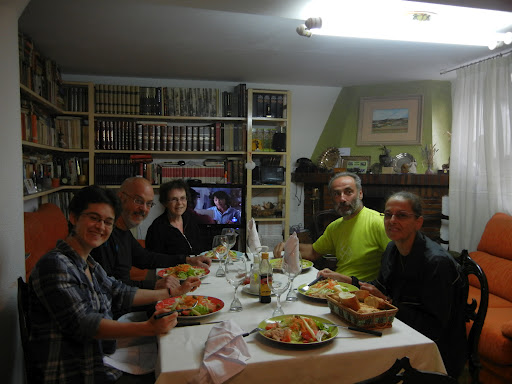
Dinner at Casa Victoria.
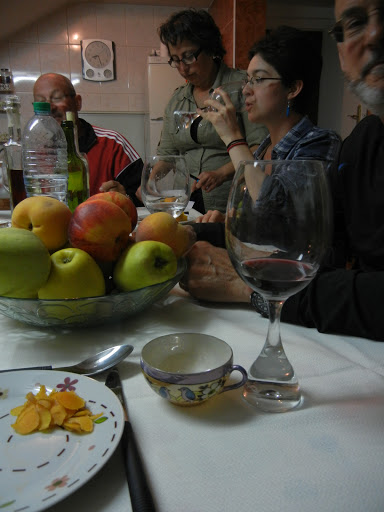
We were served with the finest china and glasses that they had to offer.
Dancing to the DJ in the evening.
Sunset in Ciruena, September 2, 2012.
Posted in 2012, Camino de Santiago de Compostela, Camino de Santiago trip, travel
Tagged Azofra, Casa Victoria, Ciruena, Francisco, Maria, Najera, Najerilla, Santo Domingo, Virgin
Leave a comment