Last day in Spain (being sent out a couple of days later)

And tomorrow we’re off. We’ve called the cab driver who’s a fan of Catalan independence, and have arranged to walk to the market with Peg and Tom for breakfast. Then they will head for Montserrat, and we will go to Newark via London. I try to spend my pre-flight time packing and double-checking lists, rather than thinking about how many hours we’ll be in the air.
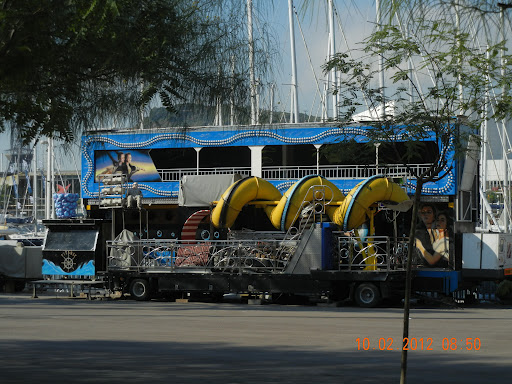
Today we agreed on laid-back beach and wi-fi time for the Carns family, and some more exploring for Peg and Tom. We all got breakfast at the market again — croissants, flatbread, raspberries, cherry tomatoes, and of course, coffee. Walking to the beach took us a little out of the way — the regular route was blocked by security that had been set up for a boat show that ran for several weeks and ended today. Back on the main route we spotted evidence of the show — carnival equipment packaged up and ready to move on to the next event.
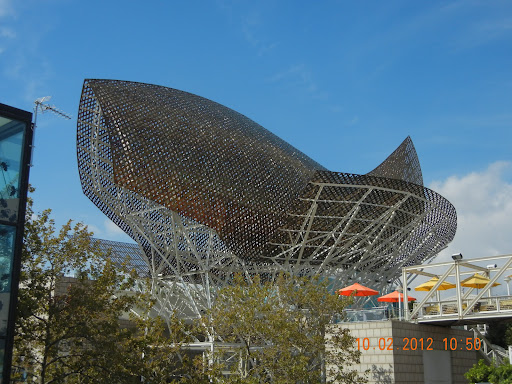
Lunch (delicious, and accompanied by a pleasant breeze) was at a cafe with tables out on the boardwalk that edges the beach. The four of us walked a few blocks to the Frank Gehry fish statue that came to the waterfront (I think) during the 1992 Olympics and Anthea found a spot to sunbathe. I joined her later, while Tom and Peg went off to explore the medieval and Roman parts of the old city and Jim headed back to the hotel for a rest. The beach was crowded with sunbathers, hundreds of them, but only a few dozen people braved the water to swim — much too cold.
Our path home from the sunshine led through the mall for some wi-fi time, checking on plane tickets and New York City arrangements. Dinner was back on Las Ramblas — every meal there means a two and a half mile round trip, so extra gelato for dessert. We’ve done pretty well in Barcelona at continuing to walk — on the 30th, 1st and 2nd, we averaged about twelve miles a day. We’ve noticed that sunrise and sunset come nearly an hour earlier each day than they did in Santiago. Because we went 400 miles due west, and then went east back to Barcelona,the sun was up an hour earlier. That would have been handy on the Camino.
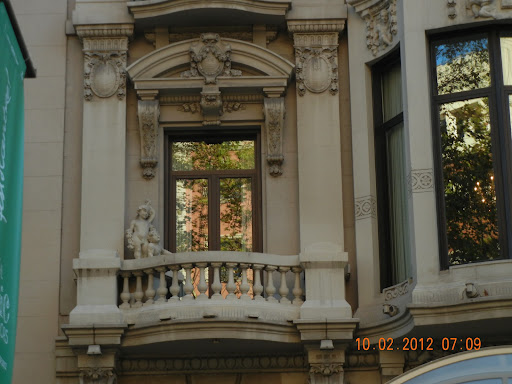
Statues on a balcony.
The Titanic carnival ride, after the boat festival, packed up and ready to move on to entertain a new batch of festival goers.
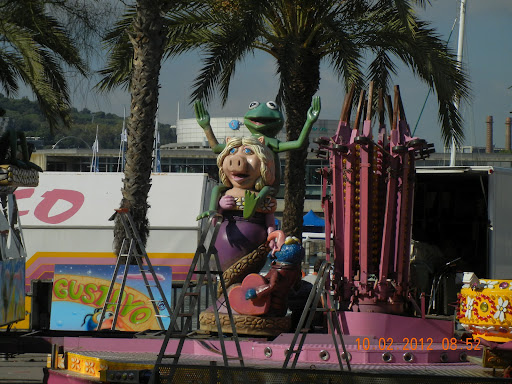
Kermit and Miss Piggy, moving on from Barcelona.
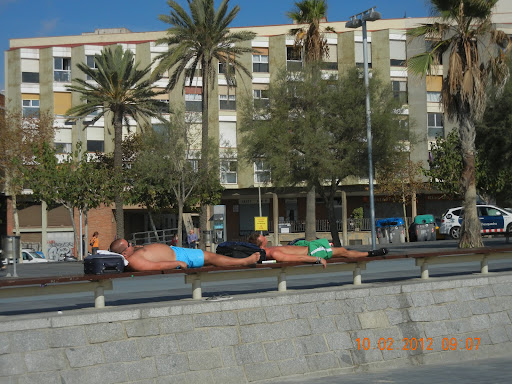
Sunbathing, minus the sand.
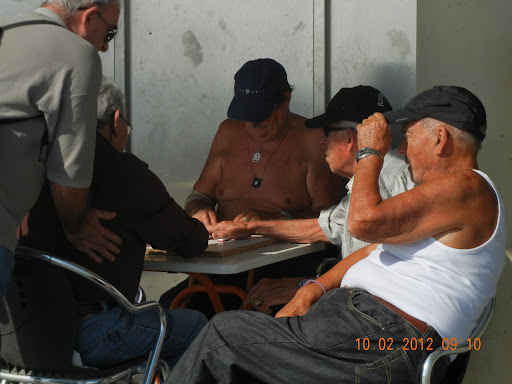
One of several tables full of mainly older men, playing dominoes along the beachfront.
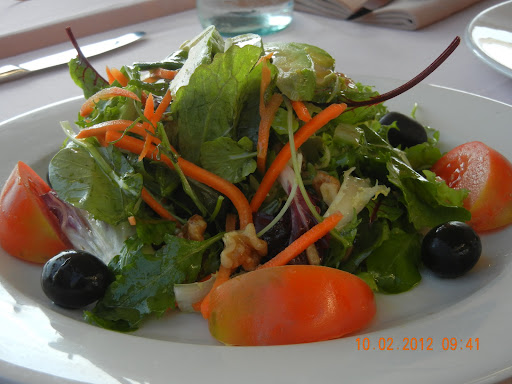
A “mixed vegetable” salad for lunch. They almost always include tuna, which the Spanish have persuaded themselves is of the plant persuasion.
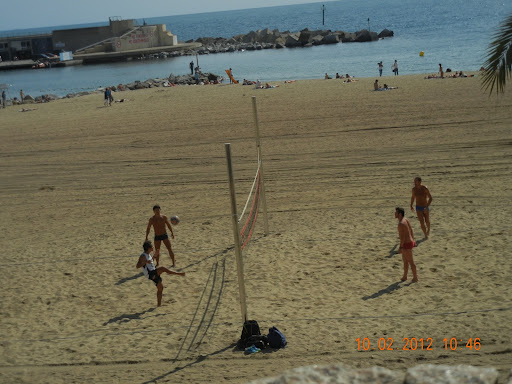
Guys playing a version of beach volleyball that doesn’t allow the use of any hands.
Fish sculpture created by Frank Gehry for the 1994 Olympics.
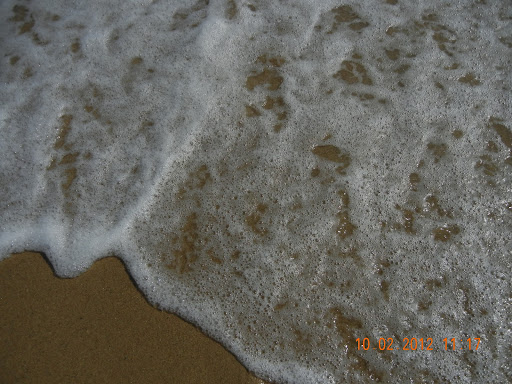
Waves rolling in. The water was cold enough that I could easily see myself seated on the sunny beach rather than wading out it to swim.
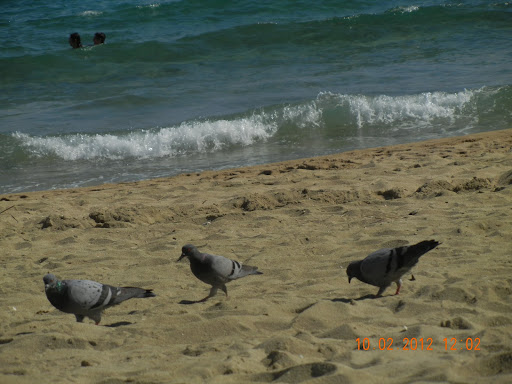
Pigeons on the beach. We were delighted to see them, but found that they have replaced gulls on the beaches. Perhaps it was because it was so cold?
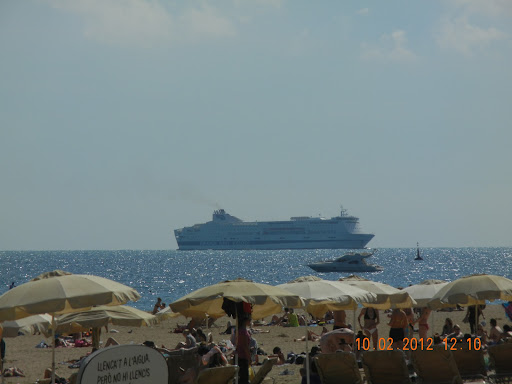
Ships and boats in the harbor.
Posted in 2012, Camino de Santiago de Compostela, Camino de Santiago trip, travel | Tagged , , , , , , | 2 Comments

Santiago to Barcelona

[This is out of order; sorry!]

We showed up this morning at the Santiago airport well before dawn, along with dozens of other peregrinos. Everyone still wore backpacks with shells, carried walking sticks, hefted backpacks. By the time we left the airport in Barcelona, they had begun to disperse among the crush of other passengers from Dubai and Los Angeles, Hong Kong and Mumbai. Yet Santiago showed up at the flea market that Tom spotted in the afternoon down by the beach, in the form of bracelets with scallop shells, and rosaries, one from Conques on the Camino from Le Puy to Santiago, and the other featuring St. James. We left our walking sticks in the hotel room, but put in nearly 11 miles anyway, exploring Barcelona (Peg and Tom’s first times here) and getting to dinner and back.
The weather stayed fine, ten degrees warmer than Galicia, and mostly sunny. Barcelona put its best Sunday feet forward, with Las Ramblas crowded with families and the elderly, tourists and teens all out for a stroll. We found Italian food for lunch with sauteed veggies and excellent gnocchi, and chocolate at Escriba, our favorite chocolate shop. Tom and Peg got gelato at one of half a dozen different shops along Las Ramblas. The two of them and I headed for the lower stretches of the boulevard, while Jim and Anthea went back to the hostal for some more much-needed sleep.
Near the port on Las Ramblas, the mimes were dressed in fantastical layers of paint and clothing, but the market was closed and only a handful of flower and pet merchants had their stalls open. The artists, sketching portraits and caricatures of the passers-by willing to pay, seemed to each have found at least one willing subject and several on-lookers.
Dinner was Spanish Italian, with Galician pizza for Tom and Peg (octopus and potato), sangria for the table, and tortellini for Anthea. We noted that the portions are smaller in Barcelona than in the north, and the bottles of fizzy water are larger. The rest of the evening was spent in laundry (still have to do that) and trying to get the Internet to work — unsuccessfully, clearly, because this is going out a day late.
Our cab driver spoke English well and we got into a discussion with him about the Catalunyan Independence Movement. His perception was that the poorer areas of Spain take money from Catalan. On this past Thursday, the region’s legislators voted to hold a referendum on independence — the Spanish government says that would be unconstitutional, and it doesn’t seem likely to happen. But we see separatist flags flying from balconies all over town (there are several different groups, each with its own variation on the flag). Besides the economic argument, the Catalonians argue that they have their own language (similar to Spanish, but with some French similarities; many of the signs around Barcelona are either in Catalan or both Spanish and Catalan) and culture, along with a history of self-government. It’s not the only independence movement — From Pamplona west into the meseta, we saw plenty of Basque separatist graffiti, and in Galicia, some of the same arguments for independence are being made.
Feeding pigeons at Plata Catalunya.
A flower stall on Las Ramblas.
Soldier washing his hands at an art noveau (“Modernisme”) fountain on Las Ramblas.
Catalan Separatist flag on a balcony across the street.
Posted in 2012, Camino de Santiago de Compostela, Camino de Santiago trip, travel | Tagged , , , , , , , , , , | 2 Comments

Barcelona on a sunny October 1

Hard to imagine that it’s October 1 and has been snowing in Anchorage when we are wandering along sunny streets with breezes in the palm trees. We did a fair amount of that today, Peg and Tom’s first full day in Barcelona. Breakfast from the market was high on the list — croissants from the pastry shop, grapes from a fruit stand, figs and dates from another vendor, and chocolate from a bon-bon booth. Then we spent an hour or so taking photos, ate some pizza at a street cafe in the sun, and set out to walk to La Sagrada Familia, about three miles away.
Along the way we stopped at the Starbucks on Las Ramblas, and witnessed the aftermath of a sad story. I was at the counter and overheard one of the baristas telling a young woman that she had to report the theft of her bag to the police; that Starbucks could do nothing about it. “Be sure to tell them that you had at least 500 euros in cash in there, or nothing will happen,” she said. “You must always keep your bags on your lap and never let go. They come and snatch the bag and hand it to an accomplice. Maybe the police will get the bag back.” After the woman left, I asked the barista if this was common, and she assured me that it happened every day in Starbucks.
La Sagrada was the highlight of the day — it’s Antoni Gaudi’s masterpiece, started by someone else in the late 1800s, worked on by Gaudi until his death in 1926, and being finished by others in the following years. Gaudi himself loved organic forms; and left instructions and plans for the whole cathedral. But while his work is lush and curving, full of symbols and whimsy, and while the people who have worked on the church since have followed his concepts, the new work is angular and modern without the intricacy and joy that Gaudi expressed. Taken all together, it is breathtaking inside and out, especially the play of light from the stained glass windows on the light-colored stone of the interior.
Dinner was paella and beer for Tom and Anthea, salad for Peg, and ravioli for me. Anthea made the owner of the establishment an origami crane from one of his placemats, and will be welcome there forevermore. Gelato finished off the evening — rich, creamy stuff in cups, eaten with tiny little spades while strolling along Las Ramblas making plans for tomorrow. Altogether we walked about 12 1/2 miles today; nearly 11 yesterday — still in Camino mode.
Spanish kids on their way to school this morning.
My favorite pastry shop, at the St. Josep Market off Las Ramblas.
Zucchini blossoms ready to be battered and deep-fried.
Candy roses at the bon-bon booth.
Mackerel.
Looking along the main nave of La Sagrada. Gaudi said that he wanted the interior of the cathedral to be sheltering, like being under trees. The light from the stained glass windows shows up particularly well on the light stone pillars; as Anthea said, we probably couldn’t have chosen a better day, or better time of day, to get the best effects.
Some of the stained glass. Many of the windows are clear glass still; people hope to finish all of the work on the church by 2026, the 100th anniversary of Gaudi’s death. Inside the church, one hears construction — drills, saws, pounding; recorded music in the background; and the echoes and voices of all of the visitors. But every half hour, the real organ plays briefly (“Jesu, Joy of Man’s Desiring,” once) and all of the sound stops for that time.
[Many more photos, but the Internet is turning fitful, so I’ll send this as is.]
Finishing off the evening with gelato.
Posted in 2012, Camino de Santiago de Compostela, Camino de Santiago trip, travel | Tagged , , , , , , | Leave a comment

Finisterre — the end of the earth

The bus for Finisterre left at 9:00 a.m. and we were on it, asleep much of the time until our arrival at 11:30. From the town we walked out to the lighthouse point, about one and a half miles, payback for the days of walking in the rain and the long treks up rocky dusty paths and then back down again. Sunshine, a breeze, and blue sea backed with green mountains and speckled with whitecaps. . .  heather and scotch broom, pines and grasses . . .  a steady stream of peregrinos in twos and threes heading up the last of the hills to the end of the earth. . . . couldn’t ask for a nicer day.
At the top, we ate some lunch, Regina and Anthea scrambled down the rocks below the lighthouse, and then we walked back down the hill and caught the 3:00 p.m. bus (and slept most of the way back). There’s no need for superlatives because they can’t really capture such a beautiful day, so we will leave you with the photos and the note that our next journey will certainly include more ocean.
Once back in Santiago we had several errands. Anthea and Jim had not yet embraced St. James, so we headed to the cathedral to pay our respects. Along the way we got distracted by souvenir shops with mementos — for Anthea, a navy blue T-shirt that shows the Beatles on “Santiago Road.” Regina acquired a small jet shell to wear on a chain; jet  has been mined in this area since the Celtic days, and is thought to bring good luck (the oldest known piece dates from 15,000 years ago and was found in northern Spain). I got a small silver scallop shell dish for a gift. We haven’t really done any shopping at all for an entire month — a couple of very small souvenir shells for Regina and Anthea, and a couple for Jim and me. Otherwise it’s been bandaids and Kleenex, chocolate now and then, and the occasional snack — plus daily meals. That’s it. Not much for a person (me) who loves to shop.
[Another thing I have not done for a month is read any book besides the John Brierly Guide to the Camino. I’ve read news on line when possible, and have done a bit of research here and there for these emails. Life has been remarkably book-free for the first time since I was five. It will be interesting to see whether I go back to reading as much as usual once home.]
We also managed to find time to take pictures in the cathedral; make a video (Anthea) of a Galician bagpiper and his friend accompanying him on the bodhran (Celtic drum); take photos of a couple of weddings (Teri); and eat oruco (the local liqueur) sherbert at the Hostal dos Reis Catolicos amid the plush couches and heavy woodwork and paintings and sculptures dating back to Ferdinand and Isabella’s days. Peg and Tom met us for dinner at the pasta place in the big mall, and then Jim and I climbed the hill to our cardboard (aka “quaint”) bungalow to start packing.
Regina and Anthea went hunting for quemada, the fire drink that we were served in Eirexe, but couldn’t find it, so they are back and  also packing. It goes something like this: “Do we need this packaged soup any longer?” “No.” (It goes into the kitchen cupboard.) “I think I’ll leave this cheap plastic poncho — it’s already got a broken button.” “What am I going to do with my walking stick in Seattle?” and so forth. Regina is still hoping to take her backpack as carryon; Jim and I have understood that we can’t, so are not as concerned about saving weight and space on the trip home.
A cab will arrive at 4:30 a.m. to pick up Regina and take her to the airport (she’s headed for Madrid and Seattle); another will pick us up at 6:00. We’ll meet Peg and Tom there, and the five of us will fly to Barcelona for another couple of days on the Mediterranean beaches, and some sightseeing.
Just looking at my notes, I find one that says, “It will be a long time before I complain about signage in the U.S. again.” The Spanish often don’t mark the streets or roads, so it’s very difficult to stand on a street corner and say,”we’re here.” Regina’s GPS on her phone has been a big help, particularly combined with Google maps. The Camino arrows and scallop shell symbols have kept us on that road (most of the time), but knowing where one is at any given moment by just relying on local signs can be extraordinarily difficult.
We’ll keep you posted on what’s great in Barcelona and then New York. The Camino is finished for now, but our way back to Anchorage (where it’s been snowing) still leads through interesting territory.
A plain stone cross at Finisterre where people leave things, and sometimes burn them. Anthea and Regina saw a small fire of shirts.
A juggler at Finisterre who has taken on Jim’s walking stick as part of his repertoire.
A large and interesting spider along the road. The wind kept catching the web; thus the blurred photo. Regina described the spider as the “size and color of a cherry tomato.”
Regina at Finisterre.
Peg and Tom at Finisterre, with the northern Atlantic shining behind them.
Jim, Regina and Anthea on the road back down to the town of Finisterre. The next adventure will include more of this blue sky and ocean.
A wedding seen through the open doors at the Chapel of the Souls (near the Santiago Cathedral). It was an evening for weddings; we saw several in process or recently completed.
The bride, at a wedding party in the courtyard of Hostal dos Reis Catolicos.
An old tapestry at Hostal dos Reis Catolicos depicting a much different wedding party.
Party man at Hostal des Reis Catolicos, the luxury hotel.
Galician piper and Celtic drummer near the cathedral.
One of Regina’s guidebooks says that these (very large) angels in the Baroque work in the cathedral were designed to cover up the iron supports for the carvings above them.
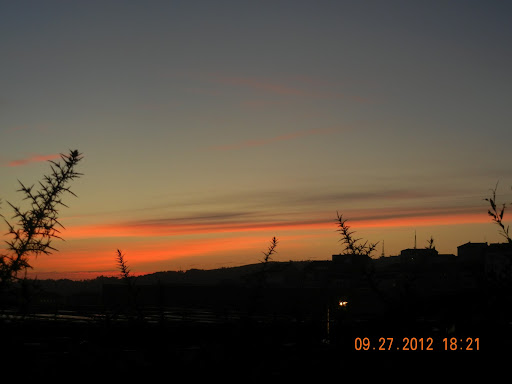
Full moon in a sunset sky, about 8:30 p.m.
Posted in 2012, Camino de Santiago de Compostela, Camino de Santiago trip, travel | Tagged , , , , , , , , | Leave a comment

The Pilgrims’ Mass in Santiago, and other sights

The Pilgrims’ Mass — the highlight, for many, of their pilgrimage. For others, like the college kids sitting on the floor next to us, it was a chance to strip down to the tank top and get a neck rub. The lady sitting on the column nearby spent most of the Mass tapping away on her cell phone, while her husband photographed and video-d everything. St. James seemed unperturbed; I’m sure he’s seen a lot in the past millenium or so.
Peg and Tom arrived at 10:15 to reserve seats for us; we got there at 11:00 and all of the other seats were gone (although a couple of Mexican ladies squeezed into our rows with us). The aisles were packed as well as the pews and any available surface on which to sit. A nun with a beautiful voice in a severe classic black habit came out and taught us some of the music that would be sung during Mass, directing with exquisite authority and gentleness. Anthea translated: “Now the young ones, you can sing louder here. Good! And you here in the front rows, sing too.” At noon, the bishop came in at the tail end of a procession of a dozen or so priests. Before the Mass, there were welcomes to the peregrinos, and a listing of the pilgrims from different countries, done by lay people representing different Confraternities of St. James.
During the early parts of the Mass, the readings from the Old Testament and the Epistles of the Apostles, the bishop stood leaning his head on his staff looking tired. but when it came time for him to give the sermon, he brightened up, and got deeply into talking about pilgrimages until he was gesturing and vigorous. He tied his speech (Anthea said) to the first reading from Ecclesiastes, “There is a season for everything, a time for every occupation under heaven. . . ” I don’t know what he said, but I could understand enough Spanish to catch the references in the reading, and thought that it could mean “there is a time for pilgrimage, and a time to come to the end of the pilgrimage,” and that was satisfying. We have come to the end of this pilgrimage, and it is complete. There may be another one, but our road to St. James came to its fulfillment in the Mass in the cathedral.
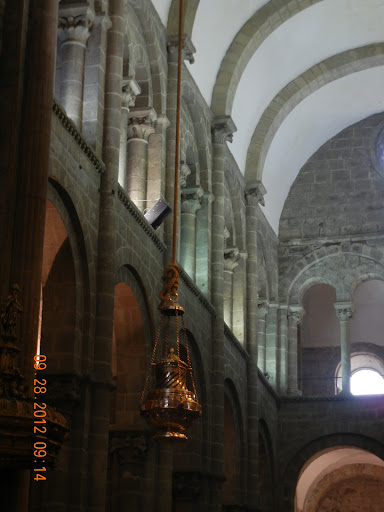
At the end of the Mass, the tirabolieros [translates as “the guys who swing the incense burner”] came forward in their rust-red robes and swung the huge incense burner, the Botafumeiro. We were fortunate to see this; we have read that they don’t do it at every Pilgrims’ Mass. It swings in a long arc up over our heads almost to the roof of the cathedral, then back down nearly to the floor and out and up again on the other side, for several minutes, with every head in the cathedral following its mesmerizing arc. Peg and Tom got us excellent seats, right underneath.
Before Mass started, about ten minutes, someone announced that there should be no photography or videotaping during the ceremony. Of course, people ignored that; a few at first, but more and more as the Mass went on. When the Botafumerio began to swing, all pretense at obedience ended — there were people using both camera and cell phone to properly record both the music and the event. As the tirabolieros brought the censor to rest before the altar, the crowds broke out in loud applause and cheering, quieted only by the firm voice of the bishop singing the final responses and blessing.
Another tradition of the pilgrimage is that when one arrives at the cathedral, and has a chance, one climbs the stairs behind the statue of the Saint and gives him a hug, or at least a pat on the shoulder in lieu of a handshake. We made our way slowly up the red marble stairs with their deep hollows worn by the feet of so many other pilgrims. St. James’s golden robe is set with gemstones — squares of citrine and ruby and others that I didn’t have time to look at. There are only a few seconds to say “Hello” and “Buen Camino” before it’s time to move along and make way for the next person in the steady stream.
We found a place for lunch (pasta, french fries, and the like), and then parted ways, with Jim and Anthea heading back up the hill to our cozy little bungalow, and the rest of us roaming around looking for coffee, shops with things for the folks back home, and sights to see. Anthea was sick last night, from something she ate; luckily by late morning she felt much better and came to Mass with us. But by mid-afternoon, she was ready for a rest.
The squares and streets were crowded with peregrinos and townspeople and tourists. We said “Buen Camino” to the new pilgrims arriving, but instead of returning the greeting, most of them ignored us. We felt that we had left that stream and could no longer (even carrying walking sticks, but not the big backpacks) be recognized as fellow travelers. They were focused on following the path to the cathedral; we were a distraction, or just not heard.
[I’m sitting in the bar/restaurant at the camping cabins place we’re staying — it’s a fairly upscale bar, and like all Spanish bars has a TV on which is playing a) futball; b) news and weather; c) Spanish soaps or action shows (Anthea can understand these, so pays more attention than we do); d) occasionally weird music videos. But mostly futball. The bars are equivalent of a cross between an American bar, a coffee shop, and a casual restaurant; neither coffee shops nor casual restaurants exist as distinct creatures — it’s always a bar.Everyone comes to these — families, singles, old men, business people, travelers. It will be strange to be in the U.S. and not hear the ubiquitous futball games in Spanish in the background.]
In the evening we went to the big shopping mall that Peg and Tom discovered when they were here for a night before they took the bus to Sarria. It has everything — shoe stores, clothing, phone shops, restaurants, electronics, game shops — you would find in an American mall but in its Spanish incarnation. The restaurant was Italian again, but had a wider variety than many, and good chefs. We laid our plans for the trip to Finisterre by bus tomorrow — two hours there and three hours back; with four or five hours to see the Atlantic, the “End of the Earth” and get some lunch.
Traditional Galician dancers performing at the Hostal dos Reis Catolicos. [The hotel on the main square with the cathedral was built by Isabella and Ferdinand in the late 1400s to house poverty-stricken pilgrims; now it’s a 5-star luxury hotel run by the Spanish government.] Note the blue sky — the day stayed clear with a breeze to cool things off. The air begins to smell like autumn, and the sun to have the distant quality that it takes on as winter approaches.
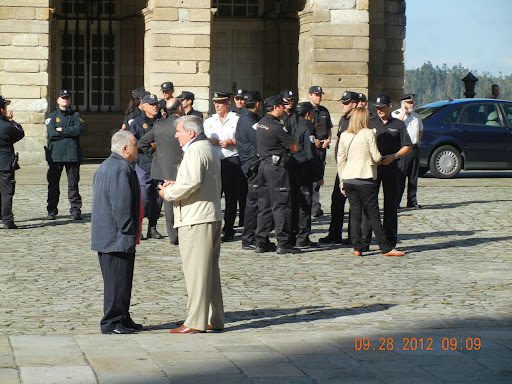
Swarms of Spanish police in the main square a little before noon. We thought maybe they were expecting demonstrations (there have been a number of these recently, especially in Madrid, that we’ve seen on TV), but soon they all piled into vans and sped away, so we decided maybe they just changing shifts.
A pilgrim backpack waiting for Mass.
The Butafumeiro and the church’s arched ceiling.
The ropes for the Butafumeiro.
Notice the pilgrim head behind St. James’s shoulder. Stairs lead up behind the statue so that people can hug the saint, or say prayers.
A “Black Madonna” in one of the chapels around the perimeter of the cathedral. Several similar statues are honored in different places in Europe; from what I’ve read, they’re black because the original varnish has discolored. The cathedral has a dozen or more chapels honoring Mary and various saints.
Challah bread in a Santiago pastry shop.
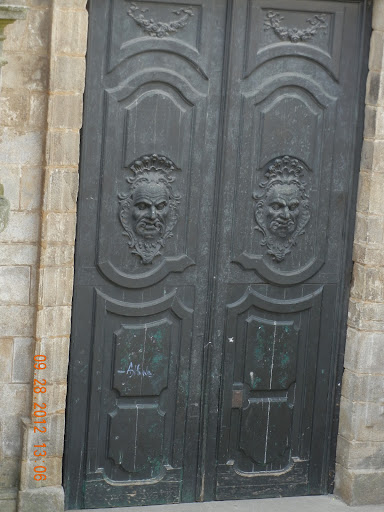
A pair of faces on a set of church doors that we liked.
A laughing cheering bunch of student pilgrims from a Spanish school making their way along the Camino. Their chant sounded a lot like a football game — they were clearly having a good time.
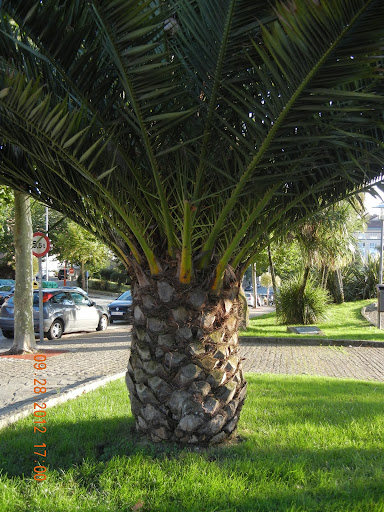
A palm tree in a park. We see more of these in Galicia than in the rest of the north of Spain; they are more common in the south.
The Carns-Lazio crew after a relaxed day; we only walked about 9 miles today.
Posted in 2012, Camino de Santiago de Compostela, Camino de Santiago trip, travel | Tagged , , , , , | Leave a comment

Santiago

Today 1,059 peregrinos registered with the Pilgrims’ Office in Santiago. Six of them were the Lazios and Carns. To get here, we walked differing numbers of miles — I got in about 367, since Pamplona. The requirement, to gain a Compostela/certificate of completion, is 100 kilometer, or about 60 miles, and they have to be at a  minimum from Sarria to Santiago on foot (or horseback or bicycle; the requirements of slightly different for them than for walkers).
Our morning started out cold (maybe in the 40s) with a mist/fog hanging over the valleys.We walked through the eucalyptus woods. One guidebook characterizes them as oases of peace; another suggests that they are invasive, sucking the nutrients from the chestnuts and pines, and dropping sloppy amounts of bark and leaves. But they’ve tall and leafy and smell good. The path itself had dried remarkably well, after four days of rain with only the occasional mud patch to avoid.
For the last day, there were many people along the way, and now and again we would see someone from yesterday, or a few days ago, or even weeks earlier. We sang a Camino song to a sea chanty tune (Regina says for her sea chanty group, there must be something about ships and water; the Camino has water but no ships). The trees shaded us enough that we didn’t have to put on sun screen. But mid-morning, the air had warmed enough from the sun that we started shedding layers of clothing, but later in the afternoon we had to put most of them back on again.
We got to town about 4:00 and climbed a (yet another) steep hill to the place that we’d reserved months earlier — a bungalow on a campground at the edge of the city. It’s “cozy” and it’s certainly fits a “roughing it” style, with minimalist furnishings and rough walls made of pressboard and paint. But it has a heater and wi-fi, and tonight at least we are so tired that we  don’t care about much else.
Our next stop was the Pilgrims’ office for our compostelas — our certificate of completion. We waited in line for a long time with dozens of other peregrinos who made their first stop the office rather than a bath or beer. We were given sheets with questions about ourselves (age, country, state, gender, occupation) and a question about why we did the pilgrimage. If one says “religious or spiritual,” one is given the Compostela. I the the answer is something like culture, history, adventure — things like that — one receives a certificate of completion.
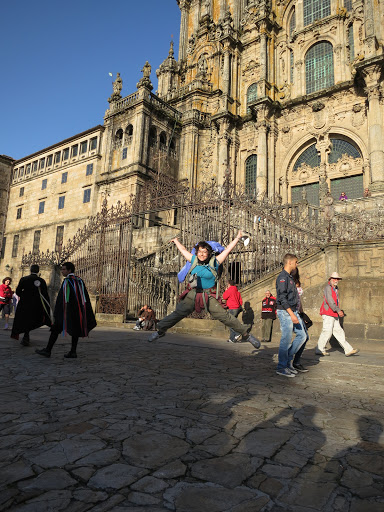
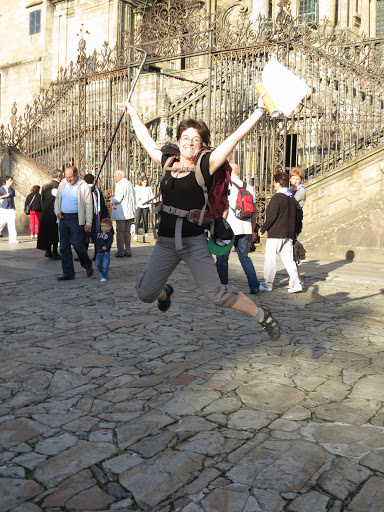
We took our celebratory photos in front of the cathedral, ate more pizza and pasta for dinner — good, homemade crust and excellent toppings, and back to our respective domiciles. We’ll meet again tomorrow at 11:00, to get a place in the cathedral from which to share in the Pilgrims Mass at noon. We get to sleep in, and eat a leisurely breakfast, and after Mass, we can shop and sightsee. The camping place will do laundry for us — another luxury.
So we made it — too tired to give much expression to our feelings about the accomplishment — we’ll say more tomorrow.
Thanks to all of you for being such friendly support — it would have been harder to do without you, and a good deal less fun — Teri, Jim, Regina and Anthea
More tomorrow!
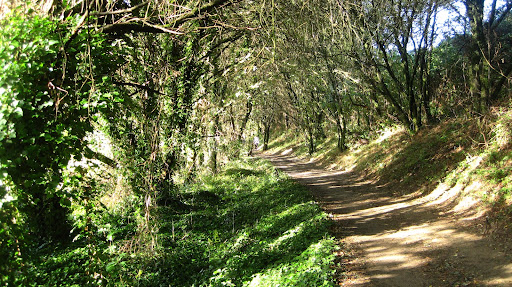
A wooded path.
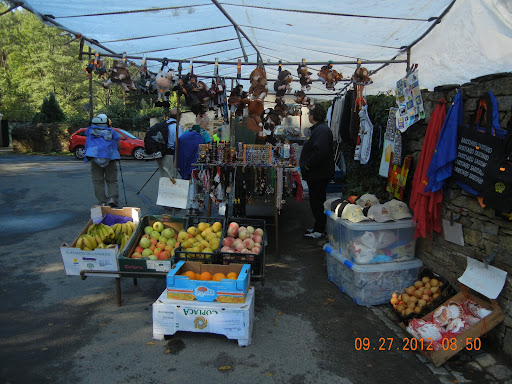
A  wayside stand, full of peregrino delights – fruit, hats, walking sticks, jewelry.
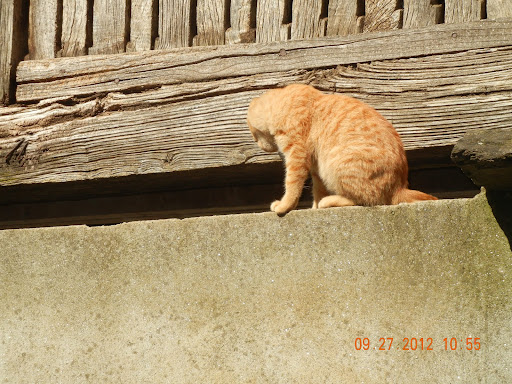
Cat on a wall, waiting for mice.
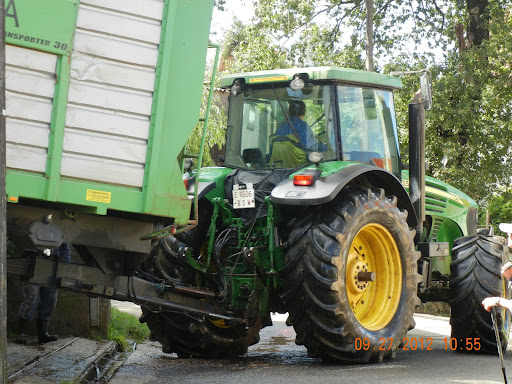
John Deere, on the move in a small village, filling every inch of the street.
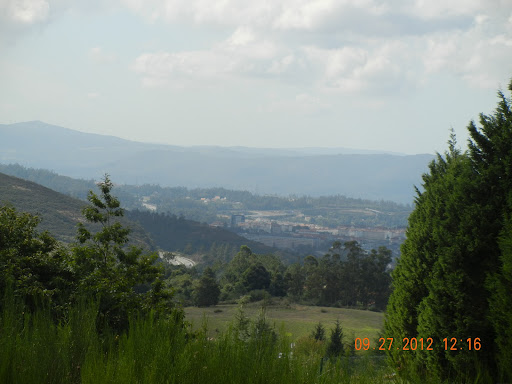
Santiago in the distance, from Monte del Gozo. It was called Mount of Joy because from here one could see the spires of the cathedral — today had too much mist/fog/clound over the city.
Standing in line to get our certificates — took about half an hour to get through.
Peg and Tom at the goal — Santiago Cathedral.
Regina rejoices.
Anthea with her Compostela certificate –leaping for joy with her backpack on.
Teri and Jim in front of the Santiago Cathedral.
Galician sunset over Santiago.

Posted in 2012, Camino de Santiago de Compostela, Camino de Santiago trip, travel | Tagged , , , | Leave a comment

Arzua to Arco O Pino

The penultimate day — tomorrow we arrive in Santiago. Jim and I almost arrived in Santiago today. We entirely missed the correct turnoff to Arca O Pino, our destination and were almost at the Santiago airport before we decided we had to be wrong. We had in fact gone about 6 kilometers too far. We slogged back downhill through the mud that squished underfoot most of the day and stopped at a hotel we’d passed earlier. The most excellent owner (an Englishman who owns three hotels in the area) was at the bar and pointed out where we’d gone wrong. He called the owner of our pension in Arca, who came out and picked us up and took us to home for the night. Peg and Tom and Regina and Anthea had long since arrived and were enjoying themselves in the bar; we all went directly to the pizza place that they had picked out for dinner. The consequence of our getting lost was that we ended the day with around 17 1/2 miles, compared to the 14 accumulated by the rest of the group. An extra 3 1/2 miles in rain and mud should get us lots of good karma points somewhere. At the moment, it’s achieved cold, muddy shoes and socks that will have to be washed before bedtime.
One clue that we might be on the wrong path was that we encountered only a couple of other people in the last hour — a couple of French guys with a cute dog who said that they were planning to spend the night at Mount Gozo just outside Santiago and who had no idea where Arca was; the other a woman who said that she was walking home from Santiago (you follow blue arrows to do that; we had seen them but not known what they were), and who also had no clue about Arca. Before that, we were passed by a steady stream of peregrinos and cyclists.
Mud — the rain started just as we left town, and returned on and off all day long. This was the fourth straight day of rain; the dirt paths have turned to streams in some places and mud beds in others. Much of the day was in pine and eucalyptus forest, with red needles, red leaves, and strips of red eucalyptus bark littering the mud and rocks. We squished uphill and sloshed downhill; sometimes with ponchos on, sometimes enjoying a few brief moments of sun.
The wildlife for the day included chickens (sometimes crossing the road), sheep, cows, horses, cats, and dogs, plus the  wild birds singing beautifully and a spider or two.
One pleasant break in the day was afternoon coffee with an Irish couple and an English girl and her mother who were on a walking tour from Sarria to Santiago. The Irishman was asking Regina about global warming, and the Alaskans about Sarah Palin and oil companies. He, like the earlier Spanish guy who attributed Spain’s troubles to the U.S., attributed Ireland’s troubles in part at least to financial practices set moving by the U.S. in the early 1990s. He also said that the European Union was created in part to avoid further European wars, but that allowing countries with less developed financial systems into the euro zone and then expecting them to be able to operate by German rules was asking for trouble.
Once again we are in a pension without wi-fi, so I am hanging out with Regina and Anthea at the lounge of their albergue across the street. I’m wrapping up early so that we can get started at 7:45 again, with breakfast, and then be on our way to Santiago.
Tomorrow — Santiago!
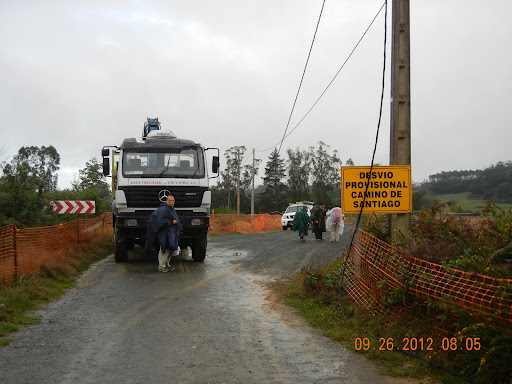
Linemen working on electric wires along the Camino (Tom Lazio in front of the truck; Jim, Anthea and Regina down the road.)
Chestnut husks littering the path at one point. They seem to have started falling in the past few days, perhaps only in this part of Galicia.
A sample of the path for much of the day.
Peg and Teri along the way; taken by a fellow peregrino.
Anthea eating breakfast #2, and feeding bits of the fried egg sandwich to the local cat.
The bar with the cats was very crowded, inside and out (the rain had stopped for a while). Note the backpacks lined up against the windows.
Free range chickens in a field.
A peregrino’s lunch — Anthea with a cheese and tomato boccadillo and a beer. Jim and I split the cheese and tomato boccadillo and Coke at the front of the photo — Anthea was very hungry.
Tractors for sale near a Spanish town. Note the John Deere — we see a lot of them.
An ewe with her lambs.
Tonight’s rainbow. It showed up as we were being driven back to the pension by the kind owner, and continued for an hour or so.
Nearly full moon in a clearing sky, tonight about 9:30 p.m.

Posted in 2012, Camino de Santiago de Compostela, Camino de Santiago trip, travel | Tagged , , , , , , | Leave a comment

Melide to Arzua — another rainy day

Rain discourages photography. Luckily it only rained much of the day, not the whole time, so we got a few photos. Early on, we walked through a forest of eucalyptus and pine trees. Someone was cutting the eucalyptus, using the Camino as a logging road (others use it as a cow path, for car deliveries, and so forth).
The woodland paths ran with new streams today. The streets, ditto. After three days of off and on rain, some of it vigorous, Galicia is soaked. By all accounts, this is its natural state, so none of the locals seemed perturbed. One reason for all of the running water is the fact that the area is all hills and river valleys. So we slithered down a steep rocky path, and trudged back up from the river banks to the top of another hill, then headed down again through woods and fields.One difference between Galicia and the rest of northern Spain is that more people have houses in the country, and there are more “hamlets” as the guidebook calls them, with two or three or four houses and barns together. Another difference is that some of the larger towns – Melide, Arzua among them — have more modern sections and the medieval parts aren’t as well defined.
Today really was a shorter day, only about ten miles (depending on whose pedometer you’re looking at). We checked into our hotel which has no heat (yesterday’s laundry didn’t dry, and today’s laundry has no better chance, given the damp) and no wi-fi, and unpacked, did laundry, got a rest. The interesting thing about the lack of heat and wi-fi is the indignation that the Spanish show at even being asked about these things — shaking their heads and wagging their fingers they say, “no, no, no.” I think that I’m spoiled because I turn on the heat in the house when I feel chilly, whereas many people I know refuse to do that until a certain date has passed
For the last couple of hours we’ve been parked at an Internet cafe that offers excellent hot chocolate, orujo (served with cream; Anthea says that it tastes like Bailey’s Irish Cream), and coffee, along with a chance to connect to the rest of our world. It’s getting to be 7:30 in the evening, with the possibility of dinner beginning to take on more importance. Regina says she’s discovered a couple of places that offer vegetarian options (even if just pasta with canned tomato sauce), so we’ll try one of those. And the sun just came out, lighting up the evening streets of Arzua. Regina has located a pizza place — how far are we willing to walk? About a mile, so we’re off — more tomorrow.
Logging eucalyptus trees in the forests along the Camino. The local police have stopped to ask a couple of questions, but they moved on.
A spider in the rain.
Translates as “Dangerous dog.”
Prickly pear cactus. The Galician vegetation seems to be a mix of tropical (palm trees, cactus) and Midwestern (weeping willow in the next photo down).
Tom Lazio, taking a brief rest.
Sheep grazing near downtown Arzua (where we’re staying tonight). The boundaries between country and city aren’t as sharp here as in the U.S.
Anthea’s keeping track of cute creatures for us — this is the kitten she met today at lunch.
Photos from earlier days:
September 24 — Eirexe to Melide —
A structure in the countryside — we saw several, but just in this area, and don’t know what they’re for — woven of branches, thatched roof. Internet time is limited, as is too often the case, so won’t look it up now.
Modern art peregrino.
Medieval bridge, still in use (possibly repaired in the meantime).
Wildlife — snail on our pension door in downtown Melide.
September 23, 2012 photos.
Wings for the peregrino — we often wish for them.
Puddles along the path — from two days ago. They grow bigger as the rain continues.
Sheep bellying up to the tapas bar.
Sunflower fields in Galicia from two days ago. We haven’t seen any since, but were a little surprised to see them this far west.
A Romanesque (meaning it probably is from the 11th or 12th centuries) front of a small village church — sorry that I can’t identify which village.

Posted in 2012, Camino de Santiago de Compostela, Camino de Santiago trip, travel | Tagged , , , , , | Leave a comment

Eirexe to Melide

For a twelve-mile day, it took a long time — in large part, because it was a miscalculation on my part, and was actually a fifteen-mile day. The forecast of “partly sunny” never came to pass — it was mostly cloudy with a few blue patches and rain off and on all day. It is Galicia, and that is the expected weather. It can be pretty — misty hills, lots of shades of green.
Random notes: Groves of eucalyptus trees appear here and there, mixed in with fragrant pines and the oaks and chestnut trees native to the area. We walked through woods and fields, and several small villages. Eau de cow dominates the air in many areas, alternating with fermenting hay, and pine scent. We stopped briefly for coffee in Palas de Rei, and then for lunch at a place more or less in the country. As the afternoon wore on, we finally stopped again for coffee at another isolated little cafe, and pressed on to Melide. As we got to the outskirts of Melide, the rain and wind picked up and blew us into town — not at all like Mary Poppins with everything in place, but soaking,dripping wet and exhausted.
The dynamics of walking have changed. The Lazios seem inexhaustible, and never complaining (unlike me). We tell stories, compare notes about childhoods, catch up on what the families have been doing, touch on politics briefly. If Regina is along, we talk science; if Anthea, more about literature and the like. Peg and Regina and I stop pretty often to take photos. Jim and Tom wait patiently and banter.
At the pension’s bar where we’re staying, they didn’t serve dinner until 9:00 p.m., and because it’s Monday, many restaurants are closed. Anthea and Regina scouted out some possibilities, but we eventually decided to try for the three-star hotel listed in the guidebook. At that bar, they served us french fries, lentil soup, pasta with tomato sauce, and plates of gray (Truly. Gray broccoli) broccoli supplemented with a couple of hard-boiled eggs sliced in half and some potato chunks. Madrid was playing someone else in futball; that was the focus in every bar in town, so we watched futball and long Spanish commercials about cars.
We comment now and then on the fact that in three days, we will be in Santiago. But it doesn’t seem real and we don’t dwell on what that might mean. We pay attention to the fact that our rain gear seems to work pretty well — our ponchos are keeping us and our backpacks dry — legs and shoes get wet because we’re not wearing gaiters or rain pants. Jim and I brought umbrellas, and if the wind’s not blowing hard, they’re a help.
Tonight’s room is chilly — as was last night’s, but there they turned on the heat. Here they said, “It’s summer, we can’t turn on the heat.” The Internet doesn’t work (I’m using Regina’s again) — we feel sorry for the young people running the hotel.
Tuesday, September 25 — in Arzua — sending this, and will send today’s later.
Posted in 2012, Camino de Santiago de Compostela, Camino de Santiago trip, travel | Tagged , , , , , , | Leave a comment

Portomarin to Eirexe — Galician rain

Drops of rain hung on our windows this morning, but we could see stars in the 6:00 a.m. dark, so hoped that the day would turn out well. It did, but in a very Galician style.
     Lacking Internet at our pension, I wrote most of this evening’s account at the bar across the street, and am finishing it and mailing it later, courtesy of Regina’s wi-fi hot spot that is associated with her phone — she has kindly loaned it to us for the evening. It’s remarkably slow (but mostly works), meaning that photos are not likely.
      Notes made earlier in the evening:
Outside the bar in Eirexe (there is only one) at 6:30 p.m. the winds blow and splatter the rain against the windows. A farmer carrying a black umbrella leads five cows down the main street, a black and four browns. Futball dominates the large TV in its place of honor across from the bar.  Three German women pilgrims, a couple of male pergrinos of indeterminate origin (in hiking clothes, most people look similar), and a few local men sit at dark wood tables set with forks, steak knives and wine glasses.
At the largest table, the Carns-Lazios have taken over, drawn there by the promise of wi-fi at the bar, made by the managers of the pension. The young man at the bar, however, frowned vigorously when we politely requested the password, as in, “who are you to ask such a thing?” and said, “No wi-fi! Only private.”
Making the best of the situation, we ordered dinner (pizza and salad) and proceeded to toast the fifteenth anniversary of Teri’s bone marrow transplant and Peg’s generous contribution of the bone marrow to make it possible. Thank you, Peg!
Another nine cows walk by, udders mostly full, accompanied by another farmer with black umbrella. The wind continues to toss the oaks and spread the water across the Galician hills. We feel that we have been baptized as peregrinos, and can claim full ownership of that title. Now we will be happy to rest on our laurels with that, and go back to the atypical sunny days that we’ve been enjoying.
We started the day at 8:00 with breakfast in Portomarin. When we stepped out of the bar, we realized that it was indeed raining a bit and we spent a good fifteen minutes pulling on our ponchos for the first time, adjusting them, and getting everything in order. But for the first hour or so climbing up from the rio Mino valley, we had sun, and the ponchos were hot so we pulled them off. The rain didn’t really start until about noon, and was fitful on and off all day. In the evening it gave the Midwest storms a run for their money, but most of the day it was more wind than rain.
Here’s the thing about ponchos – they blow in the wind. But they do keep the backpacks and top parts of the wearers dry. The legs and feet? When the Camino paths are channeling the water down the hill, turning it into new streams, the peregrino doesn’t have too many options. Brambles and stone walls line the paths, and cows graze on the other side of some of the walls. One must walk in the rivulets, and wet feet result.  Our hike was uphill most of the time. This is the last day of 1,000 foot or more climbs; for the next four days, we have little ups and downs, but more level walking.
We met Regina and Anthea for lunch at Hospital de la Cruz, another now-tiny town that existed largely to serve the medieval pilgrims. At the entrance to the restaurant, peregrinos milled about pulling off ponchos, rain jackets, backpacks, and hanging and stacking them to let them dry while they ate. At the table next to us, an Israeli couple sat with their one-year-old daughter, as cute a kid as could be imagined. We had a good time playing peek-a-boo, letting her play with the Playmobil toys we brought along for just such occasions, and talking to her parents. They are doing only parts of the walk this time. They have to carry more stuff (and they are carrying everything, not shipping anything). The little girl rides in a carrier on one or the other parents’ back, but she likes to walk some of the time, which slows them down.
Last night we mentioned the local liqueur, orujo (which is similar to cognac, a 100 proof or higher drink. It is distilled from the grape skins, seeds and stalks). Regina and Anthea asked for an even more special local concoction that combines orujo, a sliced lemon, roasted coffee beans, sliced peaches, sugar,  and maraschino cherries in a shallow earthernware bowl, about 16 inches across. Its name is “Quemada” – burnt – because the creator of the drink sets it afire in its bowl and lets it burn for about ten minutes before returning to blow out the flames and ladle it into coffee cups.Luckily, the people in the Eirexe bar knew how to make it and were willing to oblige. Of Celtic origin, the maker recites spells while the drink is burning (Regina read off the spells from her smart phone).  It was very strong and very delicious. I ate the coffee beans, and we all shared the peach slices and cherries, along with the liqueur itself.  It was the right weather for quemada – heat poured out from the blue flames, like having one’s own little firepot at the table. And then drinking it warms you to your toes.
     I’m becoming a fan of the small towns. Although you don’t know exactly what you’ll get when you make reservations, often enough we have lucked into local festivals such as the Virgin Mary celebration in Ciruena, and the castanet and flute group in another town. The quemada experience might not have been as easy to come by in a larger place, and the cows proceeding home along the main street would not be likely either.
We’ve seen sheep, cows, goats (Anthea and Regina), horses today. Early in the day we passed a grove of eucalyptus trees mixed in with the local pines. The guidebook says that we’ll see more of the eucalyptus as we continue west. Otherwise, we were too wrapped up in the rain and gusting winds to see as much of the countryside as usual.
One of my cousins asks if we all use pedometers. Yes, because if you’re going to walk twelve or fifteen miles a day, you really want to track that accomplishment (at least we do – others are probably less attached to such mundane measures of achievement). We have several Omron pedometers, but Anthea uses an app on her phone. Most of the time, our measurements are within about one-half mile of each other, which we feel is close enough.
     A few notes on our accomodations: we often have a double room with twin beds. Furnishings at this price tend to be minimal — sometimes a desk and chair, but tonight, just two small bedside chests. There’s always a wardrobe (almost never a closet) with spare blankets, and four mismatched hangers (rarely more). Everything is very hard surfaced — the floors, the hallways, everything in the bathroom, making the places noisy. You have to be very careful about standing in the hallway talking to someone in a room because the sound carries everywhere. The lighting tends to be abysmal (especially tonight), with low-wattage fluorescents. The beds in the pensions and hotels have sheets and a spread, and sometimes a blanket — but there are usually blankets in the wardrobe, if not on the bed. The bathrooms, if private, also are clean and hard surfaced, usually with two towels per person. If it’s a shared bath however, even if the price isn’t that much lower, there’s usually only one towel per person. They often have a large bottle of shower gel, and pretty often have liquid hand soap on the sink. If you’re lucky, there’s a stopper for the sink so that it’s easy to do laundry. Many places have photos or other artwork on the walls. They all have had windows that open, sometimes with unusual arrangements of shades or shutters.
     And that’s it. The next three days are shorter days, with plenty of up and downs, but no more long climbs or descents. On Monday, we will be in Melide; Tuesday, Arzua, and Wednesday, Arco O Pino. That means that we arrive in Santiago on Thursday — it will be strange to wake up one morning and not have a twelve or fifteen mile walk ahead.
Only one photo tonight because the available Internet is so slow — but it’s the most charming picture available — the little Israeli girl with her mother.

Posted in 2012, Camino de Santiago de Compostela, Camino de Santiago trip, travel | Tagged , , , , , , , , | Leave a comment