Taormina, a Haiku-ish version, September 19, 2013

It’s 10:30 p.m. and we have to be up early to catch our flight back to Rome. The program that I usually use for photos has stopped working this evening, we’ve been plied with delicious liqueurs by the restaurant and our hosts at the hotel, and I still have to pack. Regina suggests that I should view today’s email as a haiku, and write something short.
That’s both difficult and not. We had some entertaining experiences that would be worth describing in more detail (for example, our very Italian time trying to get the bus to Taormina this morning), but mostly the day was sunshine and beach, and a marvelous dinner, and brief time with our hosts at the hotel.
Taormina sits at about 700 feet elevation. To get there, the bus climbed up from the beach level along one of those switchbacked little mountain roads that has barely room for the bus, but then you are always meeting up with a delivery truck or a couple of cars that want to share the same space. The cliffs are precipitous and just get steeper with every turn up the hill. From the bus, one has a much better view of the scenery than you would from a car, but also a much better sense of how much further down you could roll than on the lower stages.
Once in Taormina, we wanted, of course, to go to the beaches, which were back down at the bottom of the cliff. We took the funicular to get down (it was possible to walk, but already in the 80s, and with all of the bus adventures, it was noon, so not really enough time). Once t,here we ate lunch on the patio of a restaurant just above the sand and suntanning crowds — not too many, because it was Thursday mid-day  mid-September.
It was the Mediterranean picture on all of the travel calendars — a little blue bay, rocky cliffs rising up to shelter it, a mysterious tower, small white boats on the calm sea, a few puffy clouds, the cooling breeze whispering along your back and toes. . . not much more to ask for in a day.
View of the Mazzaro beach at Taormina
Inline image 2
Soon enough, however, we wanted more, and set out for Isola Bella, “the beautiful island,” a small nature preserve a few blocks away. We walked there, uphill, then down a long set of steps, with a brief stop for the world’s best strawberry granita, and then onto the pebbled beach. How to get to the island? Walk through a short stretch of water that came to the middles of our calves. I was wearing my Chaco (waterproof) sandals; Jim and Regina took off their shoes and braved the stones.. Inline image 3
Once there, we discovered that we couldn’t go further than the crowded little pebble beach without paying more. Fair enough, but we couldn’t spend long, and it didn’t seem worth it. We waded back across, got another of the world’s most wonderful strawberry granitas, and climbed back up the steps.
We wandered through the main shopping street and into the Taormina square. Goethe, D. H. Lawrence and many others described Taormina as one of the most beautiful towns in Europe, and the view from the town square emphasizes some of the reasons why it deserves the praise.Inline image 4
The bus ride to Taormina had been comfortable and pleasant, but we figured out that we could take the train back from the southernmost beach town and see the ocean all of the way. It was an excellent choice — shorter trip, spacious seats, not many people, and marvelous views.
Regina and Jim on the train. Regina is wearing her white hat, “100% paper,” purchased from a vendor halfway down on the step to Isola Bella. He wanted 10 euros; she walked away several times until he got down to five.
Inline image 6
That left us with the decision of where to eat dinner for our last evening in Sicily. Regina has been our guide, using TripAdvisor to scout out the most highly recommended spots. They’ve been consistently good, and tonight’s meal at  Eat Pizzaria topped them all.
Dinner for most of us was “pizzolo” (think thin crust pizza with a filling between two layers of crispy tasty crust; fillings of veggies, and ricotta or buffalo mozzarella, plus pesto or tomato sauce). Peg and Tom had salads, each one served on a dinner plate (servings in every restaurant we’ve eaten at have been more than generous). Desserts were a chocolate souffle with vanilla gelato, and a plate of crisp fried pizza dough rolled in sugar with Nutella for dipping (their own creation, which they titled “calacala”). The wine was the Aetna red, tasting of the earth and minerals, and they brought us all complimentary limoncellos.
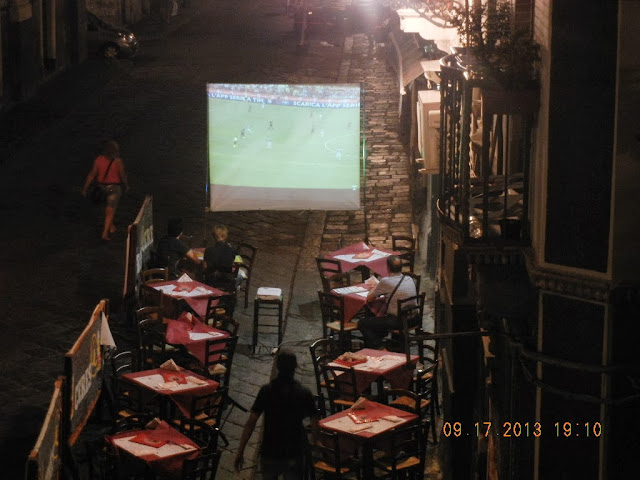
The servers were all gracious and helpful, never obtrusive, and it was in every way the sort of dinner one goes to Italy for. Well, we won’t count the police car that squeezed by (as is often the case, the tables were set up in the street, leaving just enough room for a car to get past) with its siren going. But that was a brief interruption.
When we got back to the hotel, our hosts Alice and Guiseppe, pulled out the bottle of the local herbal liqueur, Amaro, which packed even more punch than the limoncello and poured little glasses all around. I, for one, am very sorry to leave Sicily. Perhaps I will feel differently f it rains tomorrow morning? But then, it rains in Anchorage, without any expectation that when it stops the sun will come out and the blue Mediterranean will lie at your feet with sunny breezes to caress your steps.Inline image 5
Our hosts at Hotel Trieste, Alice Bianchi and Guiseppe Koenraadt (part Dutch), and twins.
Inline image 1
Posted in Uncategorized | Tagged , , , , , , , , | Leave a comment

Mount Aetna, September 18, 2013

On the flanks of Mt. Aetna at about 6,000 feet, looking at the 2001-2002 lava flows.  The poles for the old funicular have been abandoned, and a new one built alongside to take people up to about 9,000 feet (the mountain is over 10,000 feet, how much over depends on its more recent eruption). [Regina’s photo.]
Why — and how– do people live on the slopes of one of the most active volcanoes in the world? Since humans have lived in Sicily, they have found it worth their while to accommodate the volcano’s whims and wrath in order to take advantage of the gifts that it offers. The climate is excellent, and the soil unmatched for orchard, vineyards, and farming of all sorts. I’ve showed the photos of the terrain with recent lava flows, but nothing of the areas that we drove through with lush farms, orchards and vineyards.
Riana and Carmelo picked us up this morning in a late model seven-seat van, and spent close to six hours driving us up and down the mountain (Carmelo), and telling us about its history and environment (Riana). Riana is from Prague, speaks five languages fluently, and has been doing this for about five years. Carmelo is local, and speaks no English, so Riana translated for him at times.
Some clouds, some sun, some fog – but no rain and only a pleasant breeze when needed accompanied us on the tour. We started in the heart of Catania and drove up and up through suburbs, and then the town of Nicolosi, which came close to being inundated with lava in 2001. A little further up, we stopped on a lower trail in the national park (at about 1200 meters, or about 3,600 feet) and walked for a while. Riana pointed out the flows from the early 1980s, where lichens have grown, compared to the black rough rocks from 2001 and 2002 which are still bare. Along the edges of the flows, valerian, yellow hawkweed, and other wildflowers grow, and lizards and ladybugs sun themselves.
Further up, we stopped at the big tourist area that had to be rebuilt after the 2001-2002 eruptions. A new funicular runs parallel to the old gray poles that no longer stand straight. New parking lots and facilities stand on leveled lava beds; a few of the older structures escaped. We started up a steepish slope to one of the more recent craters. I gave out first — we were at 6,000 feet+, and I decided that even if I got to the top, I’d still have to get back down. So Jim and I went back, and walked around another crater that had a mostly flat path around the rim. Peg and Tom returned after about three-quarters of the climb, and Regina and Riana got to the top.
The craters in this are were created only ten years ago, with few plants as yet. Fog and clouds hung here and there, adding to the surreal scene. People bundled up — it was 85 degrees in Catania by the ocean, but at that altitude, it was more like mid-50s. We bought overpriced coffee and sat in the sun at a table on the tourist restaurant’s patio. Lunch was breads and a small pizza from the bakery near our hotel, plus the 3 euro coffee and cokes from the bar.
We started down the mountain and made three more stops — one to photograph the remains of a house caught in one of the earlier (1980s?) lava flows; the second to explore a lava tube, and the third to sample honey and wine from the farms that thrive on the volcano’s rich soil.
After a rest, Jim and I explored for a while, and then I joined Tom in the hotel family’s open air living room for a chat with them about Anchorage and Sicily, Iowa and Italy. Dinner was at an excellent restaurant (Regina’s been responsible for finding good food, and she’s done fabulously well). We ate local food — the dark red wine from Etna’s Nero d’Avola grapes with the restaurant’s own label, mussels from the morning fish market, pistachios and walnuts from the area made into pesto for homemade tagliatelle, and more. Then we went along the street, just as the bars were putting out all of the sofas and chairs and tables and big TV screens for the evening’s parties. Simpsons were on the screen at the bar closest to home, while everyone waited for the soccer match.
Craters (they look more like cones to me) on the slopes of Mt. Etna. The mountain erupts from several craters at the top; these eruptions are spectacular but usually do little damage to anything. More importantly, magma breaks through weak spots on the flanks of the mountain, and those 300+ lava flows often cover fields, homes, roads, and forests. Catania is in the far distance. It has 400,000 people (a little larger than Anchorage), and the area has 800,000 (more than the entire state of Alaska). That’s a lot of people who find themselves living within spitting distance of the mountain’s whims.
People climb up to see one of the six Silvestri craters that erupted within recent years on the south side of the mountain. Below is one of the tourist spots.
Regina at the top of one of the craters, with the tourist area and numerous other craters below. Many of them have been created on the south side where we spent much of our times. The clouds closed in around 5,000 feet, but opened up above 6,000 feet. [Riana’s photo of Regina.]
The mouth of a lava tube created when the basalt flow cools (if you want to know the physics/geology, just ask). We put on helmets and took flashlights to explore.
Carmelo crowning Regina queen of the spelumkers.
Riana in charge.
Tom and Jim contemplating life in a rock-floored cave. People have lived in the lava tubes, and used them as refrigerators, as well as to store ice during the winter so they could sell it in the summer.
Back in Catania, a glimpse of today’s wedding. We missed the bride and groom, but saw some of the preparations going on at the church in one of the plazas. The flower girl and ring boy showed up in the cafe next to the church where Jim and I had stopped for coffee. I presume that their handlers brought them over for lollipops and water because the marriage service was much too long for them. By the time we left the cafe, a dozen other wedding attendees from dress-suited men to chiffon-clad matrons were sighted in the piazza, unwilling to wait it out to the end.
Peg and Tom with their pre-dinner gelati. We decided to eat dessert first, because so many of the restaurants didn’t open until 7:00 or 7:30.
Yellow hawkweed at the edge of a lava bed; fly included.
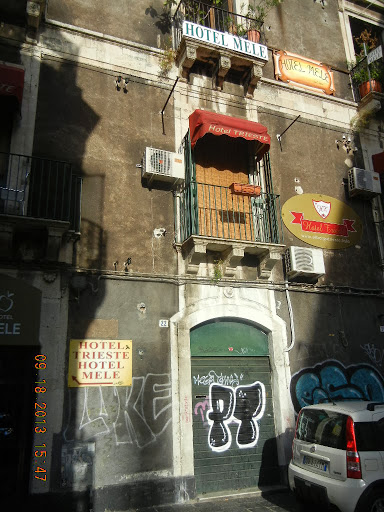
Our hotel room balcony and red awning. The gated entrance is to the left. The hotel Mele is also in this building, with the rooms on the floors above those belonging to the Hotel Trieste. The graffiti is everywhere — on buses, trains, building walls. The thing is — you can find 2,000-year-old graffiti almost as easily as the recent stuff.
Spotted in the piazza where we were eating gelato: this man with numerous large dogs, on the steps of a building from which half-a-dozen very well-dressed men and women were exiting at 7:00 in the evening. The scene belongs in a movie full of symbolism, or maybe just surrealism.


Posted in Uncategorized | Tagged , , , , , , , , , | Leave a comment

“Siracusa — the most beautiful of all Greek cities” — Cicero

The coastline of Ortygia, the island connected to Siracusa.  This was one of my desires in coming to Italy — blue Mediterranean sea stretching to the horizon, under a warm sun.
Would Cicero say the same about Siracusa today? I think not. His comment made me wonder what the city must have looked like in the days when Plato taught there, and Aeschylus came to write plays. That was before it was destroyed by earthquakes in the 1500s and 1600s, and more recently damaged by WWII bombing. Today, our bus from Catania rolled into the city along narrow streets, with a mix of yellow/ochre and gray modern and post-war apartment blocks, uninspired signs and plantings, and crowded industrial and commercial areas. We made our way directly to Ortygia, the small island that holds much of the city’s history. Barely a hundred yards off shore (and connected by a couple of bridges) it also seemed a bit rough around the edges, despite the elegant baroque buildings in the piazzas.
Yachts lined up at dock on Ortygia. The one at the far left is the Force Blue, registered in Georgetown, Cayman Islands. Always nice to have your yacht where your money is?
Wildlife? Not a lot. Pigeons, fish schooling in the water of the harbor, a few gulls (remarkably few), and the skinny but clean cats. The cats in Athens and Spain were well-loved and sleek. Those in Jerusalem were skinny and cautious. In Italy, they seem to be clean, thin, and not much interested in being petted.
Pigeon in a fruit box at the Catania market.
An Ortygian street.  We liked the juxtaposition, on the balcony, of the laundry and satellite dish. At the end of that street is the Mediterranean Sea; that’s another thing in its favor.
History for the day — Regina trying to stay alive while crossing Archimedes Square. The mathematician/scientist was a citizen of Siracusa; in 212 B.C.E., the invading Romans ordered that he be left alone because they considered him an important asset. A soldier missed the order and killed him anyway. A museum dedicated to his work is on the square.
The fountain commemorates the myth of Arethusa. She was trying to escape the unwanted attentions of Alpheus, so the goddess Diana turned her into a spring.
Note on being a pedestrian in Italy — it takes a lot of nerve. Although there are crosswalks, they don’t mean that the cars/motorcycles/buses slow down for pedestrians waiting on the sidewalk. No, you must step forward into the traffic and believe that the cars will stop for you. They do, inches away, but not until you take the first few steps. Also, you are well advised to be cautious and calculate their speed and stopping range before you risk your life. Usually we wait until we think we could get across anyway, but there are places with steady streams of traffic where you could wait until 2:00 a.m. before getting a chance to cross.
The flag of Sicily, adopted in 1232. The head in the center is Medusa’s (I haven’t found an explanation of why). The three legs supposedly represent the triangular shape of Sicily (they are found throughout Europe in other contexts), and the wheat ears represent the crops that were considered one of Sicily’s main assets. The red segment represents Palermo, and the yellow, Corleone, the two cities that formed a confederation to fight the Angevin rule during the late 1200s.
On a completely different note, we spent an hour at the Catania fish market this morning, and another half hour at the Ortygia market in Siracusa. These, more than Campo di Fiori in Rome, seemed to capture the spirit of traditional markets. At every turn, someone was doing something — weighing out the bucket of sardines just off the boat for a cluster of eager shopowners; cutting and cleaning sea urchins, whisking the flies away from the hanging meats, pushing the escaping snails back onto their trays, slicing up a prickly pear fruit for a customer, or just sharing the day’s stories. We saw plenty of vegetables that were entirely foreign, lush fruits, scented spices, cheeses, breads, innards and outers of meat, and fish of every description. There are way too many photos to include; here are a couple of the most interesting.
Guys lined up along a railing looking down to the market area (Catania) about six feet below them. Most of the people in the market — vendors and customers alike were men in the early hours; a few housewives and female tourists started coming through around 9:00 a.m.
Men cutting sea urchins in Ortygia. Sicilians seem to specialize a lot. Small shops often have only one or two types of items. These men, and others, at the fringes of the markets had just one thing to sell – snails, or mackerel, or sea urchins. [Sorry about the blue tones; my camera settings are still a mystery to me at times.]
Green olives at the Catania market.
Mt. Etna at sunset this evening, with a little cloud cap.
This evening’s wedding, with bride and groom in the Piazza Bellini. We saw them earlier going into Teatro Massimo Bellini, the opera house, presumably for the wedding and perhaps reception.
The street below our apartment this evening. There’s live soccer on TV, and our bar is now a sports bar. In one of the piazzas nearby, another bar had set out couches and tables, and a big screen with a movie showing on it – an outdoor movie theater of the classiest sort. This was our bar at 8:45 p.m. At 10:45 p.m., the scene was much livelier; by 11:45, even the heavy doors to our balcony don’t drown out the crowd’s liveliness.
We should have mentioned yesterday that while we were flying to Sicily, Anthea was headed on a harrowing journey back to Seattle. Although her plane was supposed to leave an hour before ours, it left two hours late, causing her to miss the connection in Heathrow. The good side? She was re-booked onto a flight that took her through Vancouver, B.C. and got her home two hours earlier. The downside? It was another tight connection in Vancouver, requiring running (those zombie run training sessions came in handy), and the Canadian security confiscated her TSA-approved multi-tool. She was happy to be back in Seattle. Her post here sums up some of her perspective on Italy vs. the Northwest [http://runonthewater.wordpress.com/2013/09/17/of-coffee-cups-and-caprese/].
Posted in Uncategorized | Tagged , , , , , , , , , , | Leave a comment

Catania, Sicily, September 16, 2013

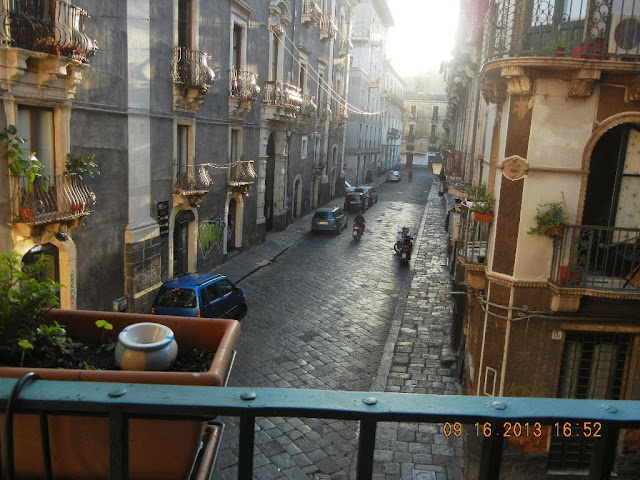
The view from our balcony at the Hotel Trieste — looking west; setting sun.
We like this life — a black limousine picks us up in front of our Rome apartment, and whisks us to the airport. There’s no one ahead of us at checkin for luggage; the security line has half a dozen people, we keep our shoes on and sail through; we get espresso and a comfortable seat to read while waiting for the plane. There are plenty of empty seats on the plane; the ride is short and the skies smooth.
We get to Hotel Trieste in Catania and find welcoming people in a picturesque place who speak fluent English (actually, Alice has a solid grasp of American idiom. She said that her (British) English teacher despaired of her. “You should imagine you are going to tea with the Queen!” But Alice didn’t think that likely). They give us comfortable clean, spacious rooms with a charming balcony and street view, and air conditioning, and start to work with us to make arrangements to get to Mt. Etna (which is now erupting so that we won’t be able to go to the top), to Siracusa, to places in town. Their cute, 4-year-old twins dart into the hallway now and then (the family lives in the hotel; her parents were visiting for a few days).
After late lunch/early dinner, we explored, looking for gelato, cannoli, coffee, and chocolate. We found the cannoli at I Dolci di Nonna Vicenzia, which also had fabulous cakes and marzipan.
We need to talk about St. Agatha, who has shown up a couple of times in our week in Italy. She was a Catanian young woman who was a Christian martyr in 253 C.E., imprisoned and tortured because she refused the advances of a Roman prefect. Her breasts were cut off, so she is usually portrayed carrying them on a plate. In her honor, small cakes called “minni virgini” or “Cassatini Siciliani” are sold, year round, and especially near her feast in early February. We saw a church dedicated to her in Rome with a dozen or heavy satin and bejeweled dresses displayed around the sides of the nave, in which her statue is dressed and carried in procession. Catania does the same, with a several day celebration.
Here is a statue of St. Agatha in the front, to the far right (no I don’t know about the woman with the skull). She is a patron saint of breast cancer patients, fire, earthquakes, and volcanic eruptions. The Catanians appeal to her when Mt. Etna begins to rumble).
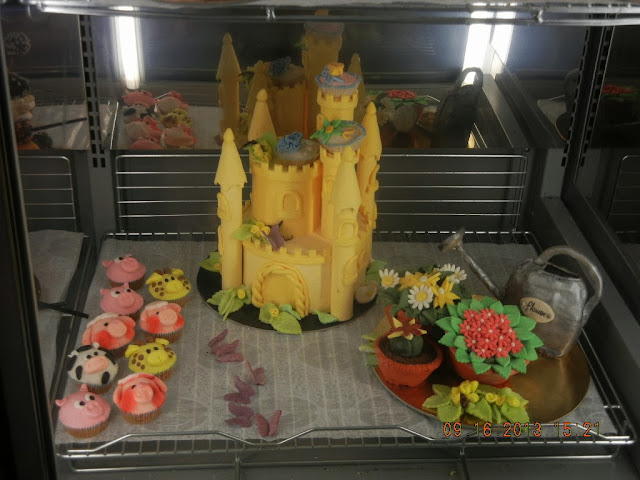
 The “minni virgini” cakes in the window of a fancy pastry shop, on the table near the bottom at the left. The store also had excellent cannoli, which Regina devoured.
One web site with stories of St. Agatha mentioned that the Catanians honor breasts, and in one of the street side shrines that we passed in the evening, we found the Virgin Mary suckling the baby Jesus, a picture that surely would not be accepted on the street in many  U.S. towns.
Still along the religious lines, we spent a little while in the cathedral that is dedicated to St. Agatha. Its foundations were laid in 1078; it was destroyed by earthquake and subsequent fire in the 1100s, and again by an earthquake in 1693. Parts of the earlier foundations are preserved in the floor of the current church, which is all Baroque, but uses some of the columns salvaged from the Roman theater. One essential feature of Baroque seems to be gilt angels.
From there we made our way through the city headed for the sea.  We passed through a somewhat shaggy park, with long grass, sagging plantings and headless statues. But the people there were enjoying the warm evening with the full moon rising.
A group of men were playing cards, while other people sat on the benches. The guy in the center with the cigarette and cards seemed to be the important person.
We followed along with a cluster of tourists headed through the park back to the cruise ship docked nearby, and caught a glimpse of the fullish moon rising about the fountain.
We turned up a street alongside the dock, and found a working class area, rough around the edges, with small stores. One sold only ropes and cords for the fishermen; another cleaning supplies; another fishing gear. The cavernous gray car repair shop stood open to the night, and at a bakery, the old baker himself came out gaunt and stubble-faced to take our coins for the evening’s last breads.
We came out from that area through the fish market that was pretty well shut down for the night. On the walls of the buildings that ringed the area were a series of faded paintings advertising meats for sale: poultry, cows, horses. Notice Mt. Etna, steaming in the background.
But no chocolate, so we walked over past the city square and found a broad street set aside for pedestrians. The stores were bright and modern, clothing and jewelry, higher-end bedding and shoes. Again, no chocolate. The retail areas seem to be very specialized. We did find gelato though, and since it had been several hours and a lot of walking since the cannoli, indulged in that.
A view looking up the shopping street toward Mt. Etna; 8:00 p.m. (on a Monday night).
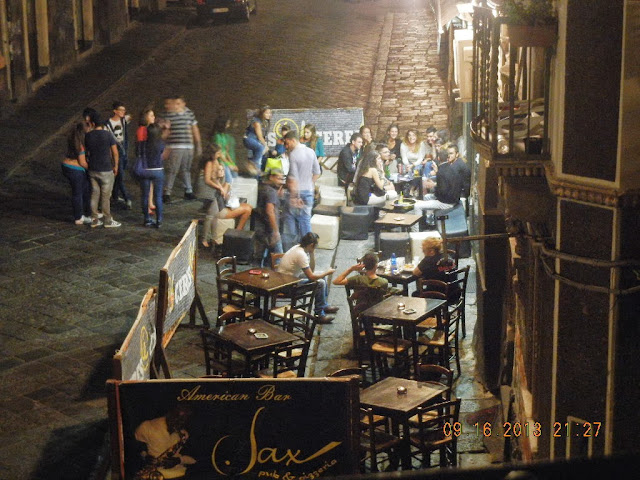
The view from our window at 10:30 p.m. (still going strong at midnight). A bar has opened, with tables in the street just across from our hotel; music, voices, all of the fun of a warm Monday night and a lot of alcohol. Note the sign that says “American bar;” the landlady explained that American bars open only in the evening, serve only drinks (no food), and play music. Italian bars serve coffee and food in addition to liquor, and are open all day,
Those are our Sicilian adventures for the day. The landlady has arranged an Etna tour for Wednesday. Tomorrow, we will check out the fish market, get breakfast, and then take the bus to Siracusa.
An elephant carved from black lava stands on a high pedestal in the main square in front of St. Agatha’s cathedral. One source suggested that it was originally prehistoric, but done over in the Byzantine era. Its job has been to protect the city from natural disasters; it hasn’t been entirely successful.
Down-at-the–heels neighborhood park with fountain, card players, and people enjoying the evening.

Posted in Uncategorized | Tagged , , , , , , | Leave a comment

Roman Sunday, September 15, 2013

A lion, stalking his destiny outside the church of Santa Maria de Trastevere.
The thunder was rolling this evening, and the kids saw lightning on the way home from the gelato shop, suggesting that we are not yet done with the autumn rains. Off and on all day, the quiescent gray skies would spit a few drops of rain, then a few more, then a lot, pelting down on the streets, filling the gutters, and  roiling the Tiber. People just stepped under an overhang, or into a shop entryway, waiting during the fifteen or twenty minutes that the rain took to wear itself thin. The drops would stop, everyone would bustle about for another hour, and then the rain would start all over, as if it didn’t get it right the first time and needed the practice. You could see how the Tiber has the potential to flood.
Regina and I started the morning with Mass at Santa Maria de Trastevere. It was built on the site of the “sacred oil,” rumored to have been a miraculous fountain of olive oil that appeared here at the exact time that Christ was born. There was in fact a small petroleum deposit discovered about 30 B.C.E.
One source says that the church was totally rebuilt in the mid-1100s, much of it using columns and stones salvaged from the Roman baths of Caracalla. Some of the altar mosaics date from earlier, between the 700s and 900s. Maybe half a dozen locals were at the 8:30 a.m. Mass, in a church that could easily hold several hundred people, and another dozen or so tourists and others (including a couple of African men who looked like they might be street vendors on their way to sell handbags and sunglasses).
We stopped for Regina’s morning cappucino on the way home at a bar whose owner was angry that we gave him a 5 euro bill. He kept gesturing at a tray next to the cash register saying “Money! Money!” — by which he meant coins. We dug through our pockets, pulled out enough to pay the bill, and left  him scowling as he scooped them up.
Next stop was home to collect Anthea and Jim who had been doing laundry and packing. We all leave in the morning, Anthea for Seattle, and the rest of us for Sicily. We gathered rain jackets and umbrellas and went to the Porta Portese flea market a few blocks away. This sets up only on Sundays, with mostly clothes (some new, and some well used), shoes, leather goods, jewelry, underwear, and the like. Regina scored a wool blazer, a cotton shirt, and a nice vest; I got a couple of necklaces and a scarf. It’s definitely a never-pay-the-posted-price sort of place — walking away is a remarkably effective technique to bring the cost down by another euro or two. Just as we finished shopping, the rain started, sending shoppers scurrying and vendors pulling plastic tarps over their goods.
An hour later, we walked through our second cloudburst to our favorite bar/coffee shop and on to the Jewish Quarter across the river to meet one of Anthea’s college friends for lunch. At Il Giordano Romano we had a traditional Jewish specialty, fried artichokes — oh, so good. We tried veggie lasagna, pasta ariabbata, and falafel — equally delicious. And after we left, we thought that the place next door had even better looking food. Finally, we’re beginning to find the food that we came to Italy for.
We shared post-lunch gelato with the college friend, then walked to the Protestant Cemetery a mile or so away, accompanied by a half hour of sunshine along the Tiber, and then the next downpour. The Cemetery turned out to be closed on Sundays, except from noon to 1:00, despite the guidebook’s assurance that it was open until 5:00. We’ve been pretty lucky — travel advisors often caution that  hours for many attractions can be quite erratic. The cats (the cemetery has quite a number of them, just like several other historic sites) were hiding from the wet, and we just had time before being dismissed from the grounds to take a couple of quick photos.
We walked through another downpour to meet Peg and Tom at the Spanish Steps for dinner. The steps weren’t as crowded as I expected — the rain has gone a long way to reduce the number of tourists out and about today. Perhaps it was the museums that were packed, instead of the streets. Dinner was pizza and pasta, at a very chic modern spot just off the Piazza Spagna. Anthea enjoyed her dinner greatly, her last in Rome for a while.
And here is rain again, pounding on the pavement outside our apartment windows. The forecast for tomorrow is yet more of the same, but Sicily offers some sun along with it.
The dome at Santa Maria de Trastevere, which is (according to one source) one of the finest examples of very early medieval mosaics (dates from 700 to 800 C. E.).
In keeping with the Eternal City’s fascination with death, we found this image in a side chapel in Santa Maria de Trastevere. If there was much of an explanation, we couldn’t read it. It would make a great tattoo.
Graffiti in Piazza San Cosimo. Vorrei means “I want.” Vorrei mangiare un enorme “donut” means “I want to eat an enormous doughnut.”
The Sunday flea market at Porta Portese. Everyone shops there, including the nuns.
An egret fishing in the Tiber River at the foot of one of the bridges.
A peek inside the Protestant Cemetery before they booted us out. Keats and Shelley are both buried here, along with numbers of other famous people, many of them not Protestant. I think that you just had to be not Catholic.
The McDonald’s sign on Via Propaganda — the street really is named that.
The fountain in Piazza Spagna, at the Spanish Steps. The rain has stopped for half an hour.
The Spanish Steps, and a romantic photo being taken, to be treasured forever.
Anthea finishing her last glass of wine in Rome for a while. Sounds like she’ll be back.
The steps, a couple of hours later.


Posted in Uncategorized | Tagged , , , , , , , , , , , | Leave a comment

When in Rome, September 12, 2013


When in Rome, accept the fact that the Internet is going to be on a
Roman Holiday (whatever that means), and not cooperating. For the last
couple of days, our apartment connection has been going downhill,
until this evening, it is one notch above primitive. I’m hoping this
will get out, but probably without photos.

Today was our day to wander about under blue skies, with a pleasant
breeze. We started the day with coffees at the bar down the street;
the barista, a silver-haired man seems quite taken with Anthea’s blue
hair (and smile). Jim. Anthea, and I got to the turtle fountain, the
big market, Campo de Fiori, and our first subway ride — very like
most other subway rides, crowded and hot. We met Regina at the train
station, and found a gelato place (I Caruso near the Borghese Gardens)
that she had read about.

By the end of the last bites of gelato it was near 4:00 p.m. Jim was
feeling like he was catching a cold, Regina was jet-lagged and
carrying her luggage, Anthea’s feet hurt, and I was hungry. We called
a cab. Anthea sat in front and deemed it a “close to heaven”
experience, as in “Will we live?” We sat in the back, and observed how
deftly the inch between the bus and the cab was negotiated by all
parties, how the breath of air between our bumper and that of the cute
little car in front of us spelled salvation, how the paint of the van
pulling in front of us was pleasantly marked with microscopic
variations. Regina was asleep, and Jim was saying how he would never
drive in Rome. I was thinking how much better this was, despite the
extra cost, than trying to figure out the buses to our place, how to
get to them, how to negotiate the afternoon crowds with sore feet and
the extra bags. Having witnessed for four days now the remarkable ways
in which everyone manages to survive the Rome streets, I had faith
that we too would reach Viale Glorioso unscathed. And we did.

Our landlady made reservations for us for a “Roman family” dinner in
the neighborhood. Regina, Anthea and I went and enjoyed roasted
vegetables almost afloat in olive oil, and classic pasta dishes — con
funghi (with mushrooms), arriabata (spicy tomato), and standard
spaghetti with tomato sauce. Then we indulged in the local (best so
far, in terms of price and taste) Fata Morgana gelato. It’s all
organic, one euro a scoop (compared to two or two-fifty most places),
and the flavors vary from day to day.

Looks like we will go to the Vatican Museum and St. Peter’s tomorrow
— Anthea’s request, and the only day available at this point for the
venture. Then we’ll meet Peg and Tom at the train station, and later
meet Joe and Jen (their oldest, and his wife) for dinner.

Photos tomorrow we hope, if we can figure out the Internet connections.

Posted in Uncategorized | Tagged , , , , , , , | Leave a comment

The Pope, St. Peter’s, and the Pantheon, September 11, 2013

Pope Francis on Jumbotron, September 11, 2013.
Many thousands of people want to see the Pope. Many thousands want to visit St. Peter’s. Pilgrims we all may be, but the journey is not for those with little patience, Speaking only for myself, I did fine when my task was to put one foot in front of another for days on end on the Camino, up hill and down. OK, I complained on occasion, but kept going. Today, however, showed the limits. I can’t stand to wait in more lines.
We got started early enough — out of the house before 8:30, making our way on the sycamore-lined path along the Tiber. The damp breeze swept over us on and off all day long, sometimes with more clouds, sometimes more sun. I didn’t stop to photograph the wonderful busload of Africans with varied and brilliant costumes who were debarking to see the Pope. We didn’t stop for coffee. We just walked as fast as we could to get to St. Peter’s Square to see the Pope.
We found the basilica by 9:30, and then began to look for the ticket office. The guidebooks and web sites said to look for the Swiss Guards’ office to the right of the basilica, but we couldn’t see that. We saw a line of people, six or eight abreast and a couple of blocks long all holding orange squares of paper, making their collective way in through security checks and guards to the plaza in front of the church. We asked, “Where do you get the tickets for the audience?” People — several different sorts — police, bystanders, guides — sent us to the Vatican Museum, and yes, there were people hurrying toward the long line all carrying orange squares of paper. So we hied ourselves off to the Vatican Museum, several blocks away, and finally reached it, to be told, “no, not here.”
Back we went, coming upon the now-longer line, and realized that the Pope was already in the square at 10:00 a.m. So we squeezed in along a railing at the back of the square, watching the “Jumbotron” (Anthea says this is the name for the huge video screen) and trying to figure out what was going on. The Pope was riding through the crowds on a mobile platform, greeting, blessing, waving, and greeting. As the next hour and a half unfolded we realized that we actually had a good location — room to breath, a railing to lean against, a better view than many crammed into the square, and no more trouble hearing what was going on. Plus, we got to watch the people going in; and after an hour, the steady stream of people leaving.
At 10:30, Pope Francis settled himself in a chair on a platform. Priests took turns reading in different languages several times throughout the hour-long event, alternating with the pope reading from prepared notes, then more readings by the priests. Anthea thinks that what she heard the first priests reading were the verses from St. Paul’s first letter to the Corinthians (verses 12 and 13), in which he says, “for as with the human body which is a unity although it has many parts, all the parts of the body, though many, still making up one single body — so it is with Christ. We were baptised into one body in a single Spirit, Jews as well as Greeks, slaves as well as free men, and we were all given the same Spirit to drink.” It seemed like a good choice for September 11 — Freedom Day for Catalunya (in Spain; we received a reminder of this today from a friend we made in Barcelona last year), September 11 for the U.S.; in 2013, a day on which the world watches and waits to see what will happen in Syria.
The Pope’s own speech, according to a news site on-line, was about the Church as Mama (here’s the link, if you want to read it: http://www.cbcpnews.com/cbcpnews/?p=22388). After more readings, and cheers, and readings, and speeches, Pope Francis sang the “Our Father” in Latin. Gregorian Chant, and blessed the crowd.
We went off in the hot, nearly noon mugginess, to eat and then go back to see St. Peter’s basilica. But alas, when we returned the lines to get into the church were just as long as the lines to get into the audience, and also involved security screening so the faithful were moving very slowly. The passes that we bought yesterday for the Coliseum and other attractions don’t work in the Vatican — the salesman looked me in the eye and said, “That’s a separate country, isn’t it.” I will have to find some other way to see St.Peter’s because I am surely not standing in line for an hour and a half in the hot afternoon to get there.
On the way to the Pantheon, our alternative to St. Peter’s, we saw plenty of street vendors. Rome is different from Athens and Barcelona where almost all of the people selling things on the street were either entirely temporary (as in, they could get away in five minutes or less from the spot where they had spread their goods), or stationary, with structures and semi-permanent booths and kiosks. Our neighborhood has both of those types, but also tables with awnings and tarps propped above, more like a farmers’ market arrangement. They sell new clothes, shoes, inexpensive plastic kitchen tools, used books (Anthea scored some old Donald Duck comics in Italian this evening), luggage, and more. People patronize them in the mornings and afternoons; not so much in the evenings.
But Rome also has the Africans and Indians/Pakastanis who sell the knock-off designer handbags, sunglasses, and  cheap toys. They line up along the sides of the bridges, and all through Vatican City, and the Roman ruins, and the parts of town with the heaviest traffic. People buy from them — I am always a bit surprised to see that — as well as from the souvenir stands.
The Parthenon, beautiful thing, looks massive but unprepossessing from the outside. Its weathered, intricately laid red brick with no windows dominates until you get around to the front with rows of marble pillars. Inside is the dome with the opening in the middle — when it rains, the marble floor inside gets wet. It seems so odd to have a building like that open to the sky.
Marcus Agrippa commissioned it 27 years before the birth of Christ, and the Emperor Hadrian finished the rebuilding of it entirely in about 146 C.E. (Hadrian left lots of monuments, many named after him, throughout the Empire). The Romans dedicated to the worship of all of the gods. When the Christians took it over in 609 C.E., Pope Boniface IV consecrated it as a church, and it has been used continuously as such since then. Signs in the building say that it is the best-preserved example of ancient Roman work despite the changes made in the ensuing centuries. Pieces of it were taken away (some to the British Museum; some to Constantinople; etc.), but the interior is much the same structure as it was for the Romans worshiping Minerva.
That was our history and art for the day; we found an excellent place for dinner in our neighborhood, along a street filled with interesting little shops — shoes, cheeses, clothes, meat, and plenty of restaurants and bars. It’s exactly the sort of area that one is supposed to discover, and we will go back. We saw the wedding for the day — the bride and groom walking down the street past the cafe where we ate dinner.
Not so many photos tonight — technology and I are at odds; my photos are all located in some obscure hard-to-access site on the computer (and the camera card re-formatted so they can’t be easily re-copied to the correct location).
Regina arrives mid-afternoon tomorrow, so the dynamic of the adventure will change. We will keep you all posted.
Patient novices and others, waiting in line to get into St. Peter’s Basilica.
The dome of the Pantheon.
Anthea photographing the Pantheon dome.
Cannabis and other varieties of absinthe for sale.
An Italian evening sky that you know from hundreds of paintings.
Today’s wedding couple, hastening down the street near the Piazza di San Calisto.


Posted in Uncategorized | Tagged , , , , , , | Leave a comment

Great Expectations, Rome version

The lower levels of the Coliseum.
Expectations make poor traveling companions. They are our hairshirts, our “true pilgrims,” our crosses to bear. They are never satisfied, always complaining that we’ve slighted them. They pout a lot. Meanwhile, we are figuring out ways to put them in their proper context, so that we can get on with taking pictures of yet another set of ruins, or spotting more gelato shops.
Our goal for the day was the Coliseum, and we did get there. Along the way, we discovered that another goal was to eat fabulous Italian food, and we realized that we had not really been doing that. Things happen — the good-looking croissants from the pastry shop turn out to be bready and dry; lunch time comes along, you’re in the vicinity of a tourist spot, and the only things to eat are overpriced and underwhelming. Good food doesn’t just happen, even with our best efforts.
For the evening, we focused on the good food, and found it at Da Vittorio near Piazza San Cosimato — a small place, with excellent gnocchi and pasta arriabata, and house wine in a little pitcher to share among the three of us. The people were friendly, the portions very large, and the bill for a dinner about the same as an uninspired lunch cost (lunch was in fact, almost Anthea’s undoing — bread, tomato and cheese sandwiches, the same things that we ate on the Camino almost every day only not nearly as good. It was too much to be borne, in a country whose food is even better than its scenery).
We walked to the Coliseum, a couple of miles from the apartment (and only got lost for a block or two). Of course, along the way we stopped to photograph a dozen other things — King Vittorio Emanuele’s monument, the one with the chariots and winged victories that we saw yesterday from Janiculum Hill. A set of ruins with Roman shops, and then churches built on top of them and one on top of the other. Lots of tour groups like the one below; the leader with her pink umbrella. And plenty of “self-guided” tourists, like the young woman to the right of the photo, studying her guidebook.
The Ponte Sisto, with blue sky in the morning.
A fresco from the church of St. Rita. In a manner typical of Rome, the story of this site is lengthy. Excavated 30 or so feet below this fresco are the remains of a shopping/apartment from 120 C.E. Retail stores were on the first floor, and apartments on the next three floors up. Several hundred years after that, a Romanesque church to St. Biagio of the market was built between 1000 and 1100 C.E., and the bell tower from that church along with the remains of the earlier Roman building were incorporated into St. Rita’s church in 1665 by the architect Carlos Fontana.
Street  scene near the Coliseum. Tourists on Segways pass by a “Roman soldier” who is putting a feathered helmet onto the woman standing next to him. Then someone will take  photo of them, and he will have money in his pocket, and she will have a souvenir. There were at least a dozen of these guys plying their trade inside and outside the Coliseum.
A mosaic commemorating games in the Coliseum. Its primary purpose was to exhibit combat.
Small clay lamps left behind by spectators. Were these the second century equivalent of cigarette lighters or cellphones at modern day events?
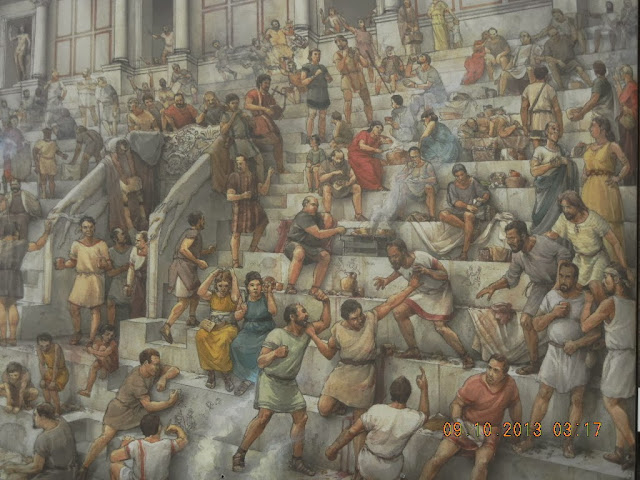
An artist’s imagining of what went on in the bleachers, based on items left behind, and accounts of the day — people didn’t tailgate, they brought their stoves with them and cooked the food on the spot. Wine was provided in measured doses, but some folks drank too much, and got belligerent. The buskers played the harp for a few extra coins, ladies put on makeup, people played games, and carved their names into the stone seats.
The lower levels of the Coliseum. The below ground rooms, separated by the long walls, were used for caging the animals, for gladiators to dress and prepare, and for all of the various machinery, water channels, and the like needed to make things run smoothly. The semicircular wood platform is modern.
Upper reaches of the Coliseum. This shows a little bit of the underground at the lower left corner, and all of the different levels going up. There is an immense amount of stone and brick and mortar here, and it has held up for nearly 2,000 years. Vespasian started it in 70 C.E., and his heir Titus finished it in 80 C.E. – not bad for something of this size and complexity. The area had been devastated by a fire in 64 C.E., so was available for building, and the fund for the undertaking came from the sack of Jerusalem and the wealth of the Temple. By the late 6th century, the Christians had built a small church at one side, and the arena was converted to a cemetery, For hundreds of years, people rented the spaces in the arcades for shops; in 1200, the Frangipani family took it over and used as a fortress/castle. A religious order moved into part of the building in the mid-1300s and used it until the 1800s. Starting in about the 1500s, the various popes renovated parts of it, and eventually the monks moved out.
Another wedding, in an area right outside the Coliseum.
Science/archaeology happening. We saw groups of (mostly young) people working at sites all around the area. These were in a blocked-off spot on the upper level.
No climbing on the ruins. A friend of Anthea’s was hoping to see a photo of her perched at the top.
A street performer, appearing to be levitating, near the Coliseum.
Cats. We had been wondering where they were – we have seen plenty of dogs (always attached to owners), but no cats at all. As we passed a set of ruins on the way home, we saw dozens of them lying about, or stalking the walls. Turned out that there was a cat shelter in an area under the street that opened into the ruins and housed dozens of them. They seemed well-fed and friendly. This one is thinking about whether to let Anthea scratch behind its ears.
The evening’s gelato from Fata Morgana in Piazza San Cosimato, all organic, and very reasonably priced (one euro a scoop; most other places have been charging two euros a scoop). Jim had chocolate, and peaches with white wine. Anthea had something called Panacea with rose water and violets, and the darkest of chocolates. (Afternoon gelato for Anthea had pink pepper and star anise, and was quite tasty too).
A fruit stand near the Coliseum. As would be expected, there were plenty of vendors on the streets around the Coliseum and in among the many other ruins in the neighborhood, but not nearly as many as I would have thought.


Posted in Uncategorized | Tagged , , , , , , , | Leave a comment

Rome, Day 1, September 9, 2013

Street market, Piazza di San Cosimato, around 1:00 p.m. so some of the displays are sparse. Sunshine, much of the day, and a breeze.


Notes from the day:

 
Some of us slept until nearly noon, catching up from jet lag. I spent my time in the morning reading the Italian news. This might be a good thing to do every day. There’s nothing dull — “Smugglers set marijuana shipment afire off Sicilian coast while police give chase. . . 30 tonnes [of marijuana] left after the fire was extinguished.” “Mt. Vesuvius could erupt at any time [this is in addition to the new baby volcano by the airport].” This sort of news is not in the New York Times.
 
Trastevere — means “Beyond the Tiber.” In the old days (2,000 years ago) it was the only populated area on the west bank of the river, infested with foreigners and minorities. The Jewish community lived there originally, and the earliest Christians, along with the traders and seamen who came up the river from the port of Ostia.
 
Our primary task was to get SIM cards and data plans for our phones so that we can communicate with each other, hotels, and so forth. We were finished with this by 1:00 (pretty good, given that most of the group didn’t arise until noon), and ate an excellent meal of pasta and bruschetta sitting at an outdoor cafe on the San Cosimato Piazza. The restaurant had a misting fan directly behind us, so now and then, a cooling mist would settle on our shoulders.
 
We took the fruit and croissants purchased along our way to acquire the phone cards back to the apartment, and then hiked up Janiculum Hill (Gianicolo). We expected something more Camino-esque and brutal, but found shade, cobblestoned walks, and a short distance to the top. It had great views, as advertised, plus a monument to Garibaldi, and rows of marble busts on columns. The busts were of his family (or other people named Garibaldi), along with dozens of men who might have been generals in the Risorgimento (the unifying of Italy into a country in the mid-1800s). As is often the case, if there was an explanatory sign somewhere, we missed it.
 
Also seen on Janiculum Hill, a wedding, with bride and groom, a couple of attendants and a photographer. We walked down the hill and paused to photograph Garibaldi’s mausoleum, and there they were again. Looked like they had been hoping for a wedding shot of them in front of the mausoleum but it was closed for the day.
 
Before dinner, we walked along Viale Trastevere down to the Tiber River, just exploring. We found a supermarket, in the basement of a building under a clothing store; St. Agatha’s church with a priest saying an evening Mass for maybe half a dozen people; lots of people strolling along the river, including two young teen boys with fishing poles (interesting, because there are no boats on the Tiber this summer due to pollution); and many eating places, mostly with English translations on the menus. We got beers and pizza slices at the Piccolo Bar and sat outside watching the brilliant sunset framed by city buildings.
 
Seen on the way home from dinner — a couple of young men in dress suits running as fast as possible up the street. Looked in the direction they were running and saw flames and black smoke rising fierce against the night sky. Walked toward the conflagration, expecting fire trucks, sirens, people to stop us. None of that. We got to within about 50 feet of the fire, apparently a motor scooter of some sort, and found a few men watching. A street cleaning truck had come along, and its driver was spraying water on the fire. About the time he quenched it, the fire engine arrived, and the crowd began to disperse. We continued on with our search for gelato, marveling at the lack of interest in the fire from passers-by. 
 
In the apartment — a real washing machine. No dryer, but hey — no washing everything by hand in the sink. We love it.
 
The motorcyclists appropriate the sidewalks here, as in Athens, although not as much. We remember to be attentive. Cars don’t stop at pedestrian crosswalks, any more than they do in Anchorage. We pay attention to them too.
 
Learning Italian (from the eating section of the Rick Steves Italian phrase book), my favorite phrase for the day: “niente con gli occhi.”*
 
And that more or less sums up the day. Tomorrow, the Coliseum, the Forum, and that area.


Wedding party near the Garibaldi monument at the top of Janiculum Hill. Note the wolf suckling Romulus and Remus at the base of the monument.
 
Bruno Garibaldi with black pigeon. The statues more in the open at the top of the hill fared worse from the pigeons than did the ones in the long row under the trees.
 
A long line of marble busts, shaded by plane (sycamore) trees, near the top of Janiculum Hill. There was great variety in the hat styles, their ornamentation, the facial hair, the costumes, and the faces.
 
Monument to Vittorio  Emanuele, with bronze chariots driven by Winged Victories, seen from Janiculum Hill. He was the first king of a united Italy since the sixth century, assuming the monarchy on March 17, 1861.
 
Ponte Sisto, a footbridge over the Tiber, 1479, named for Pope Sixtus IV who ordered that it be built. When the water comes close to the circle (“oculus,” or eye) at the middle it’s a warning that the river is likely to flood, and the central city should be evacuated. In 2012, the water was just at the base of the oculus.
 
Belzebuth beer for dinner, a 13% alcohol drink that tasted a lot like hard cider. Anthea thought it went nicely with her work on Dante’s Inferno. [The ginger beer is for breakfast.]
 
Motorcycle (?) on fire, a block up the street from our apartment. The guy with the street cleaning truck was the hero who put it out, shortly before the fire engine arrived. An amazing lack of interest by most people on the street.
 
Anthea with gelato — chocolate, and hazelnut “Prince’s Kiss.” 


* “Niente con gli occhi” means “nothing with eyeballs” [for me to eat.]
Posted in Uncategorized | Tagged , , , , , , , , , , | Leave a comment

Roma, September 8, 2013

We were as surprised as anyone to be finally jouncing along the Via Trastevere in the middle seats of a chauffeured van on the way to our apartment. The trip to London had been uneventful, and almost pleasant. The seats on the British Airways 747 were relatively spacious, the amenities – food, free drinks of all sorts, pillows, blankets — desirable, and the plane landed a half hour early due to a good tail wind over the Atlantic. But then . . .
We de-planed, hustled toward the terminal, and found ourselves being directed by purple-uniformed staff people to the end of a very long line. Its dimensions shifted as one group of people or another was called out to get screened ahead of us for a flight that was about to take off, and other people sifted in under the cords defining the queue, slid into place just in front of us, and then started making their way up along the line to get closer to the front. I would have said it was a couple of blocks long, but that would almost certainly be an exaggeration. Block and a half at the most, when we joined it, but it quickly grew to half again the length before it went out of sight around a corner.
That line eventually ended at a series of “Passport Control” booths, where the pleasant woman who took our tickets informed us that we’d been upgraded to business class (just because, I guess — no reason given). The thought of the luxuries of the upgrade sustained us through the next hour of waiting to get through security (shoes on; otherwise much like the U.S.).When we emerged into the terminal, we had just enough time left from our 3 1/2 hour layover to get a quick lunch. We headed for gate A23 after that, at the far end of Terminal 5, only to find that the flight was now leaving from A12, near where we had eaten lunch. So we hustled back, short of time due to all of the earlier delays.
Hurry up and board — and then we were late taking off, by about 3/4 of an hour. The seat across from us in business class had something wrong with the cushion, and they brought in a repairman to work on it. Seemed like they could have just sat the person who was assigned that seat in the next seat over, but it was apparently urgent. The afternoon tea with perfect little rectangular sandwiches, made of the finest, softest white bread (no crusts) with egg salad, ham salad, and roasted red peppers helped make up for the delay. There were dry citrus-y scones with clotted cream and strawberry jam, and sweet almond cakes, and for the decaf coffee drinkers, Nescafe finest instant brew. Not bad.
More lines greeted us when we left that plane — first another very long line for passport stamps. Our agent trimmed his fingernails in between people, and didn’t stamp Jim’s passport at all — not the guy’s best day on the job. Then a half hour wait at the baggage carousel, watching the bags get pushed to the top of the chute, then thunk over and land on the belt; next one — ka-thunk, next one — ka-thunk. It had a mesmerizing rhythm in my sleep-deprived blur. And finally out into the muggy warm Rome night, with billboards flashing and cars everywhere. The general guidebook suggestion is “don’t even think about driving in Rome,” and it’s immediately apparent why they say that. Our driver, sent by the apartment owner, was a young guy with a white shirt, open at the neck, sleeves rolled to the elbows, stylish and full of attitude. He  didn’t get on his cell phone until we were off the freeway, and then didn’t get off until he had to maneuver around on the narrow streets to park in front of the apartment.
Our landlady greeted us, showed us in, left the keys and instructions for the (very handy) air conditioning, and took off. It’s a very different place than our usual low-rent digs – chocolates on the pillows, a bottle of red Sicilian wine, and Italian coffee for the stove-top espresso maker. Although the streets were lively with pedestrians and plenty of restaurants even at 9:30 p.m., we spent our time settling in, and getting to bed early (Jim and Anthea at least).
Wi-fi is limited in the apartment, so here’s just one photo: our celebratory wine, a taste to make all of the day’s delays fall into perspective. This is Rome — we have arrived.
Thanks to all who sent restaurant advice, and sights to see. It’s already clear that this week is the tasting menu, and we’ll have to return, but we’ll get in as much as possible.
Ciao –Jim, Teri, Anthea


Posted in 2013 | Tagged , , , | Leave a comment